The Asterisk Is Fair. The 1999 Spurs Title Is Real. (Duncan Era 2)
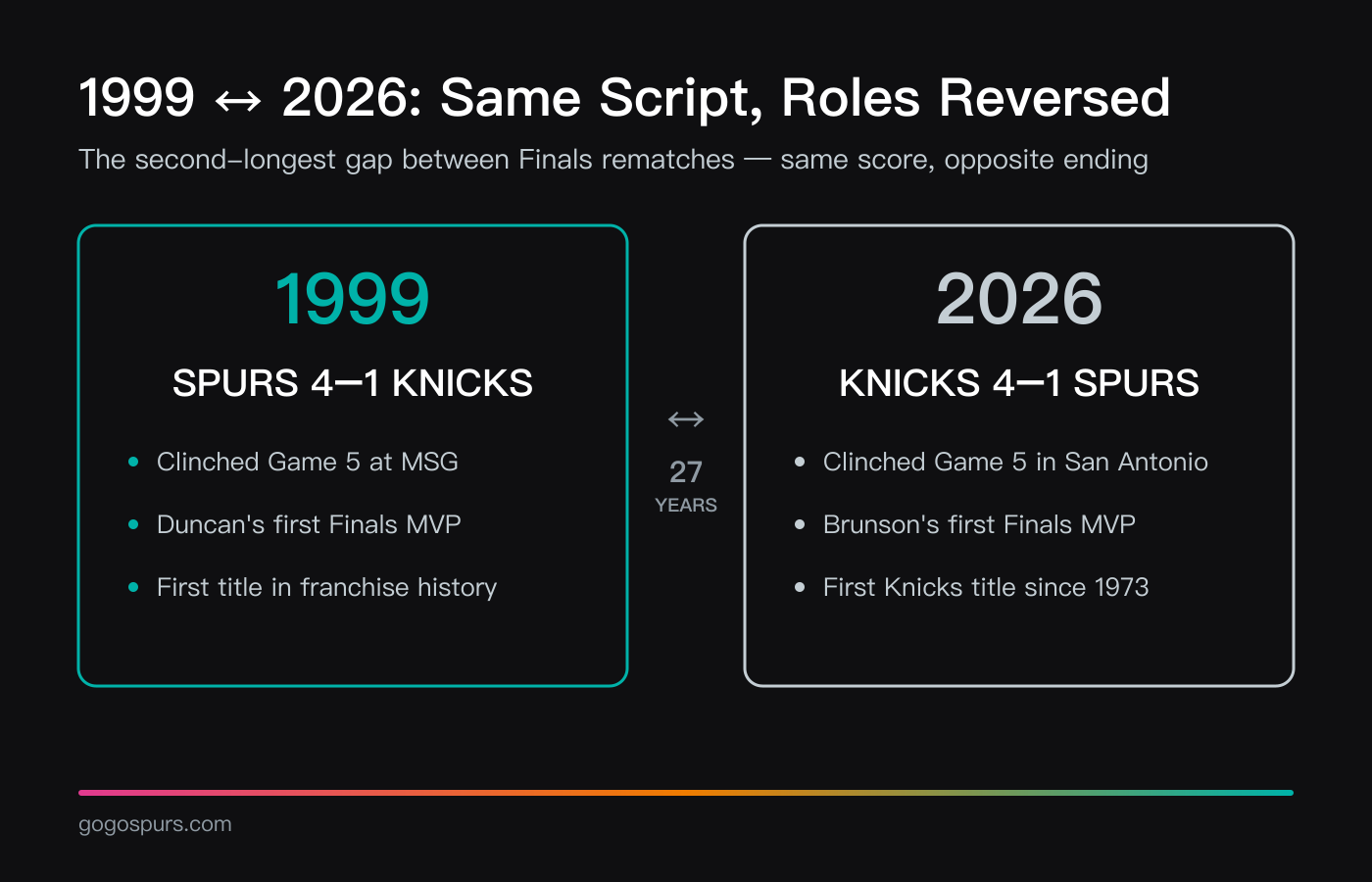
On June 13, 2026, the Knicks won the championship on San Antonio’s floor. Four games to one, closed out in Game 5 on the road, Jalen Brunson holding his first Finals MVP trophy.
Twenty-seven years earlier — June 25, 1999 — same script, roles reversed: the Spurs won it at Madison Square Garden. Four games to one, closed out in Game 5 on the road, Tim Duncan holding his first Finals MVP trophy. It was the first championship in franchise history — the lottery ticket from Part 1, cashed within two years.
History didn’t repeat, but it rhymed hard. And you cannot tell the story of that first title without the mark that has trailed it for 27 years: the asterisk.
Let me say something some Spurs fans won’t like
Phil Jackson said that championship deserved an asterisk. My answer: the asterisk is fair.
Not as a polite concession — I genuinely get it. Because cutting 82 games to 50 didn’t just change the quantity. It changed what the test was testing.
First, the math on older legs changed completely. Fifty games crammed into 90 nights, with three-games-in-three-nights a routine feature — that kind of density does not punish young teams and old teams equally. That was Jackson’s actual original argument: a compressed schedule breaks down older teams that depend on rhythm. And Spurs fans are the last people entitled to wave this away, because we lived it ourselves later: in the 66-game lockout season of 2011-12, a veteran Spurs team tied the Bulls for the league’s best record at 50-16, led the West finals 2-0 — and got run over four straight by the young Thunder. The length and density of a season is part of the game. Change it, and you’ve changed the game.
Second, the ramp-up was amputated. That January 21, free agency and training camp opened on the same day; the whole league got twelve days to prepare, then played. Teams that needed time to become themselves never got it. Fifty games is a sample that can’t measure a team’s full shape.
Third, if we’re granting the ledger, grant all of it: the quality of play measurably cratered that season — league scoring fell to 91.6 points a game, the lowest of the shot-clock era. Michael Jordan announced his second retirement mid-lockout, and the champion Bulls were dismantled, so the road to the title ran through no defending champion. And the Finals opponent was an eighth seed that had lost Patrick Ewing in the conference finals. The principle from Part 1 applies here too: count the good breaks and the bad ones alike. That’s the only honest ledger.
So yes — the asterisk is understandable. But “understandable” is not the same as “accurate as remembered,” because most people have the asterisk’s origin story wrong.
The asterisk’s actual timeline isn’t the one you remember
The version everyone carries around: the Spurs won, and Jackson took his shot. Wrong order.
Jackson pre-declared it in March 1999, months before a champion existed: there wouldn’t be “a real NBA champion — just one that is tainted. … this year is going to be an asterisk anyway.” By his own later account, he first said it in late January, right after declining the Bulls’ offer to come back and coach the shortened season. In other words, the asterisk was never a verdict on the Spurs winning. It was a pre-emptive dismissal of the whole season — whoever won, the line was already waiting for them.
What actually enraged the Spurs’ camp was the encore. Year after year. In 2001 he half-pivoted, saying it was a stance about labor and scheduling, not about San Antonio; in 2011 he said it had always been about “poking fun at San Antonio”; but he never took it back, and in 2014, by then president of the Knicks, he added a fresh cut: San Antonio isn’t a dynasty — “they haven’t been able to win consecutive championships.” David Robinson’s response tells you how much had accumulated: at the 2000 All-Star Game introductions, Jackson extended a hand in greeting, and Robinson ran past him stone-faced.
Steve Kerr’s reading is the one I trust. He was on that 1999 Spurs team, and he’d won his previous three rings playing for Jackson in Chicago. His take: “That’s just Phil. When he first mentioned the asterisk, I just rolled my eyes, because I knew his game. He likes to provoke, to get under people’s skin. He was poking the Spurs because they were a threat.”
This essay isn’t joining that fight. I’ve already granted the asterisk — and the payoff of granting it is that we can now look, calmly, at what the Spurs actually turned in on that differently-ruled exam.
That February, the team nearly dismantled itself first
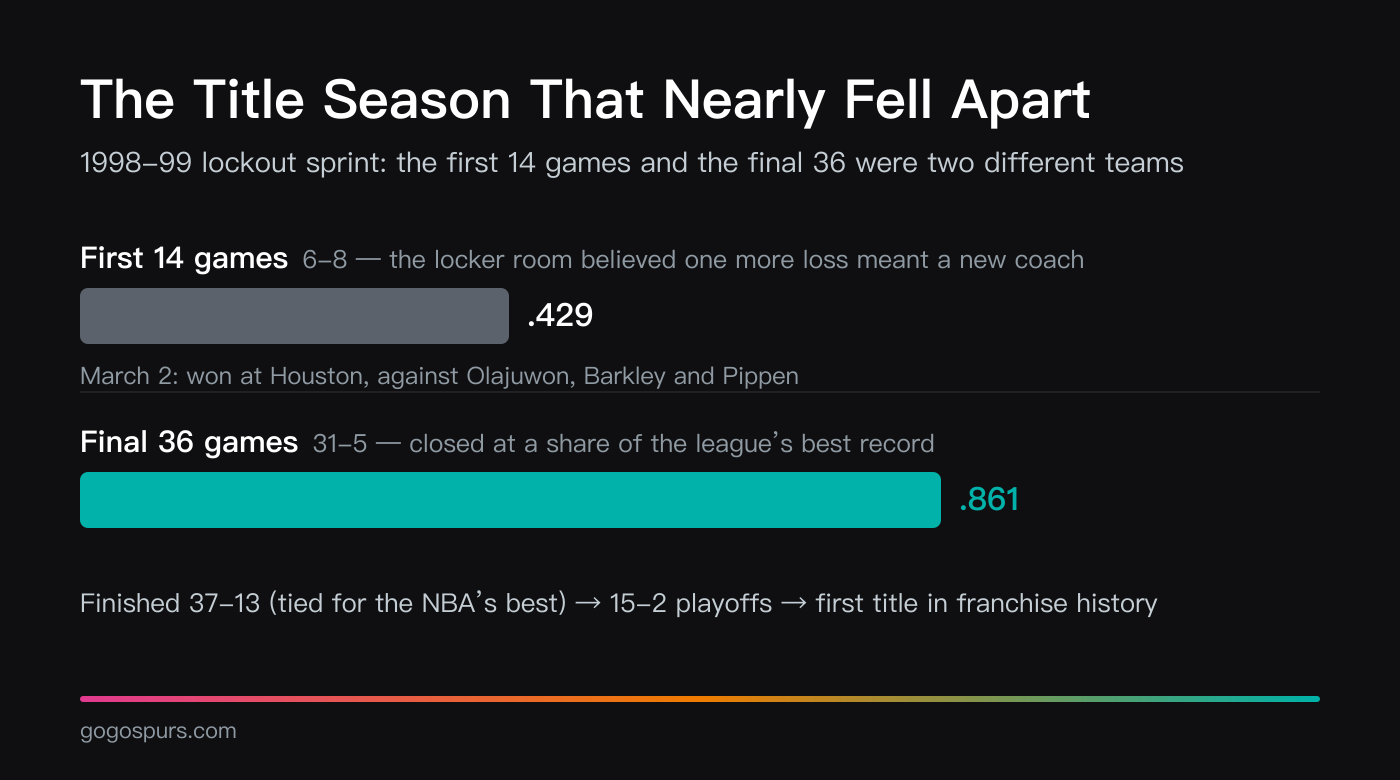
Start with a fact the trophy’s glow tends to wash out: that Spurs team opened 6-8, and came within a game of sawing off its own leg.
After Utah blew them out in San Antonio on February 28, the mood in that locker room was not “we’re winning the title.” It was “the coach is about to be fired.” Enough people who lived it have said so on the record: Malik Rose remembered the pregame before the make-or-break game feeling “different from the regular pregame … If we lost that game, they were going to fire Pop and bring in Doc … that was the rumor. I would have to say it was real because of the gravity in the locker room. I’ll never forget it.” (Doc Rivers was then calling Spurs games as a TV analyst.) Avery Johnson: “There was a lot of noise about Pop being potentially replaced by Doc … things had been communicated to us. It was really real.” Steve Kerr put it most bluntly: “Pop wasn’t Pop yet. He didn’t have a name.” For the record, all of this is the players’ recollection; ownership never confirmed a decision had been made. But a team two years from launching a dynasty, in which every player believed the coach was one loss from gone — that fact needs no confirmation to mean something.
On March 2, on the road against a Houston team carrying Hakeem Olajuwon, Charles Barkley and Scottie Pippen, the Spurs won by 17. Then something clicked into place: nine straight wins, a 31-5 sprint over the final 36 games, and a 37-13 finish — a .740 clip, tied for the best record in the league.
If you want the counterexample to “a 50-game season can’t reveal a real team,” this is it: climbing from 6-8 to first in the league, in a season with no room for error, is not a function of sample size. It’s a function of something else.
The defense, and an MVP who gave himself away
Half of that “something else” was the defense.
The 1998-99 Spurs held opponents to 40.2% shooting — an NBA record at the time, breaking their own mark from the year before. Their defensive rating of 95.0 led the league; second place was 97.1. That’s not a gap, that’s a shelf. A chaotic short season punishes teams that live on offensive chemistry — but a defense founded on two towers named Robinson and Duncan needs no chemistry at all. Rim protection is plug-and-play.
The other half is that David Robinson did something harder than any stat.
He was 33 that year, averaging 15.8 points — a career low. His offensive usage fell from 29.7% the previous season to 23.8%, while second-year Duncan’s rose to the highest on the team. That was not the natural slope of decline — that was a former MVP moving himself to the high post and handing the low block to a 22-year-old. The league’s own official retrospective puts it plainly: Robinson “unselfishly redefined his game.”
To feel the weight of that, remember what Robinson carried through the ’90s. He won the 1995 MVP — the trophy was presented on court before Game 2 of the conference finals — and Hakeem Olajuwon answered with 41 points that same night, dismantled him across the series, and left behind the famous line, “I’m going to his house to get my award.” From then on, “great numbers, shrinks in big games” was glued to him. Four years later, his answer wasn’t a 40-point revenge game. It was giving the ball away and taking a ring instead.
One more thing nobody watching knew at the time: Sean Elliott — the man who tiptoed the sideline and hit the Memorial Day Miracle three in Game 2 of the conference finals — played the entire championship run while his kidneys were failing. The condition itself had been public since 1994, when a voided trade forced it into the open; what he hid, even from teammates, was how far it had progressed. Only after the title did he reveal he needed a transplant, and that August he received one, the kidney donated by his older brother. We watched that shot live and had no idea. Watch it now and it weighs something else entirely.
Fifteen wins, two losses, and 47 seconds
The playoff Spurs were a different team — or rather, the same team, finally visible. Minnesota in four, a sweep of Shaq and Kobe’s Lakers, a sweep of Portland, twelve straight playoff wins — the longest single-postseason streak in NBA history at the time. They closed the Knicks out 4-1 in the Finals to finish 15-2, tying the 1989 Pistons and 1991 Bulls for the best playoff record of the 16-team playoff era to that point.
The clincher came on June 25 — two years to the day after Duncan was drafted No. 1. Game 5 sat at 77-76 New York late, and the man who took over wasn’t either tower. It was the 34-year-old point guard: Avery Johnson, left baseline, 18 feet. Good. 78-77, 47 seconds left. Nobody on either team scored again. Avery’s own memory of it, as he told the San Antonio Report: “That 47 seconds felt like four hours and seven minutes.”
Duncan averaged 27.4 points and 14.0 rebounds for the series, scored 31 in the clincher, and took Finals MVP. And the man protecting the rim to the final horn was Robinson. A near-collapse in February, a 34-year-old closing it, a defense as the foundation — that answer sheet does not reconcile with “they picked up a cheap one in a short season.”
So here is how to read the asterisk
With both sides of the ledger open, my reading:
The 50-game season really was a different test — and the Spurs’ strengths happened to be exactly the subjects it tested. A defense that needed no chemistry. Two towers who didn’t depend on rhythm. A coach who kept discipline inside chaos. The format favored them, and honesty requires saying that’s partly luck — if 1999 had been a normal 82-game season, would it have gone differently? Nobody can prove it wouldn’t have.
But acing the exam that favors you is a separate achievement. The climb out of 6-8. A record-book defense. An MVP who gave himself away. Fifteen and two. None of that came free with the format — they wrote it themselves. Part 1 defined skill as conversion — the rate at which you turn luck into results. The 1999 season is the exhibit: luck deals the cards; playing them beautifully is on you.
Which is why I don’t need to argue with Jackson. Keep the asterisk, if you like. The asterisked title still turned a team that nearly fired its coach into a winning machine for the next seventeen years. No footnote changes that.
Twenty-seven years later, our turn not to reach for excuses
Back to June 2026, because it’s the reason I’m writing about 1999 at all.
This time the 4-1 ran the other way. And this time there is no asterisk to hang: a full 82-game season, both teams healthy, the Spurs holding home court — and losing all three games in their own building, the four defeats by a combined 16 points, two of them by a single point. Call it inches if you want. But not one of Brunson’s 45 points on closeout night was an accident, and that Knicks team earned the championship it had waited 53 years for.
The most honest thing a thirty-year fan can do right now is set both trophies on the same scale: our 1999 title has room for an asterisk — granted. Our 2026 loss has no room for an excuse — also granted. Grant both, and “luck is part of the skill” stands up. Grant only one, and it’s just a loser’s fig leaf.
And if 1999 taught anything, it’s this: the first trophy is never the end of the story — it’s where the conversion begins. Whether the Knicks’ new era becomes a dynasty depends on how they play the hand they’ve just been dealt.
As for the Spurs — in April 2014, Jackson was still saying we weren’t a dynasty, “they haven’t been able to win consecutive championships.” Two months later San Antonio won its fifth title, and owner Peter Holt said it to the world on championship night: “Even though it was a shortened, asterisked season. Phil, Phil, Phil, Phil, we all played the same amount of playoff games, didn’t we, Phil?”
That’s how the asterisk story ends.
Next up, 2003: the Admiral’s last dance.
Sources: ESPN — the champion ‘99 Spurs on the asterisk (Jackie MacMullan), ESPN — Timmy and Pop (Marc Stein), The Ringer — an oral history of the 1999 lockout season, Wikipedia — 1999 NBA Finals, Wikipedia — 1998–99 San Antonio Spurs season, San Antonio Report — echoes of the ‘99 Finals (Ken Rodriguez)
The opinions here are my own; the facts link to original reporting. If you spot an error, email contact@gogospurs.com and I’ll correct it publicly.