The 2003 Title Ran on Tim Duncan. The Spurs Knew It. (Duncan Era 3)
June 15, 2003. The SBC Center. Fourth quarter of Game 6.
Tim Duncan’s line that night: 21 points, 20 rebounds, 10 assists, 8 blocks — two blocks from a quadruple-double that has never happened in an NBA playoff game. San Antonio trailed 72-63, ripped off 19 straight points, and won 88-77 for the franchise’s second championship.
Most 2003 retrospectives start right there and slide into the familiar chords: the Admiral’s storybook farewell, the kids taking the torch, the foundation of a dynasty.
I want to ask a different question: why did one man have to do all of that?
This is Part 3 of the Duncan-era series. Part 1 was about lottery luck and conversion; Part 2 about the 1999 title and its asterisk. Part 3’s position is less romantic than the standard version: the 2003 championship ran on Tim Duncan, and the Spurs themselves didn’t believe the handoff was finished.
First, retire the phrase “the Twin Towers’ second title”
That’s the romanticizing that needs clearing out before anything else.
The 1999 championship belonged to the Twin Towers. The 2003 one did not.
David Robinson was 37 that year, averaging 8.5 points and 7.9 rebounds — both career lows — in 26.2 minutes a night, the lightest workload of any full season he played, with Popovich rationing him all year. In the playoffs it dropped further, to 7.8 and 6.6. He was still the soul of that team. He had not been its engine for years.
The same season, Duncan put up 23.3 points, 12.9 rebounds (a career high), 3.9 assists and 2.9 blocks, and won his second straight MVP — the eighth player ever to go back-to-back, and the first since Michael Jordan in 1992.
And the 1999 title team? By 2003, four men were left: Duncan, Robinson, Malik Rose, and Steve Kerr — who only counts because San Antonio re-acquired him after a season away in Portland. Avery Johnson, Sean Elliott, Mario Elie: gone.
Structurally, the 2003 Spurs were this: one MVP, one farewell, and a group of kids who weren’t ready yet.
The load he carried that spring still reads as absurd
Twenty-four playoff games. He played every one, 42.5 minutes a night, 1,021 minutes total: 24.7 points, 15.4 rebounds, 5.3 assists, 3.3 blocks on 52.9% shooting. His 593 points led every player in the postseason.
The Finals were more extreme: 24.2 points, 17.0 rebounds, 5.3 assists, 5.3 blocks. That block number is the highest in a Finals since the 1976 merger; ESPN pegged his series PER at 32.0, second-best in the same span. He opened with 32 points, 20 rebounds, 6 assists and 7 blocks in Game 1 — a line nearly as monstrous as the closer, and nobody remembers it.
The round-by-round scoring tells the whole arc: 18.7 against Phoenix, 28.0 against the Lakers, 28.0 against Dallas, 24.2 against New Jersey. The better the opponent got, the higher he went.
Let me block one overstatement before it starts: this was not “Duncan alone.” His 21 points in Game 6 were less than a quarter of the team’s 88. Stephen Jackson scored 17 that night on 7-of-13 with three triples, Speedy Claxton had 13, Ginóbili 11 with 7 boards. Spurs fans who watched that game remember Jackson’s threes and Claxton’s fourth quarter, and any essay that erases them deserves to be closed.
The problem was never that nobody helped. The problem was that the second-best player was somebody different every night.
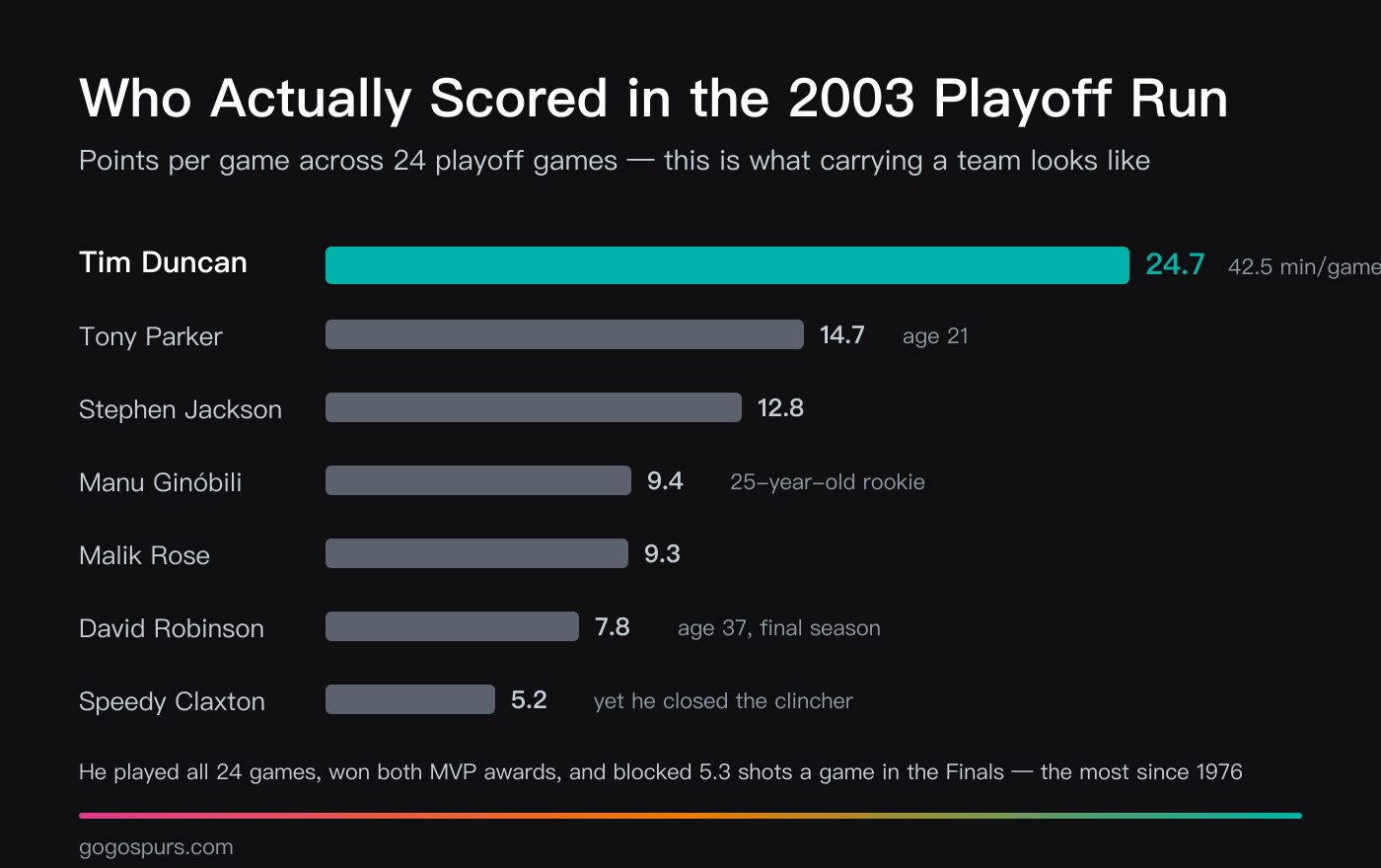
What was missing wasn’t help. It was a fixed closer.
Here’s the most honest thing thirty years of watching this team has taught me: the Spurs’ temperament is steadiness — and sometimes they are so steady they get flipped late. They had nobody of the Kobe type, or the Dwyane Wade type who came later: the guy who simply takes the last five minutes for himself.
The 2003 playoffs spelled it out three separate times.
Exhibit one: a 37-year-old closed out the conference finals. May 29, in Dallas, San Antonio trailed by 13 through three quarters and won the fourth 34-9. The fuse on that run was Steve Kerr off the bench — 37 years old, 13 minutes, 4-for-4, all four from three, 12 points. In that same game the Spurs’ 21-year-old starting point guard, Tony Parker, played 13 minutes and went 0-for-5 with zero points.
A team reached the NBA Finals on the arm of a 37-year-old bench shooter while its starting point guard watched.
Exhibit two: in the clincher, Parker went out and never came back. Midway through the third quarter of Game 6, with San Antonio down 57-47, Popovich pulled him — 24 minutes, 2-of-6, 4 points — and he does not appear in the fourth-quarter play-by-play at all. The closer was Speedy Claxton: a fringe guard who played 30 games all season with zero starts at 5.8 points a night. He played 23:44 that evening for 13 points on 5-of-8.
To be fair about it: Parker was not bad all series. In Game 3 he dropped 26 on the road and outplayed Jason Kidd. The truth is sharper and crueler than “he struggled” — a 21-year-old came apart in the two biggest games (1-of-12 for 3 points in Game 4; 4 points in Game 6). And Popovich’s answer was that he would not wait for him.
Exhibit three: they nearly gave back 25 points to the Lakers. This was the series that ended the three-time champions’ reign and denied them a fourth straight title. May 13, at home, San Antonio led by 25 — and got outscored 16-30 in the fourth quarter. With three seconds left, Robert Horry’s three rattled around the rim and out. Spurs 96, Lakers 94.
A 25-point lead, and survival hanging on an opponent’s rim-out. That is the prototype of the pattern I’m describing, and it happened in the best season this team had yet played.
(Two years later, that same Horry would be wearing silver and black, hitting the shot in Game 5 of the 2005 Finals. That’s Part 5’s story — but it connects to how this one ends.)
Then the Spurs admitted it themselves
Everything above is my read of what I watched. What follows is the organization’s own behavior — and there is no more honest confession available.
On June 15, 2003, the Spurs beat Jason Kidd’s Nets in Game 6 to win the title.
On June 16 — the next day — ESPN’s Ric Bucher put it in one line: “Kidd is at the top of San Antonio’s free-agent list.” In the same piece, Speedy Claxton said something that reads differently now: “If he comes, I know I won’t be back here.” A month earlier, Claxton had closed the fourth quarter of the title-clinching game.
In early July, Kidd and his wife flew to San Antonio. Popovich hosted them for dinner, and — in the AP’s word — Duncan “squired the couple around the city to show them the sights.” The franchise player, a month after beating this guy in the Finals, personally recruiting the opposing point guard. San Antonio’s offer was six years and more than $90 million, and the AP was clear about where that money came from: the team had $15-16 million in cap space, most of it opened by Robinson’s retirement.
Popovich later described the vision in his own words:
“We tried hard. I had this vision that he was going to teach Tony about being a point guard and they were going to live together. … It made sense to me; I thought it was pretty logical. Tony is 19 years old [Popovich misremembered — Parker was 21], and that’s Jason Kidd. Then Jason retires and Tony takes over for him in a while.”
In fairness, finish the quote set: Popovich also insisted this was not about discarding anyone — “I wanted both of them. It wasn’t to get rid of Tony Parker.” And then he conceded the more revealing part: “Tony did not love that idea at all. But we still tried to do it.”
Parker said the gracious thing publicly at the time — that he and Kidd “can play together,” and then: “People think I would have a problem with that. I don’t mind playing with him. Put me at (shooting guard) and we’ll be fine.” Years later one reporter recounted that he was privately furious and hurt — that version rests on a single source whose original reporting I couldn’t open, so you get both: in public he said the right thing; in private, so the story goes, he did not feel it.
And Kidd? On the day Duncan retired in 2016, he said this:
“I thought I was going to be a Spur. I committed when I was down there on my visit. On my flight home, I think I got cold feet. And sometimes I have nightmares about that.” “Maybe I could have won a championship or two there.”
Fact-checking turned up a crack here that I find more interesting than the story itself: no contemporaneous 2003 report says Kidd ever committed. The AP headline that day was “Kidd decision doesn’t surprise Spurs,” and Buford’s reaction was resignation — “it’s very difficult to get the face of a franchise to leave the team he’s playing for.” The “I said yes” is a memory that surfaced thirteen years later.
Did the reporting miss it, or did the memory soften it? I don’t know. But a man having nightmares about a team he didn’t join twenty-three years ago tells you how far that door had opened.
From championship to rejection, the whole thing took 26 days.
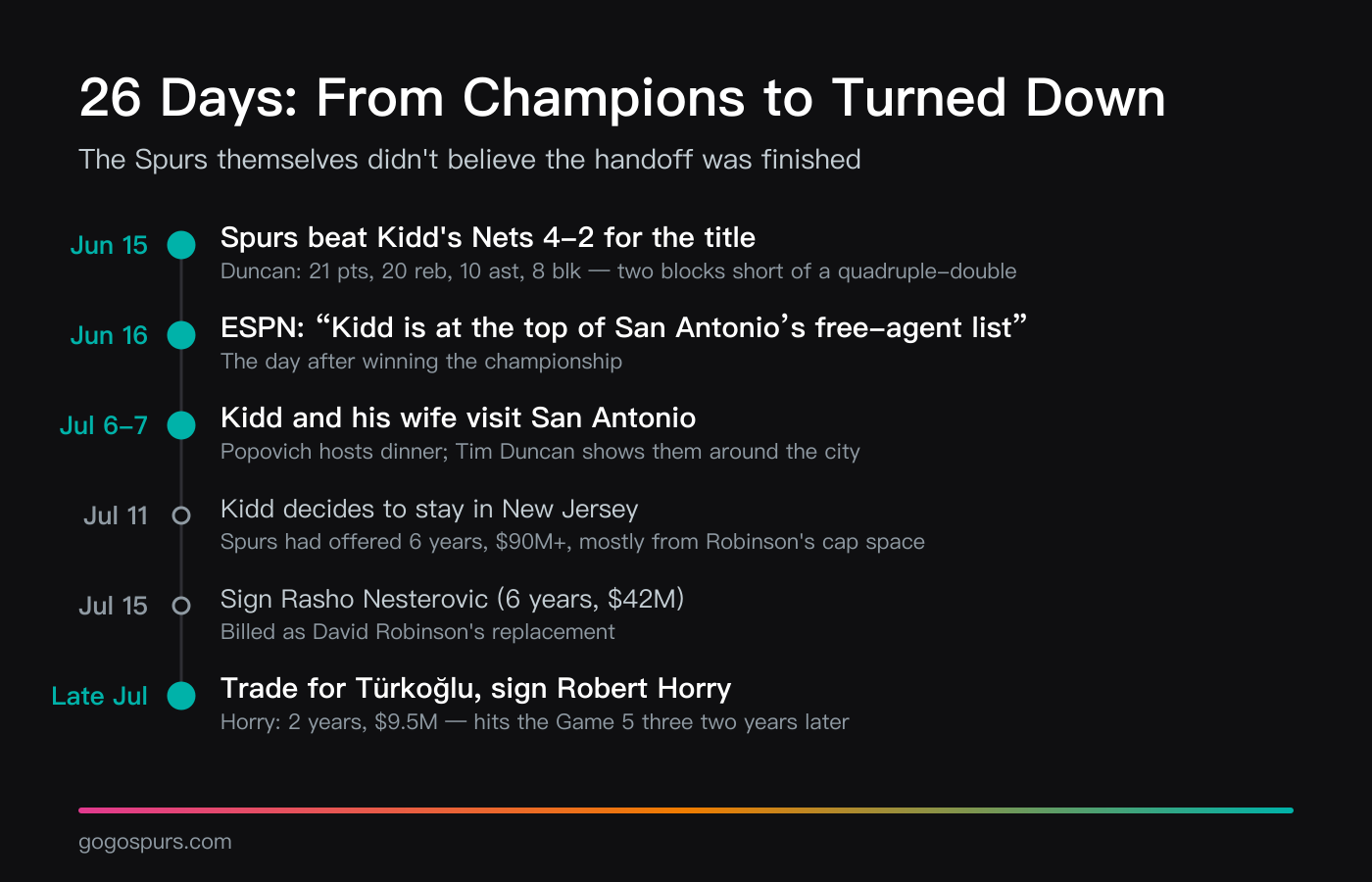
So what if he had come?
This is the what-if I’ve carried for two decades, and honesty requires saying it plainly: nobody can prove any version of it.
My instinct is that a Kidd team would have been a different animal — not just one more All-Star guard, but a different temperament in the last five minutes. Kidd averaged 19.7 points and 7.8 assists in that Finals against the league’s best defense, with a 30-point game and a 29-point game. He was not a man the moment shrank.
But the other side of honesty belongs here too: what that Spurs team lacked, they actually paid for. In 2004, the Lakers beat them 4-2 in the conference semifinals — Duncan hit a fadeaway to lead with 0.4 seconds on the clock, and Derek Fisher caught, turned, and buried it. That’s the next installment’s story, but it proves the pattern I described isn’t nostalgia talking.
So: three-peat with Kidd? There’s no answer. The only certainty is that the Spurs of that moment genuinely wanted a different temperament.
History’s answer is better than the hypothetical
Kidd didn’t come. So what did San Antonio do with the money?
Over the back half of that July they signed Rasho Nesterovic (six years, $42 million, explicitly as Robinson’s replacement), traded for Hedo Türkoğlu, and signed a veteran off the Lakers: Robert Horry, two years, $9.5 million. The same Horry who, two years later, hit the overtime three in Game 5 of the 2005 Finals.
And the 21-year-old they hadn’t replaced? He kept getting coached the hard way — years later, at Parker’s jersey retirement in November 2019, Popovich apologized for “all the physical and mental abuse I gave you over the years” — and then won the 2007 Finals MVP, the first European-born player to do it.
Part 1 defined skill as conversion: the rate at which you turn luck into results. This chapter adds a layer to that argument: sometimes even the thing you can’t get is luck. The Spurs wanted Kidd badly enough to send their franchise player out as a tour guide. They missed, and were left developing Parker and spending the money on a 33-year-old role player — and each of those consolation prizes turned into a championship.
Finally, back to the man who burned
When I say 2003 ran on Tim Duncan, that isn’t a complaint. It’s respect.
He was 27. He won regular-season MVP and Finals MVP, played all 24 playoff games at 42.5 minutes a night, and held the opposing franchise player, Kenyon Martin, to 3-of-23 in the clincher. He took a roster of one MVP, one farewell and a group of kids, and carried it to a title.
And the loveliest coincidence of that night sits on the other side of the box score.
Duncan finished two blocks short of a quadruple-double. There have been only four quadruple-doubles in NBA history and never one in a playoff game — and one of the four belongs to the man who played his last game that night, David Robinson (February 17, 1994 vs Detroit: 34 points, 10 rebounds, 10 assists, 10 blocks).
Robinson’s final game was 13 points and 17 rebounds — his best rebounding night of the entire postseason, and his biggest since November. At 37, on his last night on an NBA floor, he and Duncan combined for 37 rebounds; the entire Nets roster had 35.
Afterward, Robinson said:
“To finish my career in the NBA Finals and to win the championship is a play written only by God.”
He left the court for the last time with 35.6 seconds on the clock, got a long hug from Popovich, then ran across the floor and pulled one of his sons out of the crowd.
An era ended that night. And the man who took it over had already burned through one turn of himself — with thirteen more to go.
Next up, 2004: those 0.4 seconds.
Sources: ESPN — the Kidd question, the day after the title (Ric Bucher, June 16, 2003), Wikipedia — 2003 NBA Finals, Wikipedia — 2002–03 San Antonio Spurs season, ESPN — Kidd stays with the Nets (AP), ESPN — Kidd on nearly joining the Spurs, FOX Sports — Popovich on his Kidd vision, CBS Sports — Popovich wanted both Kidd and Parker, Deseret News — Duncan’s second straight MVP (AP)
The opinions here are my own; the facts link to original reporting. If you spot an error, email contact@gogospurs.com and I’ll correct it publicly.