Luck Built the Spurs Dynasty. That's Not an Insult. (Duncan Era 1)
From 1997 to 2016, the San Antonio Spurs won five championships.
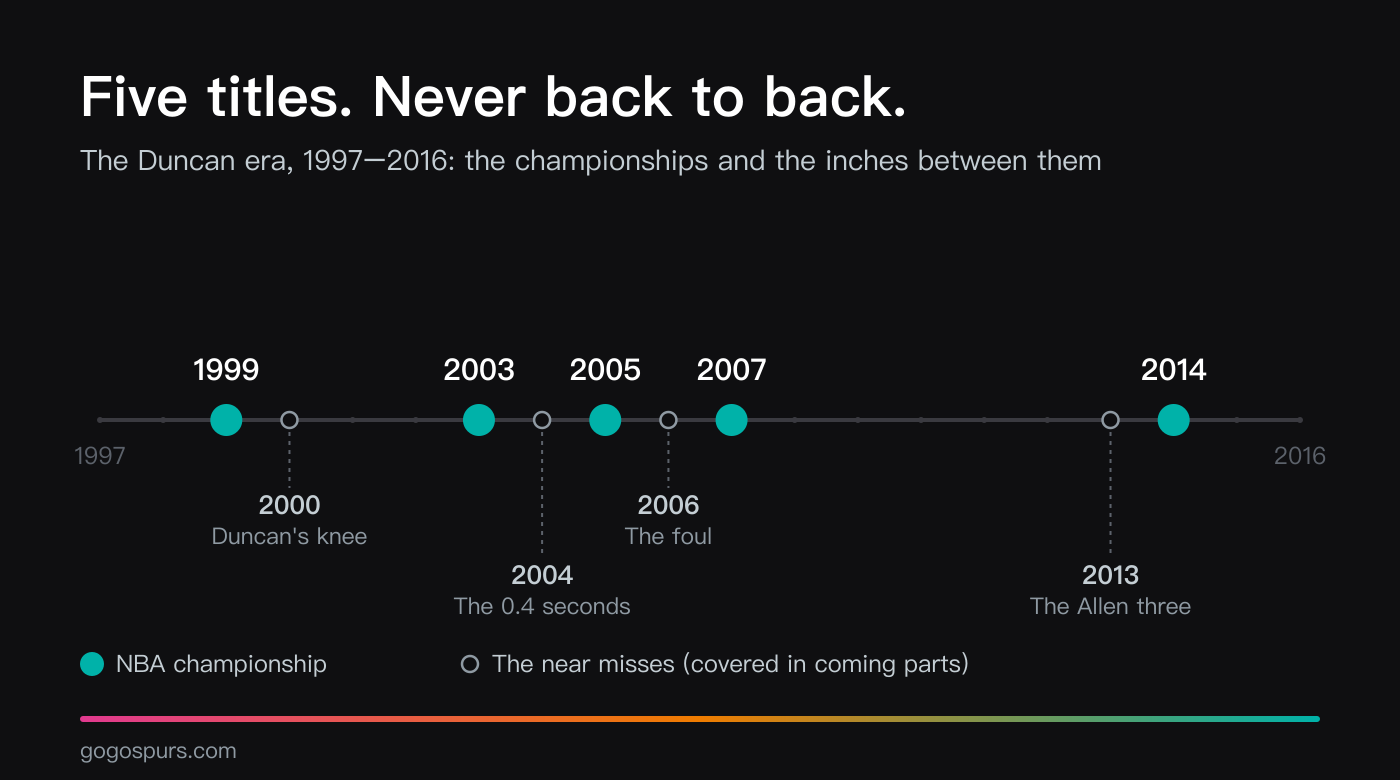
1999. 2003. 2005. 2007. 2014. Lay those years out and most people see the titles. I’ve been watching this team for thirty years, and the first thing I see is the gaps — every championship sits at least a year away from the next one. The most stable franchise in modern American sports never repeated as champion. Not once.
This is the first installment of a ten-part series on how that dynasty got built. The next nine parts will go year by year, series by series. But before any of that, I want to lay the whole story on the table and say the thing I hesitated a long time before writing:
Luck is part of the skill.
Pin the claim down, or it’s a slogan
“Luck is part of the skill” comes with a built-in trap: it’s too convenient. Win, and it was skill. Lose, and it was bad luck. Heads I win, tails was luck — any serious fan dismantles that coin in one sentence.
So let me pin it down as a claim that can actually be proven wrong.
The Spurs’ luck ran in both directions. They won because of luck — in a moment you’ll see that the 1999 title came in a lockout season that lasted only 50 games, and that the foundation of the whole dynasty was two No. 1 lottery picks. And they lost because of luck — later parts will cover the 0.4 seconds in 2004, the foul in 2006, the corner three in 2013. Count the good breaks and the bad ones alike. That’s the only honest ledger.
So where does the skill live? In conversion, and in survival. Turning a lottery ticket other front offices would have wasted into a dynasty — that’s conversion. Getting off the floor after a heartbreak and cashing the very next chance — that’s survival. Both can be compared across franchises, and both can be falsified with data. That’s what makes this an argument instead of an excuse.
This opening chapter is about where the conversion started.
The year half the league tanked for one man
To understand how much luck weighs in this story, you have to look at what the 1996-97 season actually was.
Tim Duncan was a once-in-twenty-years prospect, and the only road to him ran through the draft lottery — the worse your record, the better your odds. So the bottom of the league staged a public race to the floor, and the prize had a name: Tim Duncan.
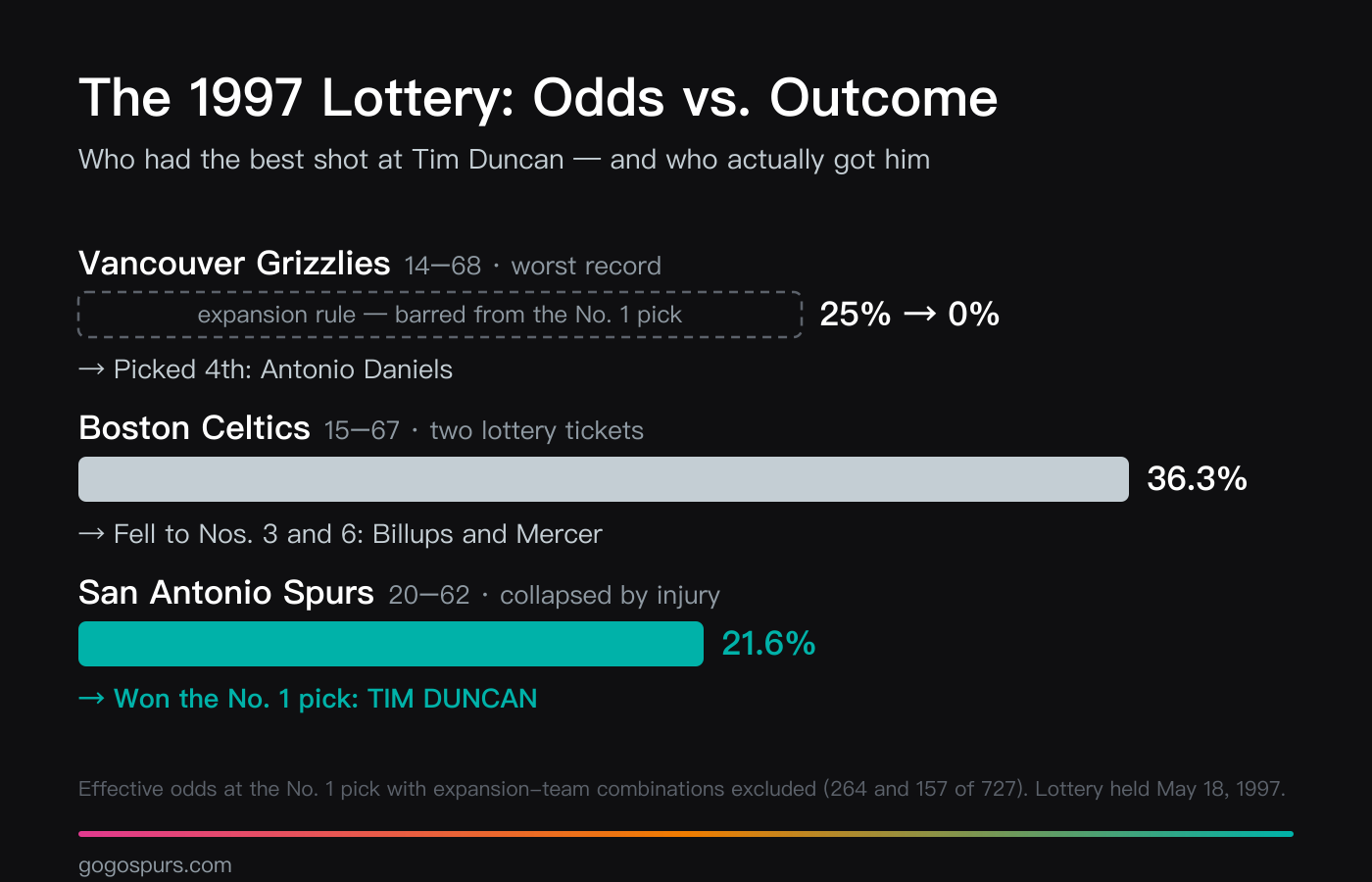
Nobody tanked more nakedly than the Boston Celtics, where general manager M.L. Carr had hired himself as head coach a year earlier and was still working both jobs — which told you everything about the plan. Carr admitted it himself later: “I was bringing in guys like Nate Driggers and Brett Szabo… It was a joke.” He called the season “so difficult, because it goes completely against your basketball DNA.” After an 11-33 start, Boston went 4-34 the rest of the way to finish a franchise-worst 15-67. And the Celtics held two lottery tickets — their own plus one acquired earlier from Dallas — for a league-best combined 36% shot at the No. 1 pick.
The worst record in the league didn’t even belong to Boston. It belonged to the 14-68 Vancouver Grizzlies. But here’s the rule that decided everything: the Grizzlies and the Toronto Raptors were 1995 expansion teams, and under the terms of their entry they could not receive the No. 1 pick in the 1996, 1997 or 1998 drafts — even if they won the drawing. The team with the worst record, the team most “entitled” to Duncan, was locked out of the room before the balls ever bounced.
And the Spurs? San Antonio finished 20-62, third-worst, for roughly a 21.6% chance at the top pick — which is to say, nearly a four-in-five chance of missing. And that record wasn’t engineered. A year earlier this was a 59-win contender; the collapse had exactly one cause. David Robinson, the franchise, played six games all season — he missed the first 18 with a back injury, came back for six, then broke his left foot against Miami and was done for the year. Sean Elliott missed most of the season too. This was a contender flattened by injuries, not a tanking project. (I ran the numbers on just how improbable San Antonio’s run of No. 1 picks is in an earlier piece.)
Sean Elliott later said it on the Dan Patrick Show as plainly as it can be said: “If David Robinson doesn’t break his foot, no Timmy Duncan, no dynasty.”
Then, on May 18, 1997, the ping-pong balls came up.
Boston — the most committed tanker, the odds-on favorite — fell to picks 3 and 6, which became Chauncey Billups and Ron Mercer. Vancouver, with the worst record, was never eligible. And the third-worst team, the one with a one-in-five shot, the one that never meant to be bad at all, jumped from third to first.
They just won it.
There is no cleaner demonstration that luck was the on-switch of this dynasty: of the two teams that wanted him most, one was barred by rule and the other wrecked an entire season and walked away with nothing — while the team that got him was the one broken by injuries, not by design.
What happened next was skill
After the lottery, the story could have forked.
Boston wasn’t done. Rick Pitino, newly installed as Celtics coach and president, offered San Antonio both Boston picks — 3 and 6 — for the No. 1. And on paper, San Antonio had every reason to waver: its franchise center had just played six games in a season, and nobody knew how much his back and foot had left.
Popovich turned it down flat. His line in the Boston Globe that week: “The only way I could see us trading Tim Duncan is if someone offered us Michael, Magic, and Larry.” Even M.L. Carr, who made the ask for Boston, remembered Popovich being gracious about it — sorry, almost, that Carr had to ask at all.
Then Popovich flew to St. Croix, Duncan’s home island in the U.S. Virgin Islands, and spent several days getting to know him. Duncan, for his part, had already done something rare for that era: he stayed at Wake Forest all four years, keeping a promise to his mother.
A ping-pong ball hands you the pick. But not blinking at picks 3 and 6, flying down to meet the kid, and then dropping him into the right room — none of that is luck. Those are choices.
So the Twin Towers took shape: Robinson, still an elite center in the back half of his career, next to a 21-year-old No. 1 pick. Duncan’s rookie line was 21.1 points, 11.9 rebounds and 2.5 blocks; he started all 82 games and made First Team All-NBA — the first rookie to do it since Larry Bird in 1980. The team went from 20-62 to 56-26, and that 36-win swing was, at the time, the biggest single-season turnaround in NBA history.
Two years later, in 1999, San Antonio beat the eighth-seeded New York Knicks 4-1 for the franchise’s first championship — the first former ABA team ever to win it all. Duncan took home Finals MVP.
The honest part: that title had luck in it too
If I stopped here, I’d be committing the exact sin I described above — counting only the good stuff as skill.
So say it out loud: the 1999 championship came in a lockout season that ran only 50 games. Some people hang an asterisk on it, and the asterisk is not entirely unfair. Both pillars of the dynasty — Robinson and Duncan — were No. 1 lottery picks. All of that is luck, and all of it broke San Antonio’s way.
I’m not hiding any of it. Admitting the good luck is what buys you the right to talk about the bad.
And the Twin Towers were never as romantic as memory paints them. Across their six full seasons together, 1998 through 2003, the Towers won two titles. In between, the Shaq-and-Kobe Lakers owned them: in 2001 a No. 1-seeded Spurs team was swept 0-4 in the Western Conference finals — those Lakers lost one game the entire playoffs — and in 2002 they went out 4-1 in the second round. One of the greatest frontcourts ever assembled walked away empty in four of its six years.
The setup: the years they couldn’t repeat were luck, too
Which brings us back to the gaps — why did this team never defend a title?
Part of the answer is bad luck so concentrated it barely seems real. The coming installments will take these apart one at a time; here’s the trailer:
- 2000. The defending champions lose Duncan to a torn meniscus in his left knee right before the playoffs. Without him, they fall 3-1 in the first round to Phoenix.
- 2004. Duncan hits a fadeaway to put San Antonio ahead with 0.4 seconds on the clock — and Derek Fisher catches, turns, and beats the buzzer.
- 2006. The defending champs lead Game 7 with 21 seconds left, put their opponent on the line with a foul, and watch the title defense die in overtime.
- 2013. The yellow rope is already coming out courtside — San Antonio is 28 seconds from a fifth championship. Then Ray Allen hits the corner three.
And I’ll be honest about every one of them: none of those were robberies. The 2004 Lakers had four Hall of Famers; even if Fisher misses, the series isn’t over. The 2006 foul was Ginóbili’s own decision — a mistake, not fate. 2013 had its substitutions and a missed free throw.
But the margins were real. Bosh’s offensive rebound in 2013. Duncan’s point-blank putback in the final seconds of regulation in 2006, blocked by Nowitzki by the narrowest of margins. Replay those nights a hundred times and San Antonio walks away with more rings. That’s bad luck — and an honest fan weighs it on the same scale as the two lottery tickets.
And this is exactly where the skill shows
If the story were just “won on good luck, lost on bad,” it would say nothing. What makes “luck is part of the skill” hold up is what happened next:
After the heartbreak foul of 2006, the Spurs won the 2007 title. After Ray Allen’s three in 2013, the Spurs beat the same Heat team 4-1 in 2014 for championship number five.
That is not luck. Most teams disintegrate after losses like those; San Antonio answered every one with the very next chance it got. Surviving your own bad luck, better than anyone else in the sport — that’s testable, and they passed.
The conversion is testable too. In the same era, the Lakers drew at least as much luck and won more titles. But turning a 57th pick and a 28th pick into Hall of Famers, and turning one lottery ticket into nineteen years with eighteen 50-win seasons — no other franchise of that era did that.
So — is luck part of the skill?
Yes. Not because luck equals skill, but because putting yourself where luck can find you, catching it when it arrives, and staying alive when it turns on you — those three things are beyond the reach of a ping-pong ball. Only an organization can do them.
And this organization’s story begins with a broken foot, a No. 1 pick that never got traded, and a flight to St. Croix.
Nine more parts. Let’s take it year by year.
Sources: Basketball-Reference — Tim Duncan, Basketball-Reference — David Robinson, Wikipedia — 1999 NBA Finals, NBA.com — Tim Duncan Hall of Fame, Forbes — Tim Duncan by the numbers
The opinions here are my own; the facts link to original reporting. If you spot an error, email contact@gogospurs.com and I’ll correct it publicly.