Point Five: The 2014 Spurs Changed One Thing (Duncan Era 9)
Miami, June 10, 2014. Game 3 of the NBA Finals.
San Antonio took 33 shots in the first half and made 25 of them. That is 75.8 percent, and a 71-50 lead at the break.
No team had ever shot better in a half of a Finals game — the previous mark was Orlando’s 75.0 percent against the Lakers in 2009. The first quarter was worse than that, if you were Miami: 13-of-15, 86.7 percent, also a record.
The series was over before halftime of the third game.
And the thing worth watching in that half wasn’t any particular shot going in. It was the ball never staying anywhere.
What this one is about
This is part nine of the Duncan dynasty series. Part eight was about 5.2 seconds in Game 6 of the 2013 Finals, and it ended with a promise: how the debt got settled.
This is how it got settled. And it happened in a way almost nobody describes correctly.
The standard account goes like this. The Spurs get destroyed by Ray Allen’s three, sit with it for a year, come back for revenge, unveil “the Beautiful Game,” and win the rematch in five. Two claims live inside that sentence — the motive was revenge, and the method was a change in how they played.
Having gone through it: neither one survives, and the name isn’t theirs either.
The players rejected the word “revenge” every time it was put in front of them. And their style of play, measured against the previous season, barely moved — they actually shot fewer threes.
One thing did change, and it is small enough to fit in a single number: half a second.
Here’s the argument. We reach far too easily for “they changed how they played” as the explanation for why a team wins. The 2014 Spurs are the counterexample. They changed nothing. They took a thing they had already been doing for two years and finally got all of it right.
That isn’t evolution. It’s a group that had finally finished coming together — and the moment it finished happened to be exactly the right one.
1. The answer the media went with: revenge
Start with the popular version.
At Finals media day on June 4, 2014, a reporter put this to Miami’s Chris Bosh:
“They’re hell bent on revenge, Chris. What do you think about a team that seems so determined in that regard?” — Reporter’s question, 2014 Finals media day, official transcript
The same day, someone asked Ray Allen — the man who hit the shot — how much revenge was driving San Antonio. His answer:
“I won’t say revenge. I don’t think that’s a word they may use. This is a whole new year.” — Ray Allen, June 4, 2014, official transcript
He was right.
I pulled every official ASAP Sports transcript from the 2014 Finals — both teams, every interview subject, June 4 through June 15, 114 of them — and ran a full-text search for revenge, redemption, payback, avenge, vengeance, and get them back.
Eight hits, spread across seven transcripts.
Five of them sit inside a reporter’s question — to Bosh, to Ray Allen, to Chalmers, to Ginóbili after Game 1, to Ginóbili on the night they won. The other three come from players answering — and all three are rejections: Ray Allen, Parker, Ginóbili, the first of whom plays for Miami.
A Spurs player or coach reaching for the word: zero times.
The cleanest one is Tony Parker. He was asked whether, given what had happened in Games 6 and 7 in Miami the year before, the previous night had felt cleansing — the reporter’s word was “cleansing,” not “revenge.” Parker introduced the word himself, in order to reject it:
“To be honest with you, we didn’t even talk about it, Games 6 and 7. The only time Pop reminded us of that was day 1 in training camp. That’s it. It’s a new year. That’s why I don’t like revenge. It’s a rematch.” — Tony Parker, June 11, 2014, official transcript
Ginóbili was flatter about it:
“So in my situation, I didn’t really take the season thinking of, oh, we have to have a revenge because of the way we lost it.” — Manu Ginóbili, June 14, 2014, official transcript
Asked whether the Spurs were coming into the series with a chip on their shoulder, Duncan said “I don’t know if we’re going in with a chip on our shoulder. We’re going in this trying to win a championship.” In the same session he got pressed on “we’ll do it this time,” the line he had given TNT after eliminating Oklahoma City on May 31. He seemed genuinely puzzled that it was a story:
“I don’t know what I said that was so bad. Everybody keeps talking about it, I don’t know what I said that was so bad, I said I wanted to win the Finals. We’re back here now and I wanted to win. If they need to find fuel in that, so be it.” — Tim Duncan, June 4, 2014, official transcript
Meanwhile, on the other side of the microphone:
Zach Lowe’s championship piece for Grantland ran under the headline “San Antonio’s Revenge.” The word “revenge” appears in the body of that article zero times. Its opening sentence is about something else entirely:
“The Spurs’ fifth championship symbolizes everything we’ve been bringing up all year: the triumph of the NBA’s beautiful game; the crowning achievement for three stars who took less money to stay together; a cathartic response from perhaps the most crushing defeat in NBA history…” — Zach Lowe, Grantland, June 16, 2014
One headline, two frames, stitched into the same piece of writing. And before the series even started, ESPN’s five-writer preview had already declared “there’s a bloodthirst for revenge” and that the title would “feel extra special because of the revenge factor” — published the same day the Spurs were denying it to reporters’ faces.
There’s a distinction here, and skipping it would be dishonest.
What the players pushed away was revenge — a thing aimed outward, at Miami. What they never pushed away was redemption — a thing aimed inward, at themselves. On the night they won, Parker said “we wanted to redeem ourselves. I’m just glad we were able to do that.” Duncan said “we remember what happened last year and how it felt in that locker room and we used it and built on it and got back here and it’s amazing. It makes last year OK.”
I ran the same check on 2005 earlier in this series, and there the finding was absolute: revenge was a pure media construction, with zero player participation. 2014 is not that. The outward half got rejected; the inward half got claimed.
Popovich’s own version contains no hostility at all. Asked about the previous year on the night he won:
“Last year’s loss was devastating. I’ve said many times, a day didn’t go by where I didn’t think about Game 6. So I think just in general, for the group to have the fortitude that they showed to get back to this spot, I think speaks volumes about how they’re constituted and what kind of fiber they have.” — Gregg Popovich, after Game 5, June 15, 2014, official transcript
Then, unprompted, he started talking about LeBron:
“LeBron James is a great player. He’s a great competitor. He’s a class act. And I know he’s feeling what we felt last year, and I don’t wish that on anybody. It’s tough.” — Gregg Popovich, after Game 5, June 15, 2014, official transcript
A team supposedly built on payback, and the first thing its coach did after the trophy ceremony was speak up for the man they had just beaten.
2. So try the other answer: they changed how they played
If revenge doesn’t hold, try explanation number two — this team transformed, started moving the ball obsessively, started bombing threes, and invented what everyone would call the Beautiful Game.
I believed that one too, until I looked at the season. It doesn’t hold either.
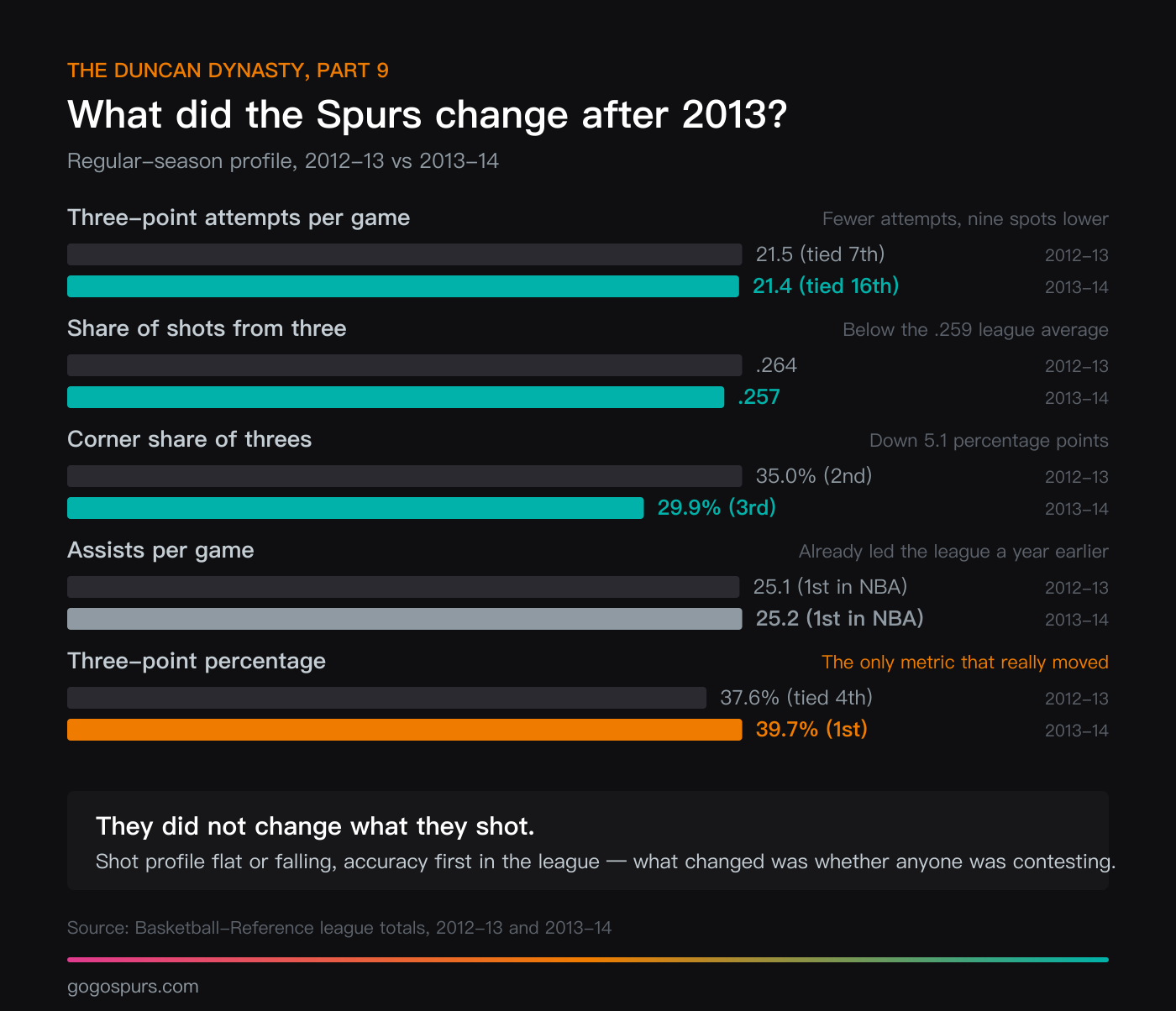
Start with the threes. Every version of “the Spurs modernized” assumes they started shooting more of them:
| 2012-13 | 2013-14 | |
|---|---|---|
| Three-point attempts per game | 21.5, tied for 7th | 21.4, tied for 16th |
| Share of shots from three | .264 | .257 |
| Corner share of threes | 35.0 percent, 2nd | 29.9 percent, 3rd |
| Assists per game | 25.1, 1st in the NBA | 25.2, 1st in the NBA |
They shot fewer threes and dropped nine places in the league. Even the corner three — the most efficient shot on the floor — made up a smaller share of their attempts than the year before. And that three-point rate is identical to the .257 they posted two years earlier. The difference is that in 2011-12 the number put them far out in front of the league (the league average was .226), and by 2013-14 the league average had climbed to .259 — leaving San Antonio below average.
The Spurs didn’t move toward the three-point line. The league spent two years walking over to where they were already standing.
Assists tell the same story. Yes, they led the league — but they had already led it in 2012-13, and the share of their made baskets that came off an assist actually fell, from 64.2 percent to 62.1 percent. The claim that they started moving the ball after losing to Miami has the chronology backwards: the passing leap happened in 2012-13 — the season that ended with Game 6.
Even the mechanics weren’t new. Grantland had already published a full breakdown of the Spurs’ drive-and-kick game, the “Hammer” baseline action, and the fact that this was one of the few rosters with no “ball stoppers” — in June 2013, before Ray Allen’s three.
As for the image of an all-time offensive juggernaut, that needs trimming too. In the 2013-14 regular season, San Antonio was tied for 6th in offensive efficiency; the defense was 3rd. And one of the teams that scored more efficiently than the Spurs that year was the Miami Heat.
So: same shot profile, same assist volume, an offense tied for sixth, and their opponent’s was better.
What happened in those five games?
3. The thing that actually changed: half a second
The answer isn’t in shot selection. It’s in time.
In the fall of 2013 the Spurs held camp at the Air Force Academy in Colorado Springs. Popovich installed one instruction there.
“…courtside fans in Miami’s AmericanAirlines Arena could hear Popovich hollering the mantra he had implemented in training camp at the Air Force Academy: ‘Point five! Point five! Point five!’” “In Popovich’s mind, the Spurs’ best — and perhaps only — chance of upending the NBA’s back-to-back champion in its own building was to ensure the ball didn’t linger in anyone’s hands for more than half a second, or .5.” — Jackie MacMullan, ESPN, June 9, 2015
Not “pass more.” Not “shoot more threes.” Catch it, and you have half a second to decide whether to shoot, pass, or drive — then it has to leave your hands.
Popovich has explained why he had no other option, and the reasoning is not romantic in the slightest:
“Let’s say you have a great offensive player like Steph Curry. You want to make him work on defense, but to do that you need a great one-on-one player to give the ball to. We don’t have a Kevin Durant, a LeBron, a James Harden, so we have to do it with pieces. And the only way to do that is to move the basketball and make the people guarding you move with it.” “We’re not the most athletic team in the world, so if we’re taking uncontested shots and the other team is taking it out of the net all the time, that’s huge for us defensively.” — Gregg Popovich, via Jackie MacMullan, ESPN, June 9, 2015
Ginóbili put it more bluntly — and this is the one quote in all of the material that ties the 2013 loss directly to a tactical instruction:
“You could sense their frustration. LeBron had to work so much, and then we’d come down and hit another 3. … Pop told us after 2013 this was the way we had to play to beat them. If we went isolation, we had no shot. The mentality, especially for those three games, was not to give away a single possession. Just keep it moving, keep it moving — it was incredible.” — Manu Ginóbili, same ESPN piece
And Boris Diaw’s version is the best single sentence anyone produced about that season:
“It fueled us, the fact that we lost, to be a little more perfect. If we don’t make those mistakes earlier in the game, then it’s easier down the stretch. That’s what happened the second year: We played more perfect, we made less mistakes.” — Boris Diaw, via J.A. Adande, ESPN, November 19, 2014
“A little more perfect.” Not “different.”
And that instruction left a very clean fingerprint in the numbers. Same attempts, same assists, same three-point rate — but:
| 2012-13 | 2013-14 | |
|---|---|---|
| Three-point percentage | 37.6 percent | 39.7 percent, 1st in the NBA |
| Field-goal percentage | .481 | .486 |
They didn’t change which shots they took. They changed whether anyone was there when the shot went up.
This isn’t a metaphor — the tracking data catches it
2013-14 happened to be the first season the NBA tracked every game league-wide. Which means “how long the ball sits in someone’s hands” stopped being a figure of speech that year and became a measurement.
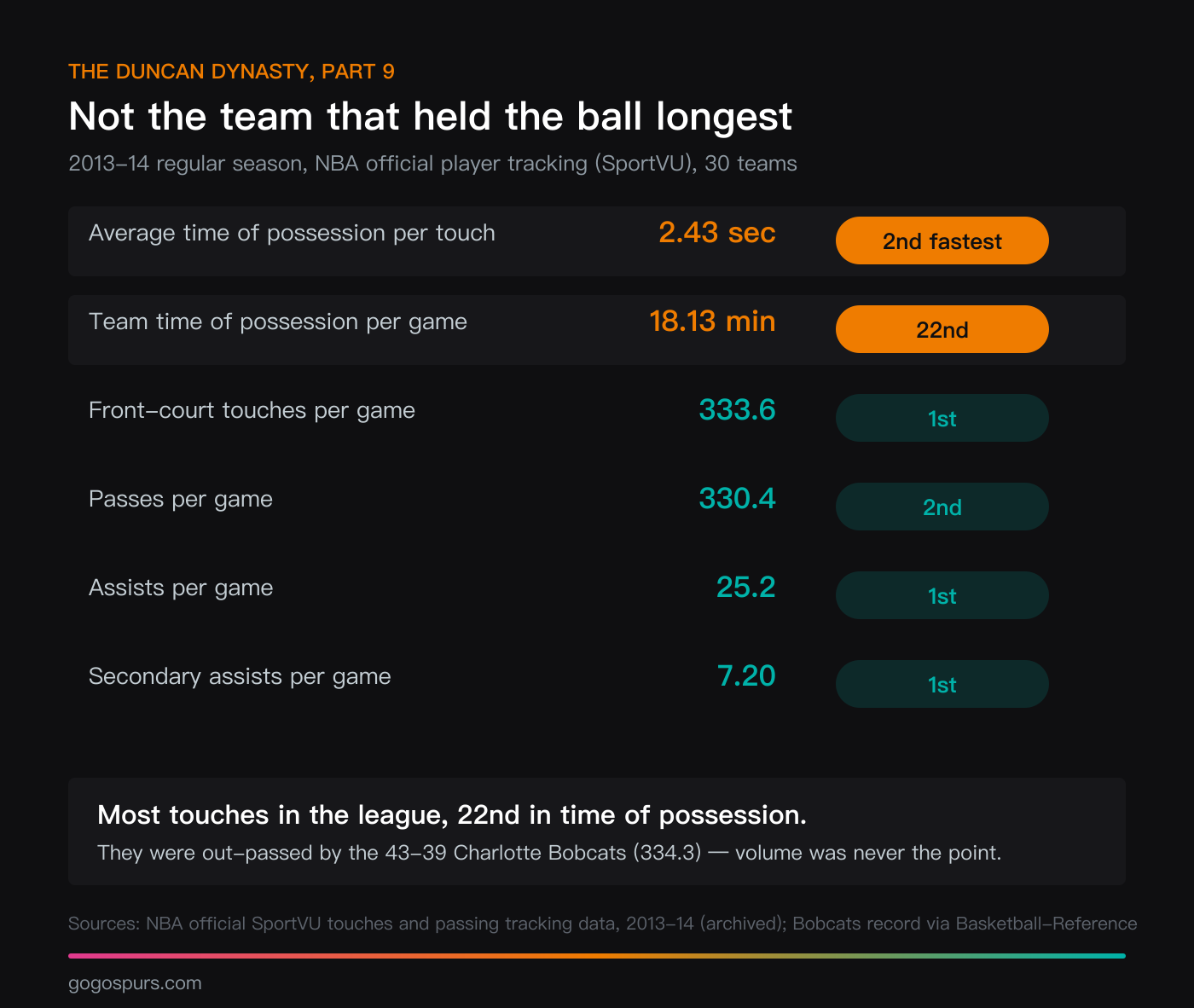
| Metric | Spurs | League rank |
|---|---|---|
| Time of possession per touch | 2.43 seconds | 2nd fastest |
| Team time of possession per game | 18.13 minutes | 22nd |
| Front-court touches per game | 333.6 | 1st |
| Passes per game | 330.4 | 2nd |
| Secondary assists per game | 7.20 | 1st |
Read those together and you get a strange profile: this team touched the ball more than anyone in basketball and held it less than all but eight teams.
Not the team that possessed the ball longest. The team where it stopped for the shortest time.
While we’re here, one more tidy line worth killing: the Spurs were not the league’s leading passing team that year. They were second, behind the Charlotte Bobcats at 334.3 per game — a team that went 43-39 and got swept in the first round. Passing volume has never been the thing. The thing is whether the defense is still catching up when the ball arrives.
Popovich’s own name for it wasn’t “the Beautiful Game”
“Pop had his own name for it: Summertime. It’s when you’re playing. Just playing. The ball’s moving, and the game’s flowing. You make a decision to shoot it, pass it, drive it. ‘Point five.’ That was the directive. You’ve got half a second. You’ve got a good shot, but he’s got a great one. So you pass him the ball, and there it is. It’s Summertime.” — Brett Brown, former Spurs assistant coach, ESPN
Two caveats on that. The line often attributed to Popovich — give up a good shot to get a great one — has no primary source in his own voice; the version that can be verified is Brown’s account above. And Brown had left for the Philadelphia 76ers in August 2013, so he is remembering the vocabulary, not describing that season from inside it.
4. Five games at the edge of what the system could do
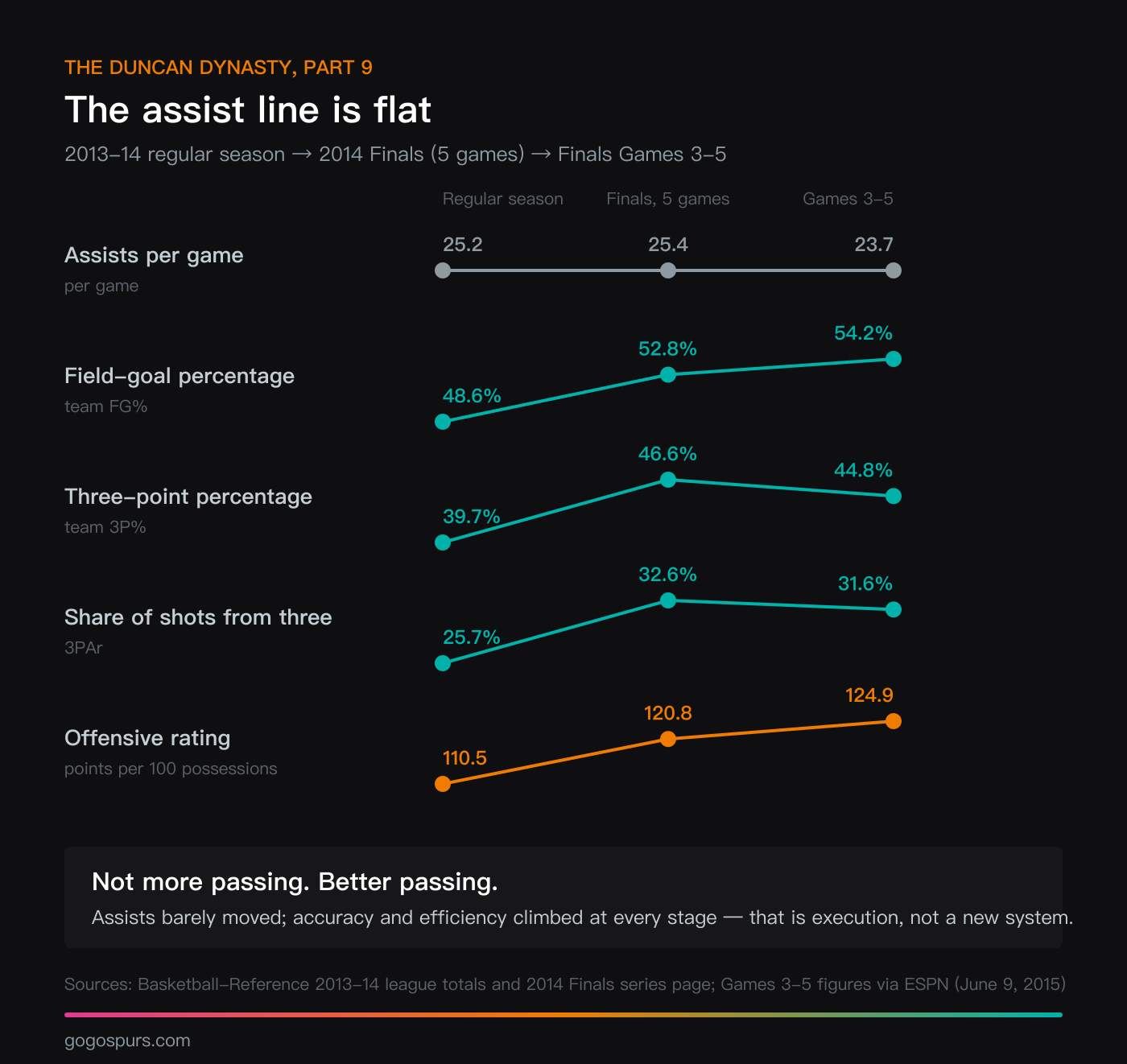
The numbers from those five games still don’t look quite real.
| Game | Date | Result | FG% |
|---|---|---|---|
| 1 | June 5 | Spurs 110-95 | .588 |
| 2 | June 8 | Heat 98-96 | .439 |
| 3 | June 10 | Spurs 111-92 | .594 |
| 4 | June 12 | Spurs 107-86 | .571 |
| 5 | June 15 | Spurs 104-87 | .474 |
For the series: .528 from the field, 55-of-118 from three for .466, and a .604 effective field-goal percentage.
The control group is themselves: the same roster posted a .537 effective field-goal percentage in the regular season. Nearly seven percentage points, inside five games.
That .528 is a Finals series record, and the .604 effective mark blew past the .555 the 2002 Lakers had held — though ESPN’s own stats desk scoped that one more carefully, as the best since the three-point line arrived.
Two personnel decisions held all of it up, and neither was a flash of inspiration.
The first was Boris Diaw. He replaced Tiago Splitter in the starting lineup from Game 3 on. But look at the first two games: Diaw was already outplaying the starter in minutes off the bench. Starting him was paperwork catching up to reality. Putting a passing big in the first five adds another relay station to a system built on half-second decisions.
The second was Kawhi Leonard. He averaged 9 points in the first two games and 23.7 in the last three; 29 points on 10-of-13 shooting in Game 3, a career high, 20 points and 14 rebounds in Game 4, 22 points and 10 rebounds in Game 5. For the series: 17.8 points on .612 shooting, and 10 of the 11 Finals MVP votes — the youngest Finals MVP since Magic Johnson, at 22, in the third year of a rookie contract paying him $1.89 million.
What he did defensively was the same idea pointed the other way. And here a popular description needs correcting: Leonard did not take away LeBron’s efficiency. Tracking data shows James shot 12-of-18 against him across the first three games — 66.7 percent, which is better, not worse. The effect was somewhere else entirely: only 17 percent of LeBron’s touches against Leonard turned into shots, half his rate against every other defender, and on 35 percent of Miami’s possessions he never touched the ball at all, against 25 percent otherwise. In Game 3, Leonard guarded him on 65 percent of Miami’s possessions; James had a series-high 73 offensive touches and attempted just 14 shots.
Don’t let the ball rest on offense; don’t let it arrive on defense. One principle, two directions.
The passing numbers from the series make the point plainly: NBA tracking data has San Antonio throwing 472 more passes than Miami across the Finals, and averaging 157 more per game in Games 3 through 5. Over those three games they scored at a rate of 124.9 per 100 possessions, the best on record at the time going back 29 seasons, with a 65.1 percent true shooting mark.
Worth stressing how narrow that window is. Across the whole 2014 postseason — 23 games — the Spurs averaged 316.3 passes and 22.2 assists per game, both below their own regular-season rate. The eruption is three games long.
For what it felt like on the other side, here is Golden State’s general manager, who had just hired Steve Kerr:
“You feel helpless when you are defending against that kind of system — just helpless. After five passes, you throw your hands up because you’ve already made your seventh rotation on defense.” — Bob Myers, ESPN
Miami had a name for the state it put them in. They called it “the mixer” — recover, recover, recover, chasing a ball that never stops.
The most persuasive testimony comes from the people who lost. After Game 5, LeBron:
“They were the much better team. That’s what team basketball and that’s how team basketball should be played. You know, it’s selfless. Guys move, cut, pass, you’ve got a shot, you take it, but it’s all for the team and it’s never about the individual.” — LeBron James, June 15, 2014, official transcript
Spoelstra said almost the same thing in different words:
“But you absolutely have to tip your hat to that team. They played exquisite basketball this series and in particularly these last three games, and they are the better team. There’s no other way to say it.” “You absolutely have to credit their offense. It was exquisite basketball, ball movement, player movement, unselfish basketball, and exploiting a lot of the things we’re typically strong at.” — Erik Spoelstra, June 15, 2014, official transcript
Neither of them mentions three-pointers. Neither mentions a scheme. Both of them talk about movement.
5. Even the name came from outside
Something turned up while I was checking this, and it fits the pattern better than I expected.
I ran the same stack of transcripts through a search for the word “beautiful.” Three hits, and none of them from Popovich — he never said it once. They are, in order: LeBron talking about his family, the phrase inside a reporter’s question, and Parker on how sport can be cruel and can be beautiful. None of the three describes an offense.
So where did the name come from? Here’s the chain:
| When | Who |
|---|---|
| Mid-May 2014 | A fan. Colin Stanton cut a Spurs tribute video titled The Beautiful Game; SB Nation’s Spurs site promoted it on May 21 — before the Finals had even started |
| June 12 | An opponent, and secondhand at that. A reporter quoted Chris Bosh calling it “beautiful basketball” in the locker room and put the phrase to Parker, who answered: “I just think we’re playing Spurs basketball.” |
| June 15 | The commissioner. Adam Silver, at the trophy ceremony: “You showed the world how beautiful this game is.” |
| January 12, 2015 | The president, who put it most precisely: “Some people have, rightfully, started calling it — the Spur’s style of basketball ‘the beautiful game’” |
Fan, opponent, commissioner, president. Not one stop on that chain is the team itself. Even Obama built the attribution into the sentence.
The two words actually in circulation inside the building were Popovich’s name for the style, “Summertime,” and the instruction, “Point five.” Neither is pretty, and neither made it into the public vocabulary.
Which means this piece has now described the same shape three times: the motive was assigned from outside (revenge), the tactical transformation was inferred from outside (there wasn’t one), and the name was coined outside (the Beautiful Game).
The thing the team was actually doing, the whole time, was one thing: not letting the ball stop.
6. What has to be conceded
If the article ended at the last section it would be a good-looking argument with no defenses. So:
One: the sample is five games, and only four of them support anything. They lost Game 2. Using four games to characterize a season is exactly the move this piece has been complaining about.
Two: the air conditioning failed in Game 1. An electrical fault took out the AC system at the AT&T Center and the building went above 90 degrees; LeBron cramped up and left the floor. But this has to be used honestly all the way through: Duncan said “it was definitely a factor… all of us feeling the heat were dehydrated” — the heat applied to both teams. And in normal buildings, San Antonio won Games 3, 4 and 5 by at least 17 points each. The AC explains one game at most.
Three: they split the regular-season series. This was not a team that spent the year dominating Miami.
Four: in that same postseason, this “unstoppable” team nearly went out in round one. They went the distance with the eighth-seeded Mavericks, including a 21-point home loss in Game 2, and in the conference finals they dropped two straight in Oklahoma City and needed overtime to close it out.
Five: Miami declined, but they did not collapse. They fell from 66-16 to 54-28 and Wade played only 54 games. But their defense slipped only from 9th to 11th in the league, and — this is the important one — LeBron played extremely well in that series. His .648 effective field-goal percentage across the five games is the best of any Finals he ever played. “The Spurs won because LeBron was worn out” has no support in the numbers.
Six: San Antonio had the harder road, not the easier one. The Spurs played 23 postseason games against opponents who had won 49, 54 and 59 games; Miami played 20 against teams that won 43, 44 and 56. This one cuts in the Spurs’ favor, and it is routinely stated backwards.
Seven: that “largest margin ever” line needs a tense. San Antonio’s average margin of 14.0 points broke the 12.6 set by the 1964-65 Celtics — but the 2018 Warriors went past it at 15.0. Written in the present tense, it’s simply wrong.
Strip all seven away and what’s left?
A team with the sixth-best offense in the regular season shot better over four games than any team in the history of the Finals, and the losing coach and the losing superstar both reached for the same word afterward: movement.
That is not a team that got better. That is a system that had been there all along, executed completely, once.
7. My take: not evolution — a team that had finally finished coming together
I’ll admit I set out to write the other version. It’s the better-looking story and it’s easier to tell: pain, reckoning, transformation, revenge. The numbers wouldn’t let me.
They really didn’t change anything.
Same shot distribution, same assist totals, same three-point rate, same aging roster — an average age of 28.9, fourth-oldest in the league, with Duncan at 38 and Ginóbili at 36. They didn’t even make a real addition in the summer of 2013 — San Antonio never announces contract terms, so these are the figures reported at the time: Belinelli for two years and $5.6 million, Ginóbili for two years and $14 million, Splitter for four years and $36 million — re-signing their own guys. The two players they drafted that June never appeared for them all season.
They took a thing they had already been doing for two years and got all of it right.
And to me that isn’t evolution. It’s a group that had finally finished coming together.
That isn’t a figure of speech — you can count it. Of the nine Spurs who played the most minutes in 2013-14 — Parker, Duncan, Leonard, Belinelli, Diaw, Green, Ginóbili, Splitter, Mills — eight of those names are already on the 2011-12 roster, two seasons earlier. The only new face is Belinelli.
So “point five” was never a new tactic. It is what the same group could finally do without thinking, after three years of doing it together. You cannot shout “Point five” at a team that was assembled last summer — they will spend that half-second finding out where everyone is. For the instruction to mean anything, the passer has to already know where the cutter will be, and that doesn’t come from a whiteboard. It comes from time.
And then the second thing, which I think matters more: the timing was exactly right.
Continuity takes time, and the men who had the time were getting old. The spring of 2014 is the one place those two lines crossed:
- Duncan was 38 and still going for 15.4 points and 10.0 rebounds a game in the Finals
- Leonard was 22, in year three of his rookie contract, grown just far enough to take over a series — a year earlier, in Game 6, he was the guy who missed a free throw with 19.4 seconds left
- And everyone in between — Parker, Green, Splitter, Diaw — was in their prime and had already been playing together for years
A year earlier, Leonard wasn’t there yet. A year later, Duncan couldn’t carry it. Same players, same system, same one-word instruction: 55-27 in 2014-15, out in the first round, Game 7 decided by a Chris Paul jumper over the outstretched arm of Tim Duncan.
The window was that wide, and they happened to be standing in it.
Which is also why “revenge” is such a poor answer — not because it’s sentimental, but because it credits the wrong thing. If 2014 happened because 2013 hurt, then hurting is all you’d need. What Popovich actually did that summer wasn’t hurting. He sat the team down and played back every possession of Games 6 and 7, and then, at a training camp in Colorado, he shouted a number — and that number worked because the men hearing it already knew each other well enough not to have to look.
Part one of this series argued that luck is part of being good. This one supplies the other half: so is timing. A team can do every single thing right — watch the film, pass, cut, cut the ball out of everyone’s hands in half a second — and still have no say in how much is left in its veterans’ knees the year it finally comes together.
That year, there was just enough left.
8. The Spurs didn’t change. The league did.
One last turn.
San Antonio’s three-point rate barely moved between 2011-12 and 2013-14, and ended up below the league average. But the league changed because of them.
MacMullan’s piece is literally titled “How the Spurs’ 2014 Finals performance changed the NBA forever.” Two general managers in it are worth reading back to back. Golden State’s Bob Myers, quoted above on feeling helpless. And Phoenix’s Ryan McDonough:
“Everybody in the NBA watched San Antonio and decided they wanted to play that way. It’s a copycat league.” — Ryan McDonough, Phoenix Suns general manager, ESPN
The following season, three-point attempts across the league hit an all-time high of 44.8 per game — up from 36.8 three seasons earlier. And the passing target Kerr set in Golden State was San Antonio’s 334 passes from the previous season, a number considered “too lofty” at the time.
So the revolution was real. The subject of the sentence is just usually wrong. The Spurs didn’t change how they played in order to win. They won, and then everyone else changed.
That’s the same structure as the “multiplier” piece: very little of what San Antonio does is new. They just started earlier than everyone else and kept at it long enough that people mistook it for an invention.
Last thing
The Spurs won Game 5 by 104-87 for their fifth championship — the fifth for the franchise, the fifth for Duncan, the fifth for Popovich, three numbers that will always match: 1999, 2003, 2005, 2007, 2014. The 15 years from first to last is the second-longest span in league history, behind only Kareem’s 17. It was Father’s Day, and the young man who won Finals MVP spent part of his press conference talking about the father he had lost six years earlier.
And in his own press conference, Duncan was asked what a team written off all season had shown everybody.
His entire answer:
“Don’t listen to the media (laughing).” — Tim Duncan, June 15, 2014, official transcript
For a year the media told everyone this was a revenge story. In the same stack of transcripts, their point guard called it a rematch, their coach said he wouldn’t wish LeBron’s night on anyone, and their backup forward said losing pushed them to be a little more perfect.
Nobody was talking about revenge. They were talking about half a second.
Next, and last in this series: 2016 — a press release, and an exit with no press conference.
Sources: Basketball-Reference — 2014 NBA Finals, Basketball-Reference — 2014 playoffs, Basketball-Reference — 2013-14 Spurs, Basketball-Reference — 2013-14 Spurs game log, Basketball-Reference — 2012-13 Spurs, Basketball-Reference — 2011-12 Spurs, Basketball-Reference — 2013-14 Heat, Basketball-Reference — 2013-14 Bobcats, Basketball-Reference — 2013-14 league totals, Basketball-Reference — 2012-13 league totals, Basketball-Reference — 2011-12 league totals, Basketball-Reference — 2013-14 league totals (archived), Basketball-Reference — Game 1 box score, Game 2, Game 3, Game 4, Game 5, Basketball-Reference — Tim Duncan, Basketball-Reference — Manu Ginóbili, Basketball-Reference — Kawhi Leonard (archived), Basketball-Reference — Spurs franchise page, ASAP Sports — Mario Chalmers, media day, ASAP Sports — LeBron James, media day, ASAP Sports — Manu Ginóbili, after Game 1, ASAP Sports — Manu Ginóbili, after Game 5, ASAP Sports — Tony Parker, after Game 5, ASAP Sports — Tony Parker, June 11, 2014, ASAP Sports — Manu Ginóbili, June 14, 2014, ASAP Sports — Tim Duncan, media day, ASAP Sports — Chris Bosh, media day, ASAP Sports — Ray Allen, media day, ASAP Sports — Tony Parker, June 12, 2014, ASAP Sports — Gregg Popovich, after Game 5, ASAP Sports — LeBron James, after Game 5, ASAP Sports — Erik Spoelstra, after Game 5, ASAP Sports — Kawhi Leonard, after Game 5, ASAP Sports — Tim Duncan, after Game 5, ESPN — Jackie MacMullan, “How the Spurs’ 2014 Finals performance changed the NBA forever” (June 9, 2015), ESPN — same piece, archived print version, ESPN — J.A. Adande on the 2014 title starting in Game 7 (Nov 19, 2014, archived), ESPN — Kevin Pelton on the most dominant Finals performance ever (archived), ESPN Stats & Info — Spurs historically dominant in the 2014 Finals (archived), ESPN Stats & Info — Kawhi Leonard’s defense on LeBron (June 12, 2014), ESPN — Baxter Holmes on how Kerr rebuilt the Warriors offense, ESPN — 5-on-5 Finals preview (June 4, 2014), ESPN — Brett Brown hired by the 76ers (August 2013, archived), ESPN — Game 1 box score, Grantland — Zach Lowe, “San Antonio’s Revenge” (June 16, 2014), Grantland — the five elements of the Spurs offense (June 5, 2013), NBA official SportVU passing tracking data, 2013-14 regular season (archived), NBA official SportVU touches tracking data, 2013-14 regular season (archived), NBA official SportVU passing tracking data, 2014 playoffs (archived), Wikipedia — NBA player tracking, Wikipedia — 2018 NBA Finals, Sports Illustrated — Game 1 air conditioning failure (June 6, 2014), Sports Illustrated — Duncan’s “we’ll do it this time” (June 1, 2014), Sports Illustrated — Finals starting lineups, Sports Illustrated — Chris Paul’s Game 7 winner in 2015, Yahoo Sports — Ginóbili re-signs, Yahoo Sports — Splitter’s new deal, ESPN — Belinelli agrees to a deal with the Spurs (July 2013, archived), Spurs.com — 2013 draft (archived), NBA.com — Tim Duncan’s NBA 75 profile, CBS News/AP — Spurs win their fifth title (June 16, 2014), ABC News — Duncan’s “it makes last year OK” (June 16, 2014), Fox News/AP — the record first half in Game 3, Guinness World Records — highest team shooting percentage in a Finals quarter, USA Today — Leonard is the third-youngest Finals MVP (June 16, 2014, archived), Pounding The Rock — the fan tribute video “The Beautiful Game” (May 21, 2014), Bleacher Report — Adam Silver at the trophy ceremony, The White House — President Obama honors the 2014 NBA champion Spurs (January 12, 2015)
The opinions here are the author’s; every factual claim links to its original reporting. If something is wrong, write to contact@gogospurs.com and I’ll correct it publicly.