5.2 Seconds: Ray Allen's Three and the Ledger the Spurs Kept
Miami, June 18, 2013. Tip-off at 9 p.m. Eastern, 19,900 in the building.
Twenty-eight and two-tenths of a second left in the fourth quarter, San Antonio up 94-89. Miami called timeout.
That is when the sideline started moving.
Out came the yellow rope, ringing the floor, running right along the feet of the people in the most expensive seats. The orange armbands that would let reporters inside that rope had already been handed out. At the scorer’s table, a league official had the Finals MVP ballots in his hands and was busy tallying the media’s votes. That official was Tim Frank, the NBA’s senior vice president of communications — and he couldn’t afford to wait for the game to end. He had just finished counting when he looked up from his seat at the scorer’s table and saw Chris Bosh grab the rebound.
The championship stage was already being wheeled into the tunnel. So was the trophy. Bill Simmons was sitting courtside that night, and he wrote later that he and Jalen Rose watched league officials wheel the Larry O’Brien Trophy into the runway to their right, no more than 15 feet away.
And then the detail that still sounds made up: the men holding the rope had to back up so Tim Duncan would have room to inbound the ball.
“Players on both teams noticed the rope — at one point the holders had to scoot back to give Duncan room to inbound the ball.” — J.A. Adande, ESPN
A championship was being staged before it happened.
What this one is actually about
This is part eight of the Duncan dynasty series. Part seven was about those 14 seconds in 2007, and it ended on a promise: someday the dice roll the other way, and it only takes 5.2 seconds.
Here we are.
I’m not going to write this as a grievance, and not because I’m big about it. The Spurs won’t let me.
I set a rule for myself in part one: if you’re going to count the good luck, you count the bad luck too. Part four, about those 0.4 seconds in 2004, was me keeping that promise — the bad bounce went in the ledger, and so did the fact that San Antonio lost all six third quarters of that series.
The trouble is that all of that was me doing the accounting. It is not hard to be honest at a keyboard twenty-two years after the fact.
What makes 2013 different is that the team did it themselves.
Gregg Popovich never once reached for the basketball gods that summer. He explicitly refused to, and then he sat the whole roster down and played the film. Manu Ginóbili, on the worst night of his career, volunteered that a few shots in 2003, 2005 and 2007 had gone San Antonio’s way too. And Tim Duncan — the man with the strongest claim to having been robbed — was asked point-blank whether Game 6 was the thing that would stay with him, and said no. What stays with him is a shot he missed.
The people crying foul were the reporters.
So this piece isn’t about the shot. It’s about the ledger.
The 8.1 seconds, and the 5.2
The sequence first.
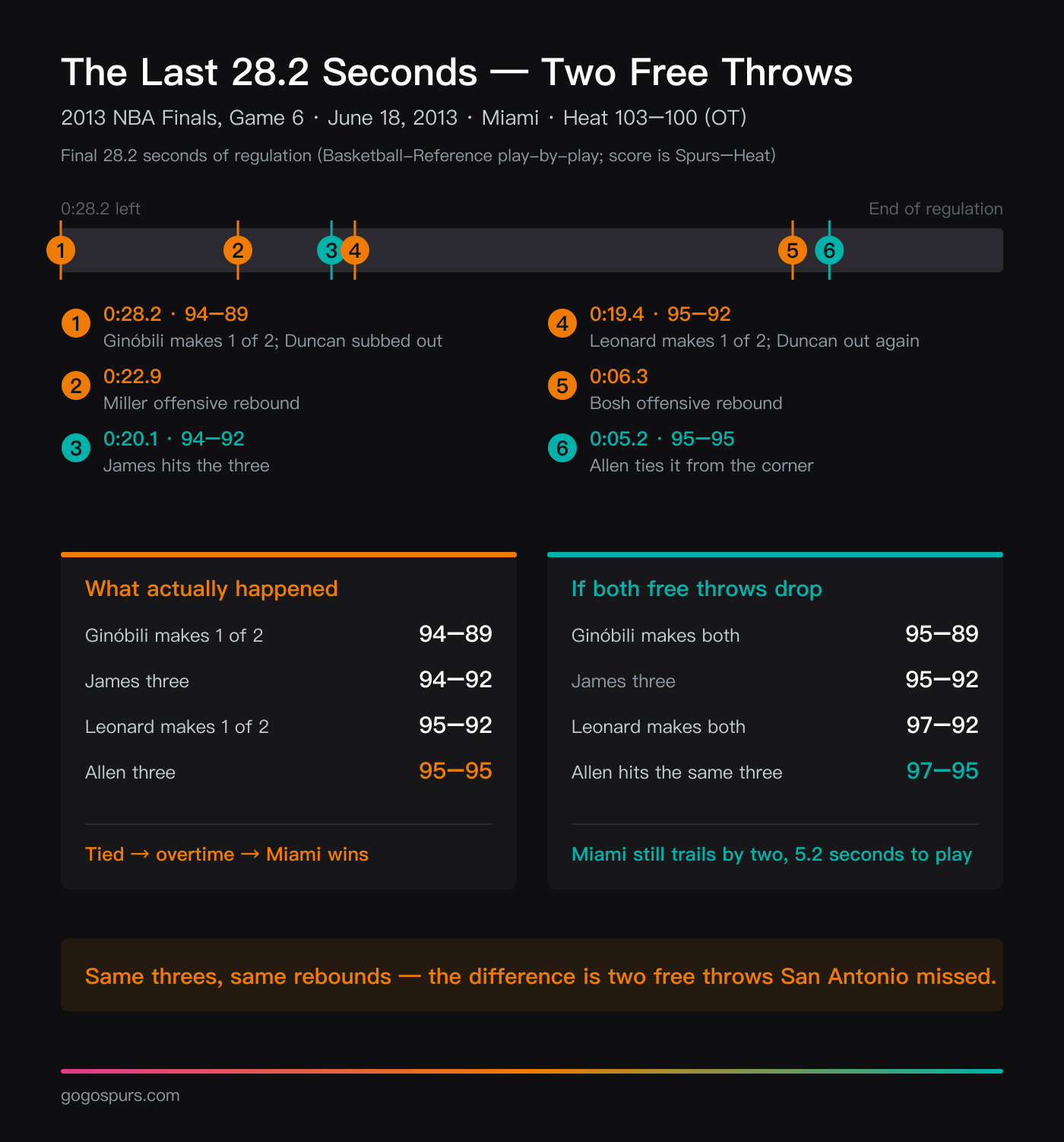
With 28.2 seconds left and San Antonio up 94-89, Erik Spoelstra pulled Chris Bosh for Mike Miller and put five shooters on the floor. Popovich answered by sending Boris Diaw in for Duncan.
LeBron James missed from 26 feet. The ball came off flat and hard and smacked the bottom right corner of the backboard square. What went through Popovich’s head, in his own words: my God, we’re up five and he just shot an air ball.
Then the ball stayed alive for 8.1 seconds.
Kawhi Leonard got to it first — Spoelstra later told Simmons that Miami had charted Leonard’s rebounding all series and he had let exactly two balls get away after touching them, and this was one of them. Dwyane Wade knocked it loose from behind: “Kawhi has those claws — his hands are claws — and you’re just doing anything you can to get a fingertip on the ball. I got just enough.” The ball skidded toward the Miami bench, into Ray Allen’s hands — and Allen bobbled it, batting it back toward the San Antonio bench, where Miller ran it down and shoveled it to James.
Eight point one seconds. Seven players touched the ball.
With 20.1 seconds to go, James buried it from 25 feet: 94-92. That was the only three he made all night, on 5 attempts.
San Antonio burned its last timeout and Duncan came back on. With 19.4 seconds left, Miller fouled Leonard. Between the free throws, Spoelstra put Bosh back in — and San Antonio, again, sent Diaw in for Duncan.
Leonard missed the first and made the second: 95-92.
Allen said afterward that the moment he saw Bosh come down with it he backpedaled straight to the line: “I was hoping I was where I needed to be. But I wasn’t quite sure. But just from years of shooting, I got to my spot.” The next day Tim Frank asked him whether he’d known his feet were behind the arc. He said: “I hoped.”
San Antonio didn’t call timeout because San Antonio didn’t have one. With 0.6 seconds left, Tony Parker’s 12-footer missed.
The Spurs scored 5 points in overtime and lost by 3.
That is the version everyone remembers. Now the bill.
Entry one: two free throws
Allen’s three tied the game rather than merely cutting into it, and there is arithmetic behind that.
With 37.2 seconds left, Allen fouled Ginóbili, who made both: 93-89.
With 19.4 seconds left, Leonard missed the first and made the second: 95-92.
Put those two misses back and the whole chain changes. Ginóbili makes both and it’s 95-89. James’s three makes it 95-92. Leonard makes both and it’s 97-92 — and then Allen hits the exact same shot and it’s still 97-95.
That shot no longer ties the game. It cuts the lead to two.
I won’t claim that hands San Antonio the title. There are still 5.2 seconds on the clock, the ball goes back to the Spurs, Miami fouls, and San Antonio has to stand at the line — which is exactly where the night had already gone wrong. But “down two and needing the other team to miss” and “tied, heading to overtime” are not the same universe.
I don’t have to make this argument, because the Spurs made it themselves before they’d left the arena. A reporter asked Duncan whether it was hard not to exhale, with the rope out and the crowd heading up the aisles:
“We didn’t exhale at all. We continued to make some plays. We missed some free throws down the stretch that could have clinched it for us.” — Tim Duncan, after Game 6
Ginóbili said the same thing:
“We were a few seconds away from winning the championship, and we let it go. A couple of rebounds that we didn’t catch, a tough three by Ray, a couple of missed free throws.”
Months later, asked how a 21-year-old was supposed to live with that free throw, Popovich added a line that nobody quotes:
“Missing that free throw should bother him, but it shouldn’t defeat him. And don’t forget, Manu missed a free throw in that game, too.” — Gregg Popovich, October 2013
In the same story, Leonard said one thing about it himself. He’d been talking about his father’s murder — “when I lost my dad, it prepared me for anything I’d ever face the rest of my life” — and then, without changing register:
“Missing a free throw didn’t hurt as much as that.”
A 21-year-old kid gives away a championship point on the biggest stage in the sport, and four months later that’s his comment. It does more for him than any column defending him ever could.
Entry two: sitting Duncan, twice
This is the part everyone argues about and almost everyone gets slightly wrong.
The facts aren’t in dispute: on the possession that produced James’s three and the possession that produced Allen’s, Duncan was on the bench. Miami got the offensive rebound both times.
Popovich laid out his reasoning the next day, at length:
“It’s not that simple. That’s not why they got the threes. We were up five when they got their first three, and so redding and switching makes sense just to take away the three. But on an offensive rebound, it’s one of the toughest things in the NBA, to pick up people. And we had one guy who didn’t pick up. LeBron shot an airball when we were up five. They got the rebound, they got it back to him and he knocked it down. And then on the last possession, we were switching at the three-point line to take away the three, and Boris Diaw has a little more speed than Tim Duncan, so it makes sense to have him out there redding at the three-point line. Unfortunately we had two guys that went to LeBron and didn’t switch with [Chris Bosh], and he went right to the hole. He’s the guy who got the rebound, so it has nothing to do with Duncan.” — Gregg Popovich, June 19, 2013
Duncan gave the organization no daylight either:
The press wasn’t buying it. Dan Wetzel closed his column that night like this:
“The game is won and the game is lost in a million small battles, but in the end the decisions by Popovich remained glaring and open to question. No Duncan when a rebound could clinch it? No Parker when a basket was needed? These are Hall of Famers.” — Dan Wetzel, Yahoo Sports
Simmons, a year on, was blunter: “we watched in disbelief as Pop removed Duncan for the ensuing defensive possession. How can you keep the power forward GOAT off the floor twice?”
And here is the detail almost every retrospective misses, the one that thins Popovich’s defense out considerably —
By the second time he sat Duncan, Miami had already put Bosh back on the floor.
“They went five-out, so we had to switch” only covers the first stop, at 28.2 seconds. By 19.4 seconds, between Leonard’s free throws, Spoelstra had brought Bosh back in and taken Miller out. There was a genuine big man out there. Popovich sent Diaw in for Duncan anyway.
Eight seconds later, the rebound that decided the series was pulled down by the big man who’d just checked back in.
Two things belong on the other side of that, though.
First, Simmons’s famous counterfactual — “had Popovich never removed Duncan for Diaw for that defensive possession, it’s difficult to imagine Duncan, the third-best playoff rebounder ever at the time, trailing only Chamberlain and Russell, not grabbing the biggest board of San Antonio’s season” — is about the first rebound, the one Miller came up with. On Bosh’s, Simmons’s own parenthetical reads: “(For what it’s worth, that was a GREAT rebound by Bosh.)”
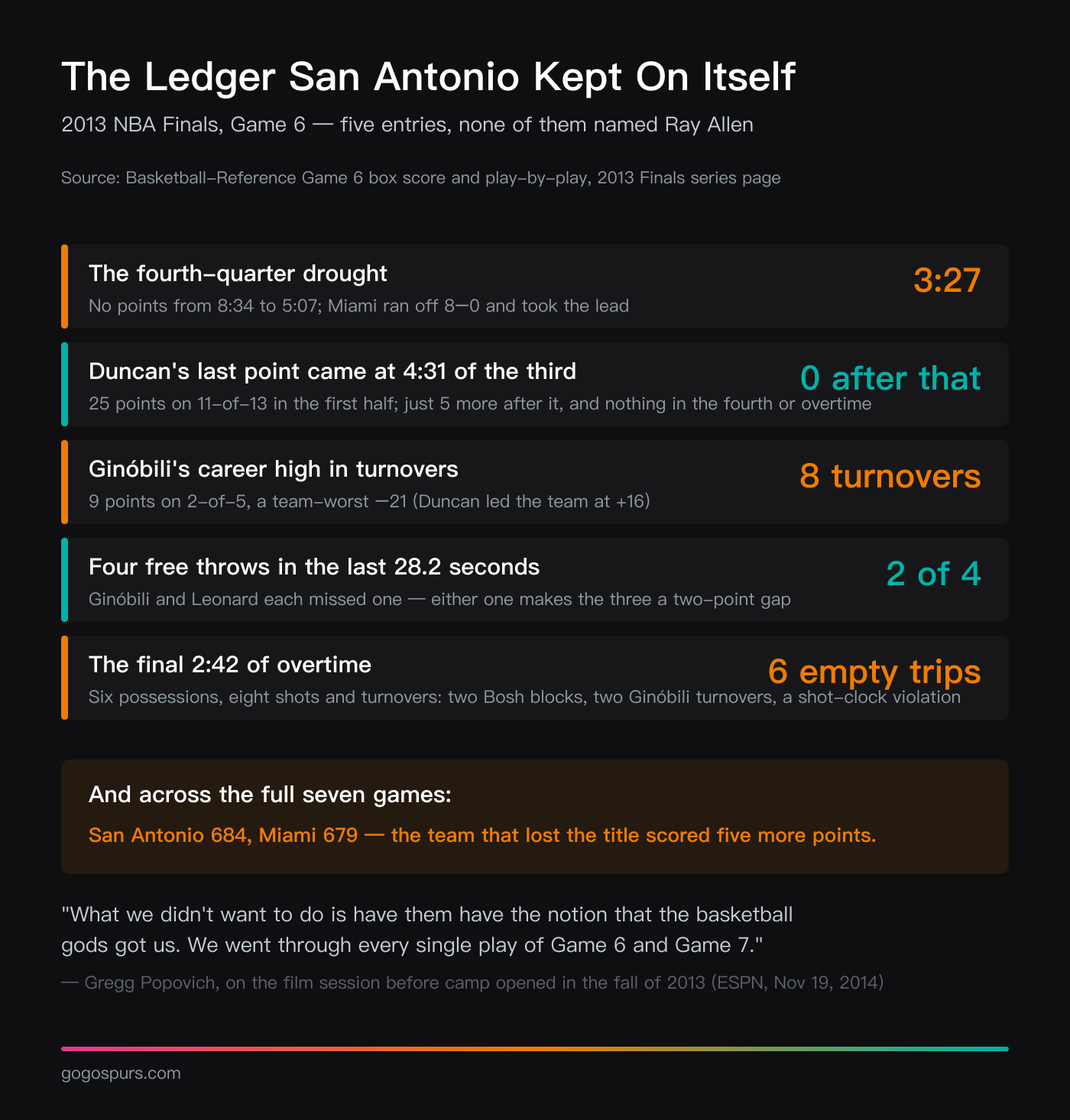
Second, a number nobody brings up: Duncan finished that game at plus-16, the best mark on the team, and Ginóbili at minus-21, the worst.
So the evidence does lean toward “Duncan should have been out there.” It just doesn’t lean far enough to be a verdict. This was a bad decision, not a crime.
Entry three: everything before that
If the ledger stops at the last 28.2 seconds, it’s still a grievance — you compress a whole game into one moment and then complain the moment was unfair.
So go back.
San Antonio went three and a half minutes without scoring in the fourth quarter. From Leonard’s basket at 8:34 to make it 82-77, to Leonard’s next one at 5:07, the Spurs went 3:27 without a point. Miami ran off 8 straight and took the lead 84-82 on an Allen layup at 6:03 — Miami’s first lead since the second quarter.
Duncan had 25 points by halftime. Nineteen minutes and five seconds, 11-of-13 from the floor, 25 points and 8 rebounds — his highest-scoring Finals game since Game 1 of the 2003 Finals. His last point came with 4:31 left in the third, and he did not score again for the remaining 21:31 of game clock — 0-for-4 in the fourth, 0-for-1 in overtime.
Ginóbili turned it over eight times. Nine points on 2-of-5 shooting, 8 turnovers, minus-21. In his own words:
San Antonio’s last six possessions of overtime produced nothing. After Parker’s free throw made it 100-97, the Spurs never scored again. Those six trips cost them eight shots and turnovers: a missed Parker three; then, on one possession, a missed Leonard jumper, a Parker offensive rebound and another miss, and a shot-clock violation after the team rebound; then a Ginóbili turnover, a Parker shot blocked by Bosh, another Ginóbili turnover, and finally Danny Green’s three blocked by Bosh at the buzzer.
And one more, for the series as a whole:
Across seven games, San Antonio scored 684 points and Miami scored 679.
The team that lost the title outscored the team that won it.
Then the Spurs did the hard thing
The locker room that night was close to silent. Popovich had booked a championship dinner at Il Gabbiano in Miami before the game. He did not cancel it. He stood at the door and greeted every player as they came in, then worked the tables one by one. Brett Brown, an assistant then, remembers the response coming down to a single word: “Family. Everybody to the restaurant. Straight there. He told us, grab your wife, your child, your mother — we’re all going to dinner.”
Tony Parker: “I’ve never seen our team so broken.”
Two nights later they lost Game 7, 95-88.
That summer Popovich seriously considered walking away. In mid-September he told the San Antonio paper the line that has followed him ever since:
“I think about Game 6 every day. Without exception. I think about every play. I can see LeBron’s first shot, and the rebound, and the second …” — Gregg Popovich, September 2013
His daughter Jill eventually had enough of it: “OK, Dad, let me get this straight: You won four championships, and you go to a fifth Finals. Other coaches lose all the time. But poor Greggy can’t lose because he’s special. Can you please get over yourself? End of story.”
And then, before camp opened that fall, with the team back together in the practice gym, Popovich rolled the tape.
His explanation:
“What we didn’t want to do is have them have the notion that the basketball gods got us. … It’s a game of mistakes. That’s why people score, because you make mistakes. So let’s figure out what we could have done, and that makes us a better team. We went through every single play of Game 6 and Game 7.” — Gregg Popovich, November 2014
“We made them sit through it. We didn’t yell and scream at ‘em or berate ‘em or anything. We were very businesslike.”
To Jackie MacMullan he put it even more plainly:
“We had to make a decision. Was it going to be, ‘Well, that was fine, the basketball gods were against us,’ or was it going to be, ‘Wait, wait, wait, wait. Let’s investigate this.’”
That’s the whole point of this piece.
“The basketball gods” is a ready-made, respectable explanation that nobody would have argued with. San Antonio had the world’s permission to use it — the rope really did come out early, and Bosh’s rebound really is a ball you lose 99 times out of 100. They declined.
And it wasn’t only Popovich. After Game 7, Ginóbili said this:
“There are moments where there’s celebration and you forget that you got lucky at a point. Like, you know, a few shots in ‘03, ‘05, ‘07 that maybe went. This time it went against us. And again, we were five seconds away from raising that trophy. And it just didn’t happen.” — Manu Ginóbili, after Game 7
When I wrote that rule down in part one, I had no idea this quote existed. A core player on that team, two days after the worst night of his career, filled in the good-luck column himself.
It took me two years of writing to get here. He got there that night.
The other half of honest
If this is an accounting, then the entries that cut against San Antonio go in too.
The officials didn’t steal this game, in either direction. In September 2013, NBA referees went through Allen’s shot frame by frame at their annual meeting and the answer on the travel was a flat no. Joey Crawford had already confirmed his feet on replay live. Popovich’s own words: “he was clearly behind the line — that’s why I was so livid.” What made him livid was the stoppage, which cost him the chance to push the ball while Miami was still celebrating.
San Antonio, in fact, got away with one. While the officials were reviewing Allen’s feet, substitutions were not allowed — and Popovich used that window to put Duncan back on the floor. The league later confirmed it shouldn’t have been permitted; caught in the moment it’s a technical foul, and Miami starts overtime a point better off — and the Heat knew, and could have filed a protest had they lost. They won, so they never needed it. ESPN put it more bluntly: it was the only thing the officials regretted about the whole sequence.
And here’s one nobody adds up: the man who hit the shot is also the man who kept sending San Antonio to the line. Allen committed 5 fouls that night, and his third and fourth both came inside the last 37.2 seconds, both on Ginóbili. He handed the Spurs four free throws. They made three.
Allen didn’t think it was all craft, either. After the game:
“It’s going to be a shot that I’m going to remember for a long time. There’s a lot of shots that I’ve made in my career, but this will go high up in the ranks because of the situation. … When you win championships, it involves a little luck. That right there was luck shining on our side.” — Ray Allen, after Game 6
James, at the same podium, took the other side of the same coin: “I think luck plays a part, of course. But at the end of the day, we’re out there busting our tails to put ourself in a position to have a little luck.”
Which is, more or less, the thesis of part one of this series — delivered from the other locker room.
My take
I’ve watched this team for thirty-odd years, and Game 6 in 2013 is the only game I’ve ever turned off before the highlights.
But what I want to talk about isn’t how much that night hurt. It’s what the organization did with it.
Most people, beaten like that, go looking for the explanation that lets them sleep. That explanation is usually sitting right there, and usually true: the rope came out early, Allen’s shot was divine intervention, Bosh’s rebound goes the other way 99 times out of 100. You can carry that story for the rest of your life and no one will challenge you on it.
The Spurs didn’t. At the end of the summer they got the whole roster into a gym and played the game back from the beginning. “Let’s investigate this” is a sentence from an internal audit, not from a team that just had its heart torn out.
The part I admire most, though, is Ginóbili’s. He’d coughed the ball up eight times and finished with the worst plus-minus on the floor. He had every reason in the world to point at the shot. What he said instead was that sometimes you’re busy celebrating and you forget you got lucky once, too.
Being able to argue your opponent’s luck at the exact moment you’d be forgiven for arguing your own — that isn’t grace. It’s a rare kind of loyalty to the facts. This franchise won for as long as it did on more than Popovich’s sets and Duncan’s footwork. It won because it was willing to hold the same ruler up to itself.
Did it work? The next year they went 62-20, the best record in the league. They beat the same Miami team 4-1 in the Finals, by at least 15 points in every win, outscoring them by 14.0 a game.
Boris Diaw’s version is the simplest: “It fueled us, the fact that we lost, to be a little more perfect. If we don’t make those mistakes earlier in the game, then it’s easier down the stretch.”
That isn’t revenge. That’s what settling the account looks like.
The one that haunts him isn’t Game 6
Back to Duncan.
Miami won Game 7 and the title, 95-88. He played 43:10 and finished with 24 points, 12 rebounds and 8-of-8 from the line, at 37 years old.
With 48.9 seconds left and San Antonio down 88-90, Duncan missed a hook from 4 feet. At 47.9 he grabbed his own offensive rebound. At 46.9 the tip-in missed too. Either one ties the game.
With 27.9 left, James passed up an open Mario Chalmers and rose up himself. It went down: 88-92. That was the game.
Afterward, someone asked him whether Game 6 was the thing that would stick with him from the series.
“For me, no. Game 7, missing a lay-up to tie the game. Making a bad decision down the stretch. Just unable to stop Dwyane and LeBron. Probably for me Game 7 is always going to haunt me.” — Tim Duncan, after Game 7
Another reporter asked about the slap — frustration, or defensive intensity?
“That’s out of me just missing a bunny. Got by Shane and had a lay-up to tie the game. That’s just frustration.”
The world remembers Ray Allen’s three. The man with the best case for saying he got robbed picked the shot he missed.
There’s one more turn in it. In Game 5 of that series, Danny Green hit his 23rd three, breaking the Finals record of 22 that Ray Allen had set in 2008 — the record at the time, passed three years later by Stephen Curry’s 32. Two nights after Green broke it, Ray Allen took the championship out of his hands with one shot. Green made 2 field goals total across Games 6 and 7, for 8 points.
And there is a question nobody could answer until three years later. Those Finals MVP ballots Tim Frank had already counted — if Allen misses, whose name is on them?
Adande went and found out in 2016. The answer: Tim Duncan.
ESPN later ranked that game the best Finals game since 1980. NBA.com calls the shot “the biggest shot in NBA history”. James said that night it was the best game he’d ever been part of. All of that is true.
It’s just not what I want to keep from it. What I want to keep is a team that got beaten like that and turned down the excuse everyone would have accepted, and then watched the tape all the way through.
The following June, they took their fifth title off the same opponent. Duncan, that night: “We remember what happened last year and how it felt in that locker room and we used it and built on it and got back here and it’s amazing. It makes last year OK.”
Next: 2014, and what settling the account actually bought.
Sources: Basketball-Reference — 2013 NBA Finals, Basketball-Reference — Game 6 box score, Basketball-Reference — Game 6 play-by-play, Basketball-Reference — Game 7 box score, Basketball-Reference — Game 7 play-by-play, Basketball-Reference — 2012-13 Spurs, Basketball-Reference — 2012-13 Heat, Basketball-Reference — 2013-14 Spurs, Basketball-Reference — 2014 NBA Finals, Basketball-Reference — 2016 NBA Finals, Basketball-Reference — Danny Green playoff game log, ASAP Sports — Duncan after Game 6, ASAP Sports — Ginóbili after Game 6, ASAP Sports — Ray Allen after Game 6, ASAP Sports — LeBron James after Game 6, ASAP Sports — Ginóbili after Game 7, ASAP Sports — Duncan after Game 7, ESPN — J.A. Adande on the rope (June 19, 2013, archived), ESPN — Adande reveals the MVP that was never awarded (June 6, 2016, archived), ESPN — AP recap of Game 6 (archived), ESPN — Adande on the 2014 title starting in Game 7 (Nov 19, 2014, archived), ESPN — Jackie MacMullan on the 2014 Finals (archived), ESPN — Baxter Holmes on the Spurs’ team dinners (April 18, 2019, archived), ESPN TrueHoop — referees say Allen didn’t travel (Sept 26, 2013, archived), ESPN — Kevin Pelton ranks the best Finals games (June 14, 2016, archived), Yahoo Sports — Adrian Wojnarowski after Game 6, Yahoo Sports — Dan Wetzel on Popovich’s substitutions, Yahoo Sports — Duncan’s two misses in Game 7 (June 21, 2013, archived), Sports Illustrated — Lee Jenkins, “Anatomy of a Miracle” (Dec 18, 2013, archived), Sports Illustrated — Popovich thinks about Game 6 every day (Sept 24, 2013), Grantland — Bill Simmons, “The Legacy of Game 6” (June 4, 2014), NBC Sports — Popovich explains sitting Duncan (June 19, 2013), NBC Sports — Danny Green breaks the Finals three-point record (June 16, 2013), NBC Sports — James’s dagger in Game 7, SLAM (via the Palm Beach Post) — Popovich’s illegal substitution (archived), Sports on Earth — Shaun Powell on Kawhi Leonard (Oct 22, 2013, archived), NBA.com — Ray Allen’s three, ABC News — the Spurs’ 2014 championship (June 16, 2014)
The opinions here are the author’s; every factual claim links to its original reporting. If something is wrong, write to contact@gogospurs.com and I’ll correct it publicly.