Game 7, 2005: What One More Year of Manu Was Worth (Duncan Era 5)
June 19, 2005. The Palace of Auburn Hills, Game 5 of the Finals, 5.8 seconds left in overtime.
San Antonio trailed 95-93. Out of a timeout the ball came in, Robert Horry caught it 25 feet from the rim, and shot.
96-95.
And in the assist column of the play-by-play, one name: M. Ginóbili.
Two things this chapter has to test
This is Part 5 of the Duncan-era series. Part 4 was about the 0.4 seconds in 2004, and it ended on this line:
That’s the skill — not being immune to bad luck, but still being there the following year.
2005 is where that gets paid off. So this installment can’t just retell a championship. It has to answer a question: what was actually different about that team a year later?
And the most interesting answer I’ve heard isn’t “they got luckier.” It’s this: Manu Ginóbili had one more year.
That claim is testable, so I tested it. It holds up better than I expected — but there’s a limit that has to be said out loud, and we’ll get to it.
What happened to Manu that year
If you assume “one more year” means he played more, you have it backwards.
His minutes barely moved: 29.4 per game to 29.6.
Everything else did.
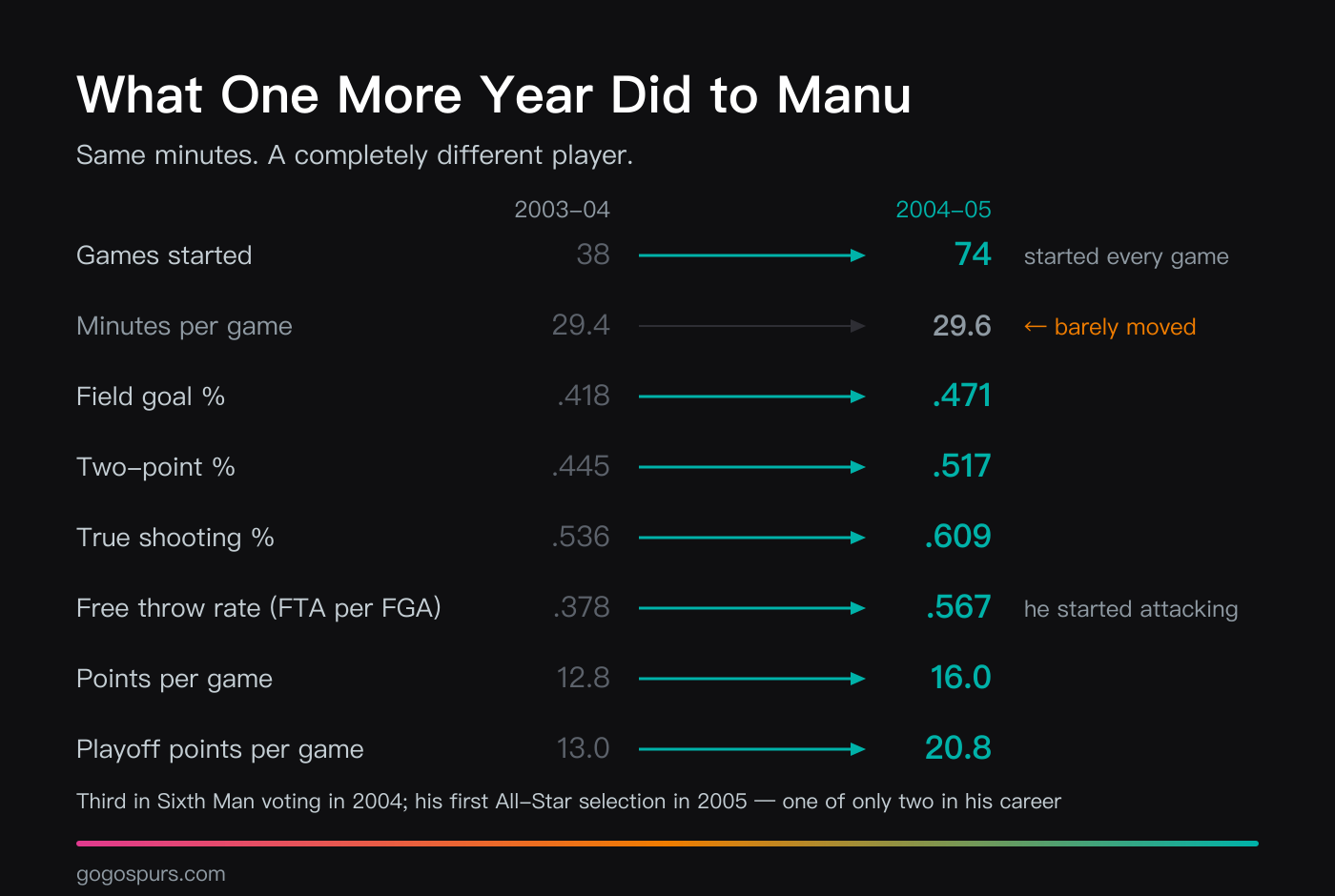
Same minutes, and he went from 12.8 points to 16.0. His two-point percentage climbed from .445 to .517. True shooting from .536 to .609.
But the number that actually explains what he changed is this one: free throw rate from .378 to .567.
Free throw rate measures how many trips to the line you earn per shot you take. A jump that size means one thing — he stopped standing outside waiting for the ball, and started going at the rim.
The playoffs are starker. In 2004 he started none of his 10 postseason games and averaged 13.0. In 2005 he started 15 of 23 and averaged 20.8 points on .652 true shooting, hitting 43.8% from three.
And that season he made his first All-Star team — one of only two in a sixteen-year career.
Now the honest part
If I stopped there I’d be selling you something. Two things discount those numbers, and I’m going to give you both.
First, shooting was up across the whole league that year. 2004-05 was the first season of the NBA’s serious crackdown on hand-checking; defenders could no longer use their hands to steer ball-handlers, and league-wide true shooting rose about 13 points. Part of Manu’s improvement is a rising tide.
Only part, though: he gained 73 points, roughly 5.6 times the league-wide gain. The rule change helped everyone. He took far more from it than everyone.
Second, and this one is more awkward: the team as a whole barely improved.
The 2003-04 Spurs: net rating +8.1, SRS 7.51 — first in the NBA — with a point-differential expected record of 62-20, also first. The 2004-05 Spurs: net rating +8.7, SRS 7.84 — still first in the NBA.
In other words: San Antonio was already the best team in basketball in 2004, and lost in the second round. You cannot explain 2005 by saying they got better, because in the aggregate they were already at the ceiling.
So what did Manu’s extra year actually change?
My read: it didn’t change the total, it changed the distribution. The 2004 Spurs were a team where nobody but Duncan could generate a shot for himself — Part 4 covered the four straight empty possessions in the last 2:14 of that Game 5, everyone waiting on Duncan’s fadeaway. The 2005 team was not that. The 2005 team’s second option could go get a bucket on his own, more efficiently than Duncan could.
The Finals box scores show it plainly.
How ugly the series was, and how hard the opponent
Detroit were the defending champions — they had dismantled the Lakers 4-1 in 2004, the same Lakers who had just eliminated San Antonio.
They went 54-28, third in the league in defensive rating, and played at the slowest pace of any of the 30 teams. Their whole method was to drag the game into the mud and see who suffocated first.
Seven games looked like this:
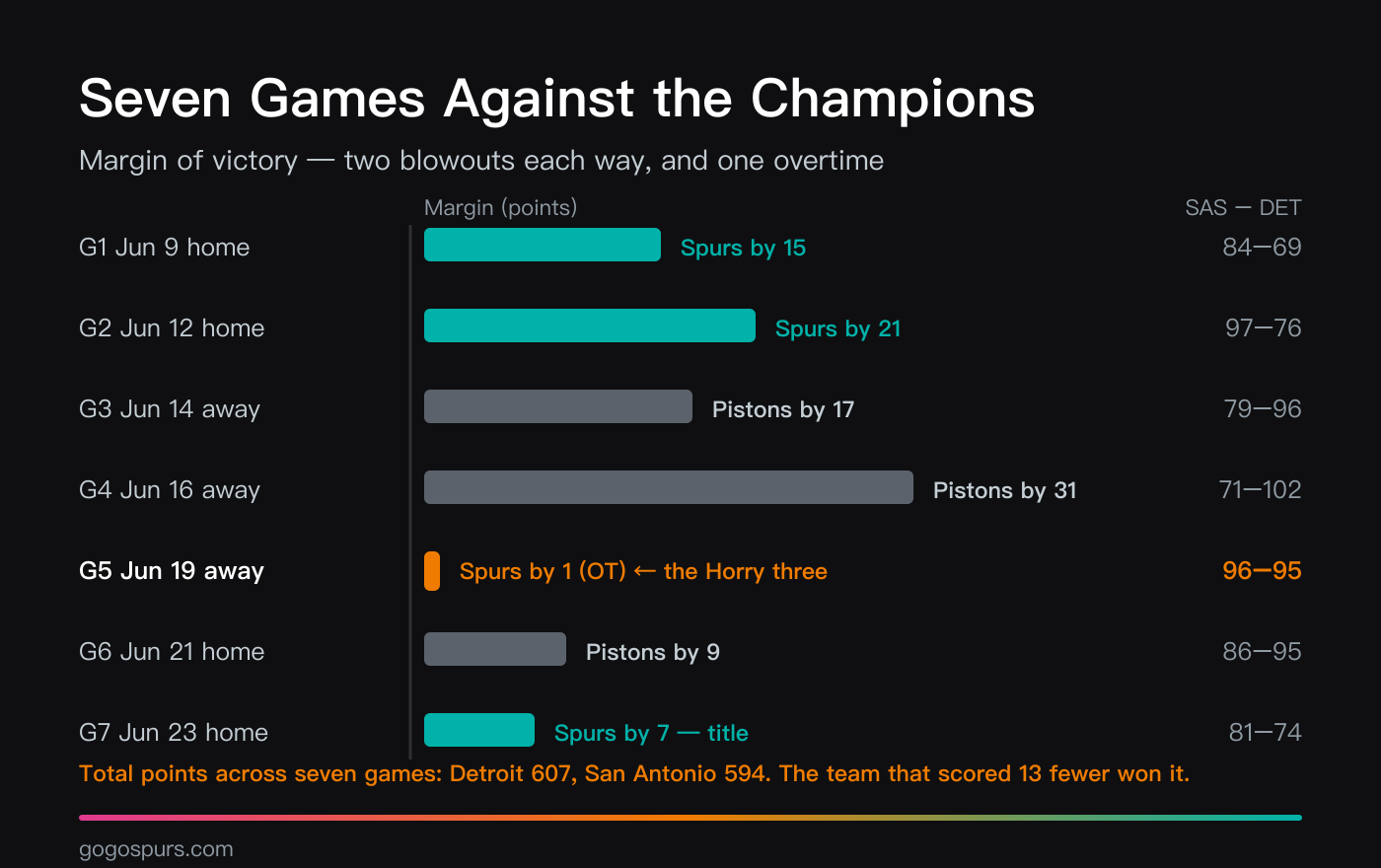
The Spurs won the first two at home by 15 and 21. In Auburn Hills they lost by 17 and then by 31, scoring 71 points in Game 4.
And then there’s this, which I think is the truest footnote the series has:
Across seven games Detroit scored 607 points and San Antonio scored 594. The team that scored thirteen fewer won the championship.
Detroit’s offensive rating for the series (104.5) was higher than San Antonio’s (102.3). This title was not won by force. It was won by a blade’s width.
Manu’s role in it: game-high 26 points in Game 1, game-high 27 in Game 2. For the series he shot .494 from the field, .854 from the line, and averaged 18.7 — the most efficient Spur on the floor.
Duncan, who won Finals MVP: .419 from the field and .667 from the line.
I’m not arguing the trophy went to the wrong man — Duncan averaged 14.1 rebounds and anchored the defense. I’m arguing something narrower: the 2004 version of this team loses that series.
Game 5: Duncan’s nightmare, and a hand
Game 5 is all of it compressed.
Duncan had a miserable night: 11-of-24 from the field, 4-of-11 from the line. The fourth quarter was worse. In the final seconds of regulation Ginóbili had a layup blocked by Ben Wallace, Duncan grabbed the offensive rebound with 0.3 on the clock — and missed the tip. 89-89, overtime.
Afterward a reporter asked him whether that fourth quarter felt like a nightmare. Duncan gave him one sentence:
“Absolute nightmare, yes, and it all compounded itself in the fourth quarter.”
With 9.5 seconds left in overtime and San Antonio down two, Popovich called time.
He drew a pick-and-roll for Duncan and Ginóbili. Horry’s job was to cut through. Then Rasheed Wallace committed to the double team, and —
Horry’s own account:
“Actually, I wasn’t even thinking about it, I said, ‘Okay, I’m getting ready to cut through,’ and Manu, it was supposed to be a pick-and-roll with Tim and I saw Rasheed bite and I said, ‘Oh, let me stay out here.’”
Popovich’s version is shorter:
“We drew up what you saw. We put all the people where you saw we put them, and Rasheed double-teamed, things changed and Manu made a great pass.”
Twenty-five feet. 96-95.
Horry played 32 minutes off the bench that night: 7-of-12 from the field, 5-of-6 from three, 21 points. Asked afterward whether that was the best half in a Finals game since Jordan’s six threes in 1992, he said:
“my second half, probably ranks probably 25th, somewhere down there like that”
Asked how it felt to bail out a teammate drowning at the free throw line, he said:
“Forget about Tim. He needs to make his free throws. Where is he? (Laughter) It’s a team effort.”
Duncan was less coy about it:
“He pulled me out of an incredible hole that I put myself in.”
One more frame, also Manu
While Duncan was missing those free throws in the fourth, something happened on the bench. Popovich was asked afterward about the mood of the team:
“I think initially they were a little bit down, understandably so. But I thought Manu, especially, he went over there and grabbed Timmy and talked to him, touched him and, you know, got to him on the bench.”
Manu was 27. A year earlier he had been a reserve.
I won’t make too much of it — a word on the bench doesn’t win a title. But set beside the assist, the two form the same picture: the 2005 Manu was no longer the one who needed carrying.
The honest part: “revenge” is a word reporters brought
Now for the feeling that this was finally reclaimed.
Start with something that’s easy to misremember, and that collapses the whole frame if you get it wrong: the team that eliminated San Antonio in 2004 was not Detroit. It was the Lakers.
Those 0.4 seconds happened in the Western Conference semifinals, and Derek Fisher took the shot. Detroit beat the Lakers 4-1 in the Finals afterward — Detroit and San Antonio never met in the 2004 playoffs at all. The two teams played twice in the regular season that year, each winning at home; Duncan sprained his ankle in the March 20 loss in Auburn Hills.
So strictly speaking, there was no revenge available against Detroit. The debt, if there was one, was owed by the Lakers — who went 34-48 in 2004-05 and missed the playoffs.
So where did “revenge” come from?
I went through every press conference transcript from the 2005 Finals — Duncan, Popovich, Ginóbili, Parker, Horry, Bowen, Nesterović, Barry, and Detroit’s Larry Brown and Billups too. Here is the pattern:
Every time 2004 came up, it was a reporter raising it. Not once did a Spur bring it up himself.
The day before Game 7 a reporter went straight at Duncan with the Fisher shot — “You’ve had your heart broken in games before like Fisher last year…” — and Duncan deflected it with a question of his own: “How does a team do what?”
The only time a player actually engaged was Tony Parker after Game 4, with the series tied 2-2. The question: “Yesterday you kind of brought up that it was on your mind what happened in the Laker series last year, the 2-0 deficit, is it more on your guys’ minds that they have tied it 2-2?”
Parker’s answer was three words:
“A little bit.”
Look at what that exchange is actually about. What the reporter asked, and what Parker conceded, was not payback — it was “we’re about to blow a 2-0 lead again.”
So 2004 was on their minds, and for more than one day. But it showed up as the opposite of reclamation.
That isn’t revenge. That’s fear of a repeat.
So what does “getting it back” mean
I spent a while on how to write this, because the feeling and the evidence part ways here.
Where I landed: “we finally got it back” is what it felt like to watch — not what it sounded like to play. And neither of those is wrong.
To them, 2004 wasn’t a debt to collect. It was a failure not to repeat. So what they did wasn’t revenge; it was replacing the thing they’d lost with: someone who could solve the last five minutes by himself.
Part 4 made the point that the 2004 Spurs led the league in point differential and still had nobody but Duncan when they needed a basket. By 2005 they had Manu — and Robert Horry, the 33-year-old consolation prize from the summer they failed to land Jason Kidd.
And from where we were sitting, fixing it looked exactly like getting it back. The pain was the same shape, and this time the ending inverted.
That feeling doesn’t need a player to sign off on it.
Game 7
June 23, the SBC Center. The day before, Duncan admitted something:
“I’ve never been in a Game 7 before.”
Eight seasons, two championships, and he never had.
Neither team scored 25 in any quarter. Final: 81-74. Duncan led everyone with 25.
What he said afterward is a lot plainer than “we got it back”:
“I felt like the game was going bad for me, yeah, I did feel that. But it was about just kind of pushing through it… my teammates just continue to throw the ball in and to feed me. They were more confident in me than I was, and that is so appreciated.”
Popovich was briefer:
“I don’t know how the hell we did it, but I am thrilled.”
And on Ginóbili, Duncan said something that reads like a prophecy now:
“Manu is unbelievable… I don’t think we’ve even scratched the surface with him.”
Manu was 27. He played thirteen more seasons and won two more titles.
So did Part 4’s line get paid off?
It did — but not by luck returning.
The 2005 road was harder, not easier. San Antonio’s playoff opponents that spring were a combined 217-111, including a Phoenix team with the best record in the NBA at 62-20; in 2004 the opponents were 106-58. And Duncan was less healthy, not more: three fewer games, three fewer minutes a night, and that ankle he turned in Auburn Hills in March.
They didn’t wait for the luck to swing back. They walked a road just as hard — harder — with one more man.
Part 1 pinned “skill” to two things: conversion and survival. 2005 gave survival a concrete shape. It isn’t gritting your teeth and enduring. It’s turning the reason you lost last time into the reason you win the next one.
The team that got knocked out by 0.4 seconds spent the following June on the other side of a 5.8-second possession. Horry took the shot. The pass came from the 27-year-old who had been on the bench a year earlier.
Next up, 2006: the foul, and why a 63-win team still didn’t get there.
Sources: Basketball-Reference — 2005 NBA Finals, Basketball-Reference — Game 5 play-by-play, Basketball-Reference — Game 5 box score, Basketball-Reference — Manu Ginóbili, Basketball-Reference — 2003-04 Spurs, Basketball-Reference — 2004-05 Spurs, Basketball-Reference — 2004-05 Pistons, ASAP Sports — Robert Horry, Game 5, ASAP Sports — Tim Duncan, Game 5, ASAP Sports — Gregg Popovich, Game 5, ASAP Sports — Tim Duncan, day before Game 7, ASAP Sports — Tim Duncan, Game 7, ASAP Sports — Tony Parker, Game 4
The opinions here are my own; the facts link to original reporting. If you spot an error, email contact@gogospurs.com and I’ll correct it publicly.