2006: The Foul, and the 63 Wins That Didn't Get There (Duncan Era 6)
May 22, 2006. San Antonio. Game 7 of the Western Conference semifinals, 32.9 seconds left in the fourth quarter.
Manu Ginóbili catches a kickout from Tim Duncan, 24 feet from the rim, and lets it fly.
104-101.
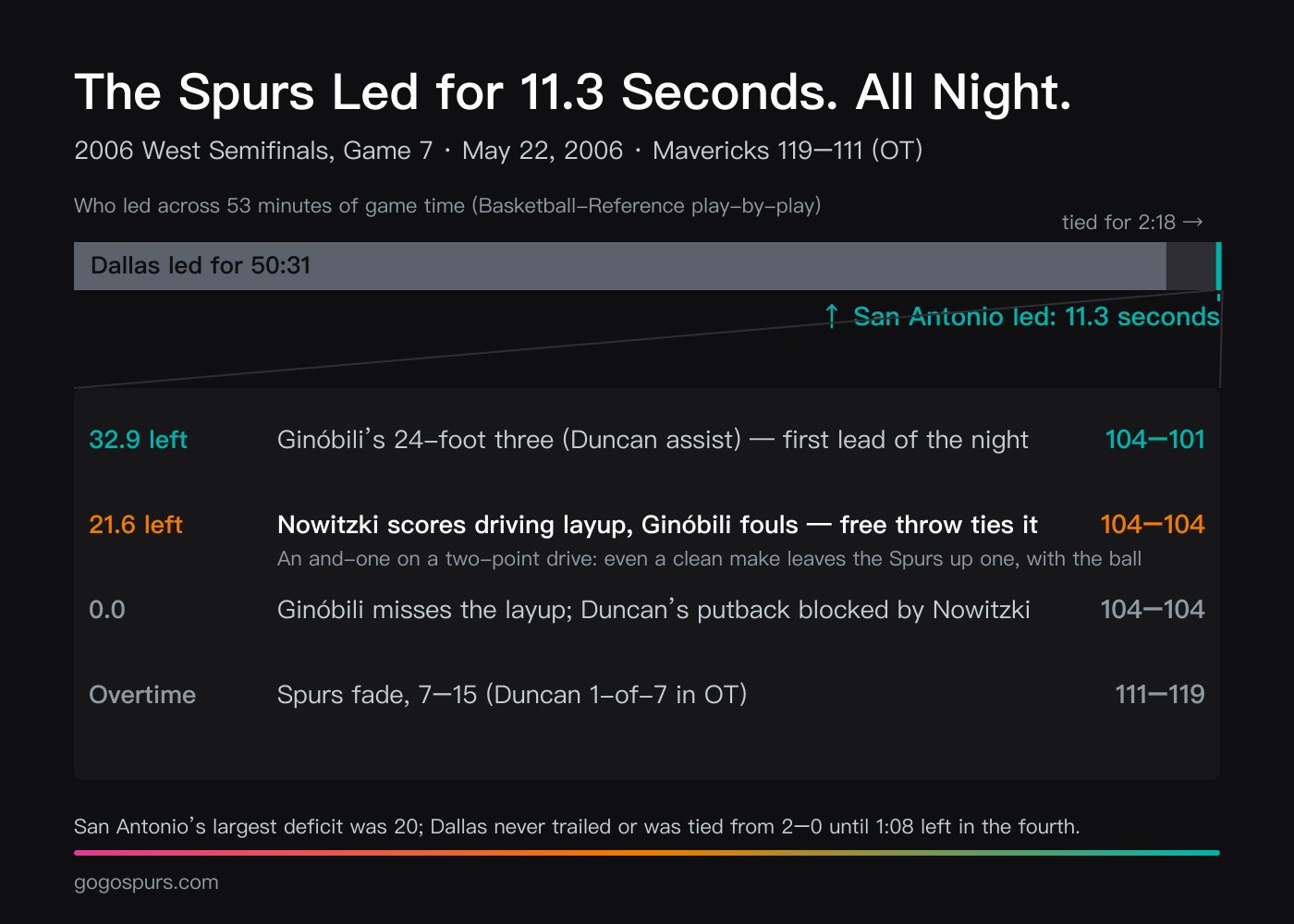
It was the Spurs’ first lead of the entire night. On the play-by-play, that lead runs from 32.9 seconds left to 21.6 seconds left — 11.3 seconds in all.
The hand that ended it belonged to the same man.
The question this chapter owes an answer
Part 5 closed with a promise: 2006 — the foul, and why a 63-win team still didn’t get there.
And the thread Part 1 planted pays off here for the third time: after 1999, 2003 and 2005, San Antonio once again failed to repeat. In 2000 it was Duncan’s knee. In 2004 it was the 0.4 seconds. In 2006, it was the foul.
But this chapter isn’t only about those 11.3 seconds. Because “why didn’t 63 wins get there” has a two-part answer — one part is an injustice, and one part isn’t. The league itself eventually owned up to the first. The Spurs never once blamed the second on luck.
The injustice first: that year’s second round was the real conference finals
Start by putting the 2005-06 Spurs where they belong.
63-19 — a franchise record at the time, breaking the 62-20 from David Robinson’s MVP season in 1994-95. Two honest caveats first: it was not the league’s best record that year (Detroit went 64-18), and it was later passed by the 67-win team of 2015-16 — so no, this was not “the best regular season of the Duncan era.” But by SRS, the schedule-adjusted margin of victory, San Antonio’s 6.69 led the entire NBA (Detroit sat at 6.24), and the defense — 99.6 points allowed per 100 possessions — led the league too. By the numbers, this was the strongest team on the planet that year.
And it was built in Duncan’s most miserable season. Plantar fasciitis gnawed at him all year — ESPN’s Pat Forde described him at the time as “the guy who pushed himself through 80 regular-season games with plantar fasciitis” — and his 18.6 points per game were a career low to that point, while his .484 from the floor remains the worst full season of his career. A defining streak ended too: first-team All-NBA in each of his first eight seasons, the first player ever to do it — then, in 2006, second team. The team’s leading scorer was 23-year-old Tony Parker at 18.9 a game. Ginóbili played just 65 games.
A team in that much pain still won 63 games. Then the seedings came out: San Antonio No. 1. Phoenix, at 54 wins, No. 2. Denver, at 44 wins, No. 3. And Dallas — 60-22 — No. 4.
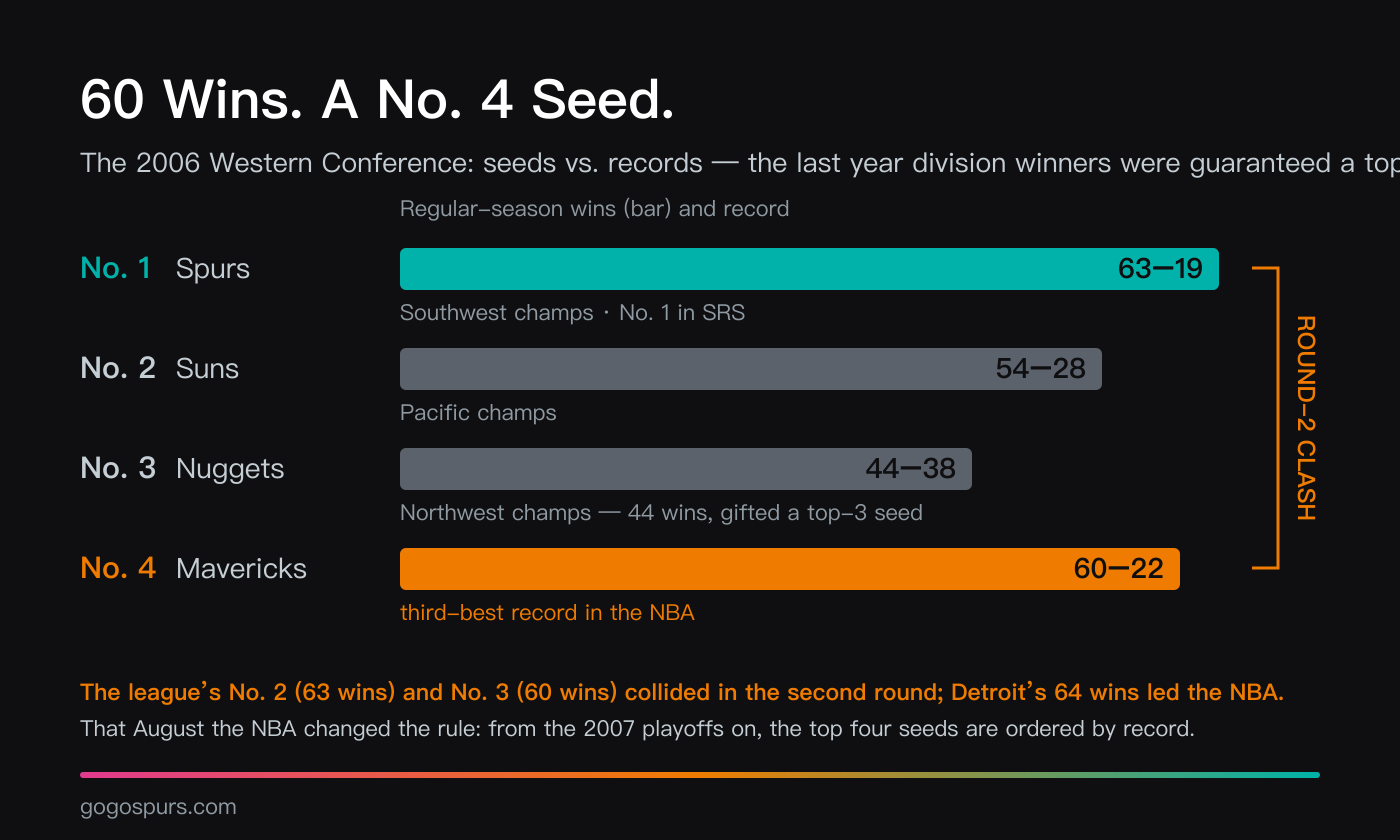
Not a typo. The rule at the time guaranteed division winners a top-three seed. Denver won the Northwest, so 44 wins got escorted into the top three; Dallas finished behind San Antonio in the Southwest, so the third-best record in the NBA settled for the No. 4 seed. Which meant the league’s second-best and third-best teams met in the second round. The same rule produced a bonus absurdity: the 44-win, third-seeded Nuggets opened against the 47-win, sixth-seeded Clippers — without home-court advantage.
When the round was over, the NBA changed the rule that August: starting with the 2007 playoffs, the top four seeds would be ordered by record, with the stated purpose of keeping a conference’s two best teams out of each other’s way until the conference finals.
So yes, this layer is an injustice: the prize for 63 wins was a second-round date with a 60-win team that went on to reach the NBA Finals. The team that eliminated San Antonio was no Cinderella — it was the West’s other finalist. The format was broken, and the league fixed it for the following year. The Spurs’ 2006 didn’t get a following year.
The series: down 1-3, and Manu drags the season back
People remember the foul. They forget how the Spurs even got to a Game 7.
San Antonio won Game 1 by two, then dropped three straight — blown out by 22 at home in Game 2, a one-point loss in Game 3, an overtime loss in Game 4. Down 1-3, the defending champions were one loss from summer.
What pulled the season off the ledge was Ginóbili’s kind of basketball.
Game 5, 3.4 seconds left, a loose ball in Jason Terry’s hands — and Manu piles in on top of it. The play-by-play entry reads: “Jump ball: M. Ginóbili vs. J. Terry.” It was in that scrum that Terry threw a punch into Michael Finley’s groin and drew a one-game suspension. Worth remembering: Finley had been amnestied by Dallas the previous summer before signing with San Antonio — this series was never just basketball to him. Spurs 98-97. Held.
Game 6 in Dallas, Terry suspended, and the Mavericks still would not go away — so Ginóbili put up a game-high 30 points with 10 rebounds, 12-of-13 from the line, and the Spurs won 91-86 on the road to force Game 7.
Keep those two games in mind. The hand that dove into the pile in Game 5 and the hand that reached in in Game 7 are the same hand.
Game 7: 11.3 seconds
The Game 7 in most people’s memory has the Spurs comfortably ahead until one foul ruins everything. The real one ran the other way around.
Dallas scored the game’s first basket and was not caught again until 1:08 remained in regulation — in between, the lead touched 20 in the second quarter (58-38). Duncan, on those feet, produced what was then a playoff career-high 41 points, with 15 rebounds, 6 assists and 3 blocks, and hauled the Spurs back anyway: with 1:08 to go he stood at the line — missed the first, made the second. 101-101.
Then, 32.9 seconds left: Manu’s three. 104-101. The only lead of the night.
Then, 21.6 seconds left.
The play-by-play needs three lines: Nowitzki drives, one-foot layup, good; shooting foul, Ginóbili; free throw, good. 104-104.
Why it was a decision, not bad luck
Part 1 put it on the record: the 2006 foul was Ginóbili’s own decision — a mistake, not fate. This chapter shows the arithmetic.
The Spurs led by three. Dirk’s drive was worth two. Lay the branches out: if he misses, the game is essentially over. If he scores clean, San Antonio still leads by one, with the ball. The only branch that lets Dallas tie in a single trip is the one where a two becomes a three-point play. That is exactly what the reach purchased.
And this isn’t hindsight. San Antonio’s WOAI wrote it plainly at the time: Dirk drove, and Ginóbili reacted — doing “the one thing Gregg Popovich had stressed not to do.” Years later Robert Horry said the huddle instruction was literally “DO NOT FOUL,” and that without the foul, “we three-peat.” (A necessary caveat: that interview survives as an aggregator’s re-post with no original show cited, and Horry misremembers Game 7 as being played in Dallas — nineteen-year-old memories wobble. But “the huddle said don’t foul” matches what was reported in 2006.)
Even the beneficiary said as much. Dirk, after the game:
“We had a similar situation in game six. We didn’t have a lot of time left, I forced a three and the game was over. This time, I had a clear shot to the basket and a lot of time left. I don’t know how the ball went in. Manu hit my hand. It was a lucky bounce.”
Even Dirk calls it a lucky bounce. But watch what the luck attaches to: the layup. The bounce was luck. The trip to the line was a gift.
The honest part: one foul can’t carry a whole loss
Hanging the entire defeat on one foul is unfair to Manu — and unfair to the facts.
San Antonio took more free throws (39) than Dallas (31) that night, so there’s no referee conspiracy to hide behind. Nowitzki finished with 37 points, 15 rebounds, 15-of-16 at the line and zero turnovers; Terry came back from the suspension and dropped 27. And after the tie, the Spurs still owned the final possession of regulation: Ginóbili got to the rim and missed; Duncan grabbed the offensive board and went back up — and Nowitzki blocked it. The man who tied the game and the man who erased the game-winner were the same man. In overtime the Spurs shot 2-of-10 as a team, Duncan 1-of-7, faded 15-7, and lost 119-111.
Zoom out and the series reads the same way: six of the seven games were decided by five points or fewer, or went to overtime — the lone exception was that 22-point Game 2. Two elite teams traded knife wounds for two weeks, and the last cut simply wasn’t San Antonio’s. The foul was the single highest-leverage event of the round. It still was not the loss’s only father.
Where I stand: don’t curse what you don’t understand
Both layers on the table — here’s my judgment.
The foul was a decision error. I’ve held that line since Part 1, and I’m not letting “lucky bounce” hand it back to fate. Up three, reaching in on a two-point drive is wrong on the math, and no amount of affection changes the math.
But if all you can see is the mistake, you never really watched Ginóbili.
The dive into the pile in Game 5 and the reach in Game 7 are the same instinct. One saved the season; the other spent it. You don’t get to keep only half. Calling him a hero for the first and a villain for the second amounts to demanding that a man with a fraction of a second to decide first check which gamble history will forgive. Pounding the Rock, the Spurs fan site, later put it in a line I’ve never forgotten: jumping in to help on Dirk “was brazen. It was wild. It was probably inadvisable… It wasn’t a mistake.” Meaning: that wasn’t a lapse. That was the man being the man.
So here’s my phrasing: it was a virtue spent in the wrong place. A virtue in the wrong place still goes in the ledger as an error — but before you curse it, you have to admit you were on your feet applauding the very same thing in Games 5 and 6. Don’t curse what you don’t understand.
As for the 63 wins — I think this team was genuinely wronged by the format. The league’s No. 2 and No. 3 settling things in round two was a bug in the bracket, and the league patched it within three months. But the injustice explains why the collision came so early, not why they lost. The loss happened across seven games of real basketball, and Dallas earned it — they beat Phoenix next and went to the Finals.
How the locker room caught him
This chapter doesn’t end at the foul. Because the Spurs didn’t end there.
Years later, Zach Lowe’s ESPN feature reconstructed that summer: Ginóbili shut himself away and moped through all of it. Sean Marks, then a Spurs reserve, told Lowe:
“I don’t say this lightly, but we all told each other: We have to stick with Manu. We had to talk him off the ledge. We had everyone calling, texting, trying to hang out with him.”
Duncan worried enough to ask Malik Rose — a former Spur and one of Manu’s closest friends — to call and check on him. R.C. Buford’s version:
“I don’t think I’ve ever seen a person so hard on himself. He is maybe the greatest competitor that we have ever witnessed here.”
And Popovich? The day after the loss, per WOAI’s reporting, he went out of his way to absolve his guard — called him “the stud of the world,” and said the Spurs would have two fewer championships without him.
Notice what nobody in that building said: “bad luck.” They treated it as one man’s mistake — and then they caught the man, whole. That’s what Part 1 called survival: not being unknockable, but how you pick up your own after the knockdown. Why this franchise could keep doing that is a bill I’ve itemized elsewhere.
A year later, in June 2007, the Spurs swept Cleveland 4-0 for their fourth title. The man who reached in was still there — still playing exactly the same way.
Next up, 2007: what the man they caught did with his next chance.
Sources: Basketball-Reference — 2005-06 Spurs, Basketball-Reference — 2005-06 league standings, Basketball-Reference — Spurs season-by-season, Basketball-Reference — Tim Duncan, Basketball-Reference — Manu Ginóbili, Basketball-Reference — 2006 West semifinals, Basketball-Reference — Game 7 box score, Basketball-Reference — Game 7 play-by-play, Basketball-Reference — Game 5 play-by-play, Basketball-Reference — Spurs 2005-06 transactions, Basketball-Reference — 2006 playoffs, Basketball-Reference — 2007 playoffs, ESPN — Pat Forde column (May 16, 2006), Taipei Times (AFP) — Game 7 report (May 24, 2006), The Spokesman-Review — on the Terry suspension (May 21, 2006), Wikipedia — 2006 NBA playoffs, Blazer’s Edge — history of NBA playoff seeding, FIBA/WOAI — Ginobili: The Haunting (Aug 17, 2006), theScore — on Zach Lowe’s ESPN feature (2016), Pounding the Rock — Manu Ginóbili and “The Foul” (2019), Yahoo/Basketball Network — Robert Horry interview re-post (2025)
The opinions here are my own; the facts link to original reporting. If you spot an error, email contact@gogospurs.com and I’ll correct it publicly.