0.4 Seconds: The Spurs Won Duncan on Luck, Then Paid (Duncan Era 4)
May 13, 2004. The SBC Center, 18,797 people.
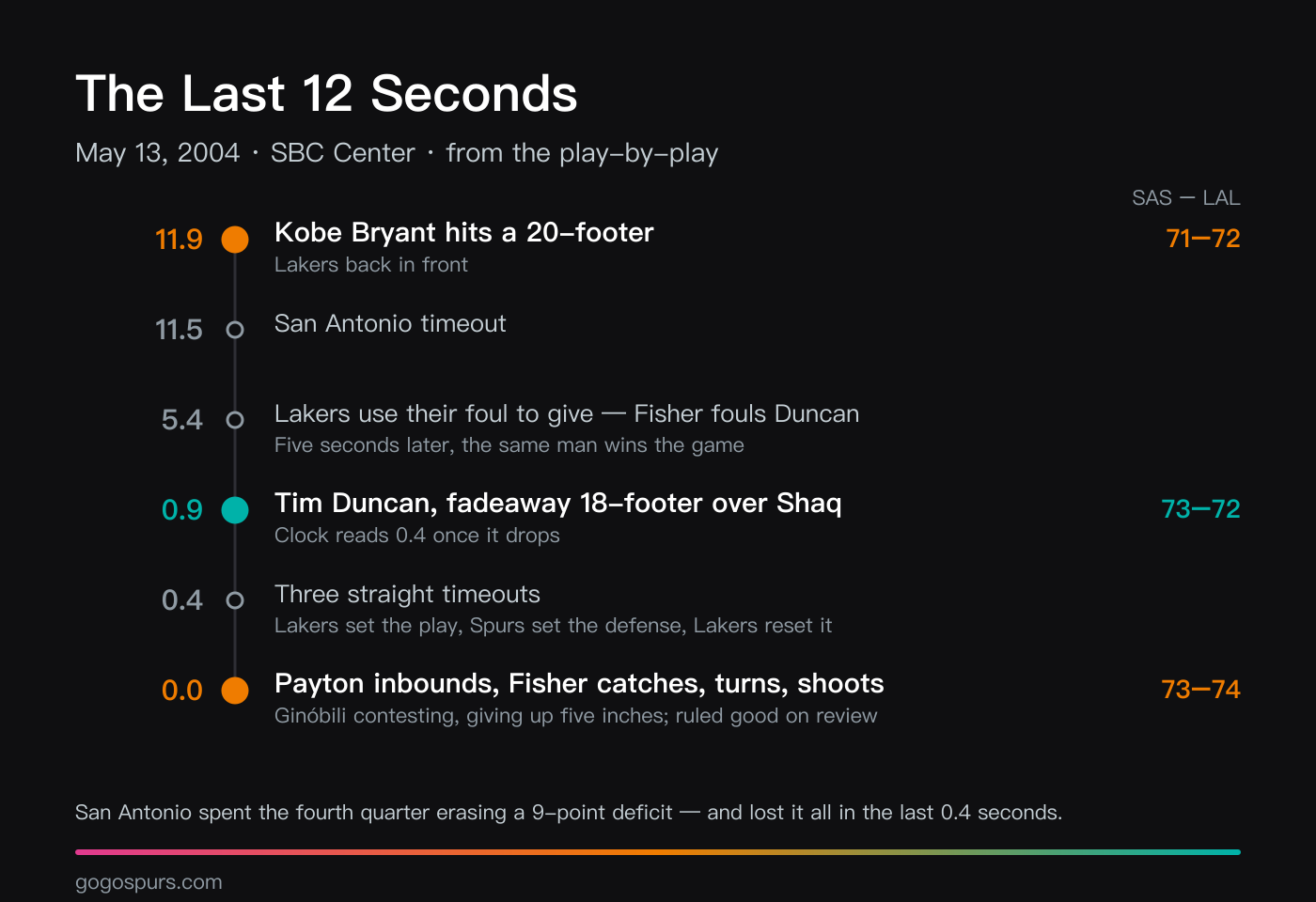
With 11.9 seconds left, Kobe Bryant hit a 20-footer to put the Lakers up 72-71. San Antonio burned two timeouts, and then Tim Duncan rose from around the foul line, falling away, over 7-foot-1 Shaquille O’Neal, and dropped it in — 73-72.
He landed on the floor. Here is how the Associated Press wrote it that night: Duncan, on his hands and knees, looked to the San Antonio bench with wide eyes and asked, “Did it go in?”
It did. When the Lakers got the ball back, the clock read 0.4 seconds.
Then Gary Payton inbounded, and Derek Fisher caught, turned, and shot.
74-73.
What this installment is arguing
This is Part 4 of the Duncan-era series. Part 1 was about the ping-pong balls of 1997 and the claim that luck is part of skill; Part 3 was about the 2003 title that ran on Tim Duncan, and it ended by pointing at this night.
In Part 1 I wrote a line that was meant to bind me: good luck and bad luck both count, or it isn’t honest.
That piece conceded three things — the dynasty’s foundation was two lottery jackpots, the 1999 title came in a 50-game season, and this franchise never once defended a championship. Admitting the good luck was how I earned the right to talk about the bad.
The bill has arrived.
The position here is simple: those 0.4 seconds and that ping-pong ball are the same thing. Both are a matter of just barely. In 1997 the margin fell San Antonio’s way. In 2004 it fell the other way. Same franchise, on the scale twice — catching it once, flattened by it once.
I don’t get to claim only one of them.
Before anyone yells robbery: that game was ugly
An essay that covers only the last 0.4 seconds is lying by omission. The first 47 minutes and 59.6 seconds say far more about what that Spurs team actually was.
It was a rock fight. The two offensive ratings were 84.7 and 83.5, roughly 18 points per 100 possessions below the league norm that season. San Antonio shot 29-of-76, 38.2%, and 6-of-23 from three. Los Angeles wasn’t much better at 43.1%.
And the Spurs trailed nearly all night. They were down 53-62 after three, and the Lakers led by as many as 16. San Antonio’s biggest lead all evening was three points, which happened twice: early in the first quarter, and during the comeback.
That comeback is the real content of the game. The AP put it precisely: the Lakers were up 16 with 3:59 left in the third and scored only 13 points the rest of the way, while a 26-7 Spurs run put San Antonio ahead by three with 2:14 to play.
Put another way: San Antonio spent the entire fourth quarter clawing back nine points, and lost all of it in the final 0.4 seconds.
But over that same stretch the Spurs did plenty to lose it themselves. They committed 18 turnovers in a 73-point game, seven of them by Duncan. They shot 9-of-17 from the line — eight missed free throws in a one-point loss, three of them Duncan’s. After taking that three-point lead with 2:14 left, they missed four straight shots and did not score again until Duncan’s buzzer jumper.
Duncan finished with 21 points and 21 rebounds with four blocks, on 7-of-15. Tony Parker went 7-of-23. Robert Horry played 26 minutes and went 0-for-4 with zero points. And the Lakers’ second-leading scorer wasn’t O’Neal, who had 11 — it was reserve Devean George, who hit four threes for 16.
This was not a masterpiece that got stolen. It was a game both teams played badly and San Antonio nearly swiped.
Those 0.4 seconds: the rule, three timeouts, and five inches
After Duncan’s basket there were three consecutive timeouts — Lakers, then San Antonio to set the defense, then the Lakers again to change it back.
The Spurs brought in Robert Horry and Rasho Nesterovic for a pure defensive lineup. Phil Jackson’s play was a lob to Shaq or a curl for Kobe. Here’s the AP’s description of what actually happened: two defenders followed Bryant as he ran toward Payton, and Fisher — who had been screening for Bryant — popped free from the foul line by taking two steps toward the inbounder.
Jackson said it flatly afterward: “Fish was the beneficiary of everybody focusing on Kobe.”
The man guarding Fisher was Manu Ginóbili: 6-foot-6 against Fisher’s 6-foot-1, five inches of reach. He contested. He didn’t touch it.
Now the part most people don’t know: the shot was legal, and it was legal by exactly one tenth of a second.
The 2004 NBA rule book read as follows, quoted verbatim in the Los Angeles Times the next morning:
“No less than :00.3 must expire on the game clock when a player secures possession of an inbounds pass and then attempts a field goal.”
The floor is 0.3 seconds. Below that, only a tip-in or a dunk counts. The clock said 0.4.
Fisher’s shot cleared the legal minimum by one tenth of a second.
All three officials — Ron Garretson, Dan Crawford, Joe Forte — wear remote clock-starting devices on their belts. They went to the television replay on the spot and ruled that Fisher had released the ball in time.
When the call came down, a Spurs assistant slammed his clipboard onto the scorer’s table, and a building that had gone silent erupted in boos — loudest when the replay went up and everyone saw how close it was.
San Antonio did not accept it. The Los Angeles Times captured the scene in the bowels of the SBC Center: the Lakers had already danced off to their locker room while general manager R.C. Buford could be heard yelling from the video room, working through the angles. Within an hour the Spurs filed a written protest with the league office arguing the clock had started late. “We think after looking at it in a bunch of different angles that the clock did not start in a timely manner,” team spokesman Tom James said. “We think there’s a pretty good case.”
The league denied it before Game 6.
Even the man who made it wasn’t sure
Fisher didn’t celebrate. He turned and sprinted off the floor, into the tunnel.
He explained why later:
“I just wanted to get out of there and not give them an opportunity to think that we didn’t believe it went in.”
The AP adds the detail that finishes the picture: he stopped in the tunnel and watched a television with the paramedics, waiting to see what the officials would decide.
At the other end of the building, Kobe Bryant — close enough to overhear the referees’ conversation — smiled and pumped his fist before they signaled anything. He caught up with Fisher in the locker room and the two embraced for nearly thirty seconds.
The Spurs’ side of it is a different photograph. From the Los Angeles Times:
“Spur guard Tony Parker and forward Malik Rose had their arms around each other on the sideline. They were still smiling at Tim Duncan’s shot.”
The smile hadn’t come off their faces yet when the game ended.
Reserve guard Devin Brown sat at his locker afterward, staring down at a towel:
“Four-tenths of a second, four-tenths of a second. I still can’t get that out of my mind. How do you catch a ball and make a shot in four-tenths of a second?”
Ginóbili — the man on the shot — said:
“This game was cruel. We were very focused on Kobe on the last play. It was really hard for me when Fisher’s shot went in because I was the guy guarding him.”
Parker: “I don’t even want to look at the tape of that last play. I really thought we had the game. We came back and Timmy made that awesome shot. I thought we won the game. I didn’t think Fisher had time to catch the ball, turn around and shoot it.”
Popovich, that night, needed one sentence:
“That’s the cruelest loss I’ve ever been involved with.”
The honest part: that shot did not eliminate the Spurs
This section has to be here, and it has to carry weight.
Because if I wrote this chapter as “an impossible shot robbed San Antonio of a title,” I’d be doing the exact thing I attacked in Part 1 — counting wins as skill and losses as luck.
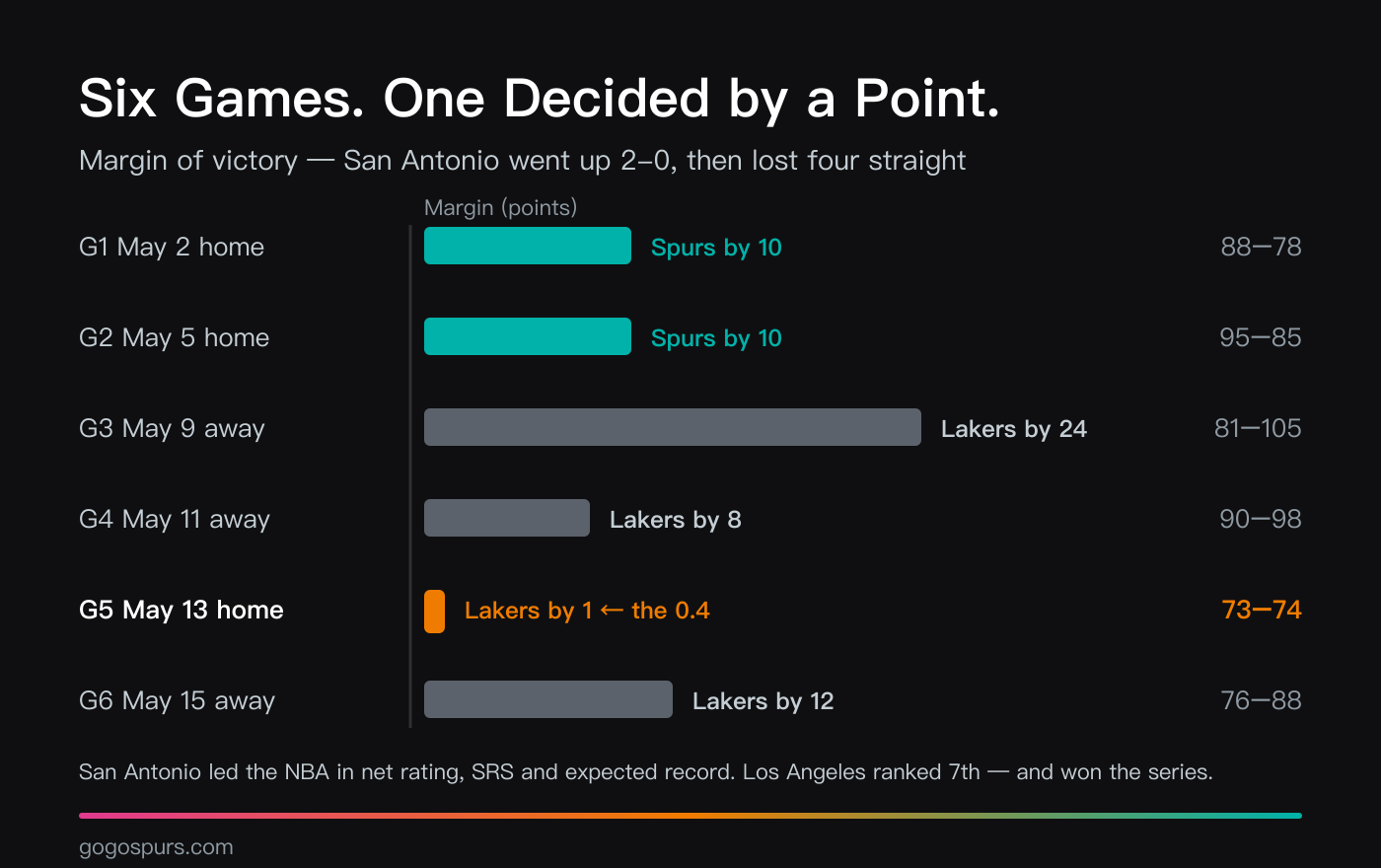
The fact is that Fisher’s shot made the series 3-2, not 4-2. Game 6 was still to be played, two days later.
In fairness, the other half of that: the AP noted at the time just how much a Game 5 matters when a series is level — teams winning Game 5 from 2-2 had gone on to take 96 of the previous 115 series, better than eight in ten. In probability terms, Game 5 nearly is the series.
But “nearly” isn’t “is.” And in Game 6, the Spurs were dismantled.
May 15, at Staples Center, the game was tied 39-39 at halftime. San Antonio then shot 3-of-23 (13.0%) in the third quarter for 13 points. They finished 26-of-86 (30.2%) from the field, 3-of-24 from three, with an offensive rating of 89.2. Parker went 4-of-18 with six turnovers and a minus-20. Starters Bruce Bowen, Hedo Türkoğlu and Rasho Nesterovic combined to shoot 2-of-17 for four points. Final: 88-76.
That isn’t luck. That’s a beating.
And the third-quarter problem wasn’t confined to one night. Adding up the quarter-by-quarter scores across all six games turns up something I had never noticed: San Antonio lost the third quarter in every single game of the series, by a combined 106-156. Across the other three quarters, the Spurs outscored the Lakers 397-372.
Losing all six third quarters isn’t variance. That’s an unsolved tactical problem.
There’s a more uncomfortable number too: the Lakers won the regular-season series 3-1 that year. Counting the playoffs, Los Angeles beat San Antonio seven times in ten meetings.
The roster was thin on offense to begin with. After Duncan (22.3 a game), Parker (14.7) and Ginóbili (12.8), nobody else averaged double figures. With David Robinson retired, the starting center was Nesterovic, who shot 1-of-6 from the line across the series; starting forward Türkoğlu shot 13-of-50 (26.0%). On the other side, O’Neal went 54-of-85 for the series — 63.5% — averaging 22.5 points, 14.5 rebounds and 4.3 blocks, while Bryant averaged 26.3 and dropped 42 with zero turnovers in Game 4.
Four of the Lakers’ five starters are Hall of Famers — O’Neal, Bryant, Karl Malone, Gary Payton — plus a Hall of Fame coach in Phil Jackson. Of San Antonio’s eventual three, Parker was 21 and Ginóbili was 26 and started zero games in the series.
Finally, the Lakers didn’t sneak through on one shot. They went on to beat a 58-win Minnesota team led by that season’s MVP, Kevin Garnett, 4-2. Bryant led the entire 2004 postseason in points; O’Neal led it in win shares.
So who was actually better? Both numbers matter
All of that is the case for the prosecution. But there’s a set of numbers on the other side, and they’re stubborn.
In 2003-04 the Spurs went 57-25 with a defensive rating of 94.1 (first in the NBA), an SRS of 7.51 (first), and a net rating of +8.1 (first). Their expected record from point differential was 62-20 — also first.
The Lakers? 56-26, but an SRS of 4.35, a net rating of +4.2, and an expected record of 52-30 — seventh in the league in all three.
By season-long point differential, San Antonio was the best team in basketball and Los Angeles was the seventh. The seventh won.
How should those two contradictory bodies of evidence be reconciled?
My read: both are true, and that’s the whole point. San Antonio was the better team across a season; Los Angeles had the higher ceiling. Bryant played 65 games that year, O’Neal 67, Malone just 42 — that regular-season record badly understated what the Lakers looked like healthy. A seven-game series isn’t a bet on season-long averages. It’s a bet on who is better over two weeks.
So the honest conclusion is this: the Spurs were the best team that year, they were not the best team in that series, and they had a hand in losing it.
Only against that backdrop do the 0.4 seconds count for anything. It wasn’t a robbery. It was a team already standing at the edge, shoved by one last gust.
Back to the ping-pong ball
Now the thing this chapter is really about.
May 18, 1997, the draft lottery. San Antonio, 20-62, third-worst in the league, with a 21.6% shot at the top pick — nearly an 80% chance of missing. Boston, who had tanked hardest and held a combined 36% across two picks, fell to third and sixth. Vancouver, the worst team in the league, was barred by its expansion terms from picking first at all. And the team that had collapsed only because David Robinson lost a season to injury — the one franchise in the room that hadn’t been trying to lose — jumped from third to first and took Tim Duncan.
May 13, 2004, 0.4 seconds. The legal minimum was 0.3. A reserve guard who averaged 7.1 points that season on 35.2% shooting and started zero games in the series caught, turned and shot inside a window one tenth of a second wider than the rule allows. It went in.
What those two events share isn’t a probability. It’s just barely.
The ping-pong ball just barely came up San Antonio. The clock just barely read 0.4 and not 0.3. Everybody just barely committed to Kobe. Ginóbili’s hand, five inches longer, just barely missed.
If “luck is part of skill” applies only to 1997, it’s a compliment I paid myself. To hold up, it has to apply to 2004 as well — and applied there, it means: the Spurs did nothing that night that deserved a loss, and they lost. Exactly as, in 1997, they had done nothing that deserved the number one pick, and they got it.
Same coin. You don’t get to look at one face.
”This was not lucky” — Fisher’s rebuttal, and he’s right
Still, an essay that stops at “it was a lucky shot” is missing a piece.
O’Neal’s line that night became famous enough to end up on a T-shirt:
“One lucky shot deserves another.”
The “other” he meant was Duncan’s fadeaway over him. Which is to say: even the Lakers thought Duncan’s was the fluke.
Fisher disagreed, forcefully. Three weeks later he told the Los Angeles Times’ Bill Plaschke that he’d gone back through the tape:
“I literally rewind it 30 or 40 times. And now I know. This wasn’t some shot you throw up from halfcourt behind your back. This wasn’t some fluke. This was not lucky.”
In the same piece: “Man. People were really calling it luck.” He talked about walking through an airport and hearing people say, “There he is, there’s Point-Four.” Nobody called him Fish anymore.
And his own technical account proves his case: “I was halfway into my shot even as I was catching the ball.”
I think Fisher is right — and that doesn’t weaken this article’s argument, it is the argument.
Because “luck is part of skill” never meant luck equals skill. It means luck and skill don’t come apart. For a ball to go in inside 0.4 seconds, you need a man who has spent a career catching and shooting in one motion standing in that spot — that’s skill. You also need the tenth of a second, the opening, the contest that just misses — that’s luck. They are not separable.
The same is true of that 1997 pick. The ping-pong ball was luck. Turning down Boston’s third-and-sixth without blinking, then flying to St. Croix to spend a few days getting to know a 21-year-old — that was skill. Also not separable.
So the honest way to say what happened on that night in 2004 is: the Lakers won that shot and the Spurs lost it, and both things are true at once.
Where the skill is: look at the next twelve months
Part 1 pinned “skill” to two testable things: conversion and survival.
Survival means what you become after you’ve been knocked down that way. And here history handed us an unusually clean control group, because those two teams went in exactly opposite directions.
The Lakers won the shot and were gone within a year.
They reached the Finals and lost 4-1 to Detroit. On June 18 the franchise announced Phil Jackson would not return; that same day, O’Neal requested a trade and Bryant opted out of his contract. On July 14, O’Neal was shipped to Miami. On August 6, Payton and Rick Fox went to Boston. Malone never played again.
In 2004-05, that four-Hall-of-Famer roster went 34-48 with the worst defense in the league, used two head coaches, and missed the playoffs.
The Spurs lost the shot and took the title back the following June.
And they didn’t sit waiting for the luck to even out — they went and fixed the thing that was actually broken. The problem with the 2003-04 team was the offense (16th in the league), not the bounces. On July 15 they signed Brent Barry and, on the same day, re-signed Ginóbili.
The result: 59-23, still the league’s best defense, and an offense that climbed from 16th to 8th. Then 4-1, 4-2, 4-1 through the West, and seven games with Detroit, closed out at home 81-74. Duncan took his third Finals MVP.
As for the man who went 0-for-4 with zero points in that Game 5 in 2004? Robert Horry hit the overtime three in Game 5 of the 2005 Finals. That’s the next installment.
Last, the man who was guarding him
There’s one more ending here, and I think it’s the loveliest part of the whole business.
The player who couldn’t quite reach that shot was Manu Ginóbili. When he said “I was the guy guarding him,” the self-blame was right there in it.
Three months later, on August 27, 2004, in the Olympic semifinal in Athens, Argentina beat the United States 89-81. Ginóbili went 9-of-13 from the field and 4-of-6 from three for 29 points. Playing 20 minutes for the losing American team that day: Tim Duncan.
The next day Argentina beat Italy 84-69 for the gold medal. Ginóbili was named the tournament’s MVP.
I’m not going to claim a causal line between those things — that would be cheap. But set side by side they say something true about this franchise: when the bad luck lands on you, you have no idea where that man will be standing three months later.
San Antonio’s five championships came in 1999, 2003, 2005, 2007 and 2014. Never back to back, always with at least a year in between, and those gaps are stuffed with the 0.4 seconds, the foul, the corner three.
But on the far side of every gap, they came back.
That’s the skill — not being immune to bad luck, but still being there the following year.
Next up, 2005: seven games with Detroit, and Robert Horry’s three.
Sources: Basketball-Reference — Game 5 box score, 2004 West Semifinals, Basketball-Reference — Game 5 play-by-play, Basketball-Reference — 2004 Western Conference Semifinals, Basketball-Reference — 2003-04 Spurs, Basketball-Reference — 2004-05 Spurs, Deseret News — AP game story (May 14, 2004), Los Angeles Times — Spurs reaction and the rule book (Mike Bresnahan, May 14, 2004), Los Angeles Times — Bill Plaschke column (May 14, 2004), Los Angeles Times — game story, with Fisher on the shot (May 14, 2004), Los Angeles Times — Fisher three weeks later (Plaschke, June 6, 2004), Los Angeles Times — Popovich after the protest was denied (May 15, 2004), NBA.com game recap (Wayback archive), Wikipedia — Derek Fisher, “The 0.4 shot”, Basketball-Reference — Argentina vs United States, 2004 Olympic semifinal, Wikipedia — Basketball at the 2004 Summer Olympics, men’s tournament
The opinions here are my own; the facts link to original reporting. If you spot an error, email contact@gogospurs.com and I’ll correct it publicly.