14 Seconds: Parker's FMVP and the 2007 Spurs Asterisk (Duncan Era 7)
May 14, 2007. San Antonio. Game 4 of the Western Conference semifinals, 32.5 seconds left in the fourth quarter.
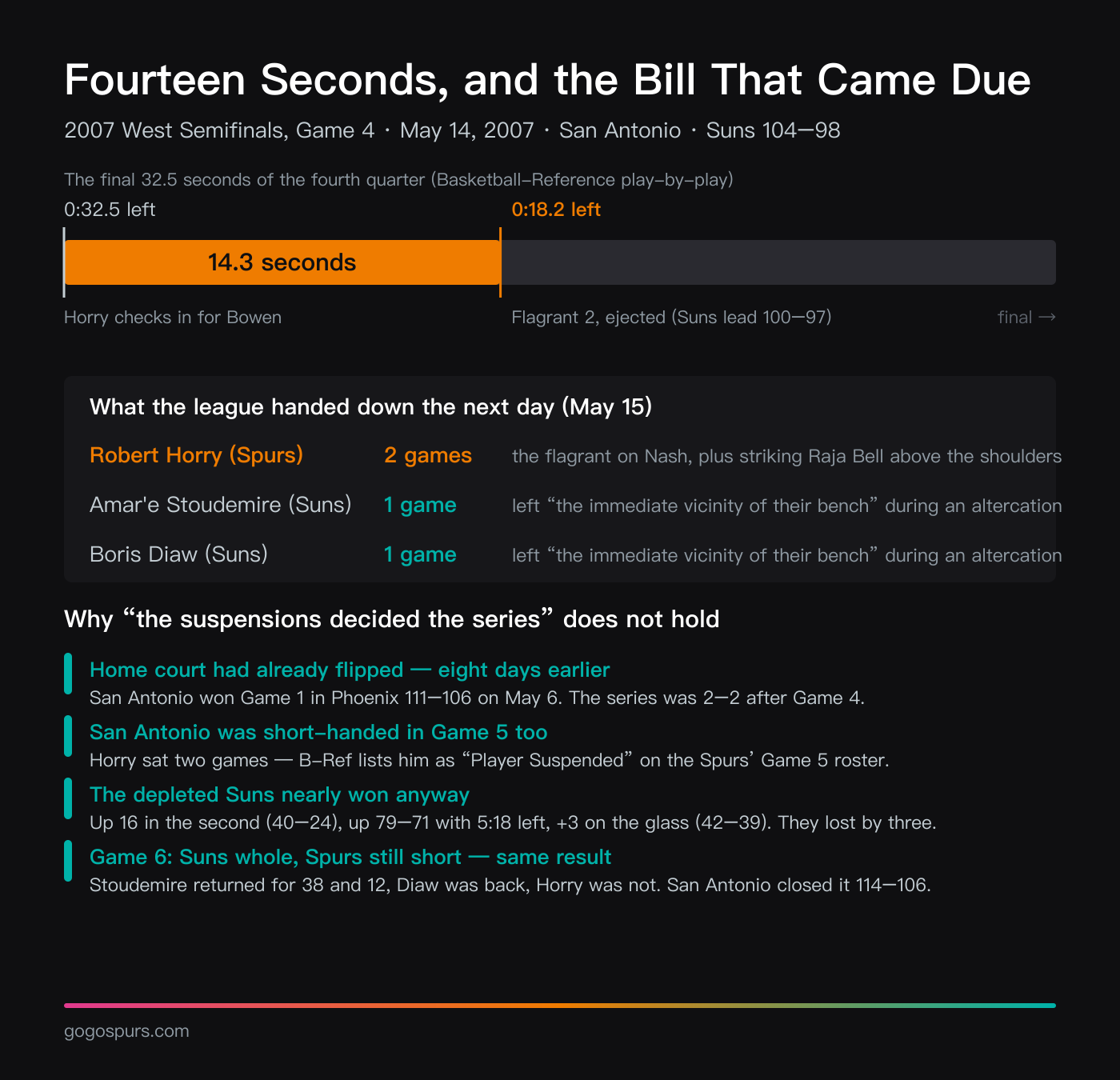
The play-by-play logs a substitution nobody would remember: R. Horry enters the game for B. Bowen. Phoenix leads 100-97, Phoenix has the ball, Phoenix leads the series 2-1.
Fourteen seconds later, at 0:18.2, the same document produces three consecutive lines:
Flagrant foul type 2 by R. Horry (drawn by S. Nash) R. Horry ejected from game Technical foul by R. Bell
Steve Nash goes into the scorer’s table. On the Phoenix bench, Amar’e Stoudemire and Boris Diaw stand up and take a few steps toward the floor.
Those few steps became the most popular reason to hang an asterisk on this championship.
The question this chapter owes an answer
Part 6 ended with a promise: 2007 — how the man they caught hit back. He hit back beautifully. San Antonio went all the way and swept a 22-year-old LeBron James 4-0 for the franchise’s fourth title, and Tony Parker became the first European-born Finals MVP in league history.
But you can’t write only the hitting-back part. For nineteen years, almost nobody has brought up 2007 without bringing up those fourteen seconds — “the Spurs only got there because of the suspensions.”
In Part 2 I granted the asterisk on 1999: a 50-game season is a 50-game season, and there’s no point pretending otherwise. So this chapter has to ask the same question honestly: does 2007 deserve one too?
I did the accounting. The conclusion first: the suspensions were real and the outrage was real, but “the suspensions beat Phoenix” does not survive contact with the evidence.
The ledger: who actually got punished
- Robert Horry, two games (5 and 6) — for the flagrant on Nash and for striking Raja Bell above the shoulders in the scuffle that followed
- Stoudemire and Diaw, one game each (Game 5) — for leaving “the immediate vicinity of their bench” during an altercation
“Horry only got one game” is a common misremembering. He got two, and not solely for Nash.
The rule Jackson was applying still sits in the current rulebook, Rule 12, Section VII, essentially unchanged nineteen years later:
“During an altercation, all players not participating in the game must remain in the immediate vicinity of their bench. Violators will be subject to suspension, without pay, for a minimum of one game and fined up to $50,000.”
“A minimum of one game” is mandatory. That matters: Jackson didn’t choose severity, he had no leniency available. What he said at the time was that “a precedent wasn’t necessary here… the rule is the rule”, and that the two players were “about 20 to 25 feet away from their seats” and moving “towards the altercation.”
Phoenix, naturally, was not persuaded. Stoudemire’s statement pointed at something else:
“I am disappointed that the NBA looked at the letter of the rule and not the spirit of the rule. I admit I stepped on the court, and that I should have had some more restraint, but Tim Duncan did the same thing, just not in such an aggressive manner.”
That charge has a factual core. Phoenix noted that earlier in the same game, when Francisco Elson’s dunk landed on James Jones, Duncan and Bruce Bowen also left the bench. Jackson’s answer was to concede that Duncan “should not have been on the playing court” — while ruling that the Elson-Jones tangle wasn’t an altercation, so there was “no cause for the suspension rule” to apply.
That is the league’s own double standard, in writing: same night, same act, one called an altercation and one not. ESPN teed up its own reporter’s column with the line that Jackson’s ruling was “utterly, profoundly, alarmingly, unreasonably ridiculous.” Bill Simmons put it more precisely: you can’t blame the officials for correctly interpreting a stupid rule — you can blame the league for having the rule.
Why “the suspensions beat Phoenix” doesn’t hold
Having criticized the league, now the other half of the ledger. I checked this part especially hard, because it decides whether the asterisk sticks.
First, home court had already changed hands — eight days before the incident. Phoenix was the second seed and owned home court, but San Antonio took Game 1 in Phoenix, 111-106 on May 6 (Duncan 33 and 16, Parker 32 and 8). That happened eight days before Horry touched Nash. When Game 4 ended, the series was 2-2 — Phoenix had merely won its home court back, not lost a sure thing.
Second, San Antonio was short-handed in Game 5 too. Everyone remembers Phoenix missing two starters. Almost nobody remembers that Robert Horry appears on the Spurs’ Game 5 roster as “Player Suspended”. Both benches were down a man.
Third, Phoenix nearly won that game anyway. Without the reigning first-team All-NBA center, the Suns led by 16 in the second quarter (40-24, still led 79-71 with 5:18 to play, and won the glass 42-39). They did it with seven players — Bell 46:40, Nash 45:59, Marion 45:45. They lost by three, 88-85.
The shot that flipped it came with 36.4 seconds left: Bruce Bowen, off a Tony Parker kickout, from 23 feet, for an 84-81 lead. It was San Antonio’s first lead of the second half.
Fourth, and this is the one that ends the argument: in Game 6 Phoenix was whole and San Antonio still wasn’t. Stoudemire came back for 40:51 and 38 points and 12 rebounds; Diaw was back; Horry was still suspended. San Antonio closed it out 114-106 at home (Ginóbili 33 and 11, Parker 30, Duncan 24 and 13 with 9 blocks).
The Spurs finished that series with Phoenix at full strength and themselves a man down.
The last word belongs to the man who got hit. Nash asked the league to weigh the context, and what he actually said was:
“That would be terrible if that silly play at the end of a game, when the game is really over, if that causes a detriment to the rest of the series. That would be ridiculous.”
The player who got flattened said the game was already decided when it happened.
Where I land: that was luck. Call it fate.
Both sides accounted for. Here’s what I think.
Honestly? It was luck.
If the hit doesn’t land, or Nash doesn’t go flying quite that far, there’s no controversy at all. The action itself happens several times a round in any playoffs. What decided everything downstream was how far he went, and the angle that made the bench believe a teammate was hurt, and the fact that the two men who stood up happened to be starters instead of the last two guys on the roster.
One small detail got amplified. When two teams are that evenly matched, any single link can send a game somewhere else. At that point you just call it fate.
I know this take gets me yelled at from both directions. Suns fans will read it as letting San Antonio off. Spurs fans will say there was never anything to concede. But I think it’s the honest version, and it’s the same ledger this series has been keeping all along.
In Part 1 I wrote that the 1997 ping-pong ball was luck, and that luck is part of what a franchise is. In Part 4 I took the bad end of it: Derek Fisher’s 0.4 seconds and that ping-pong ball are two faces of one coin, and you don’t get to claim only one. Having owned the good luck and the bad, 2007 — the roll that went San Antonio’s way — has to be owned too.
But owning the luck is not the same as accepting the asterisk.
The difference is this. An asterisk says this title wasn’t deserved. Luck says this title could just as easily not have happened — the same way 2004 and 2006 could just as easily have. The first is a verdict. The second is a probability. A best-of-seven has never been a precision instrument for measuring who is better; it measures quality multiplied by a great many things nobody controls.
But Part 6 said “a decision, not fate”
Someone will catch the contradiction: in Part 6 I argued that Ginóbili reaching in on Dirk Nowitzki in 2006 was a decision, not bad luck. So why does Horry get fate?
The difference is whether the consequence is proportional to the act, and whether the person who made the decision is the person who pays.
Manu’s reach cost exactly what his own miscalculation was worth: up three, hand on a two-point drive, and-one, tie game. That causal chain is short, straight and closed, and it begins and ends with him.
Horry’s hit cost two men who never touched the ball and whose only act was standing up from a bench. In between sits the distance Nash traveled, and a rule that files “walking a few steps” and “fighting” under the same heading, and a league official deciding in real time what counts as an altercation. That chain is long, bent, and full of forks — and every fork could have led somewhere else.
A decision is the key you press. Fate is how the dice fall after you press it. In 2006 Manu pressed the wrong key. In 2007 Horry pressed a key that rolled a number nobody could have predicted. The two claims don’t conflict.
So what were the Spurs, really?
The asterisk argument rests on a premise: that the 2007 Spurs were a 58-win team who lucked into it.
That premise is wrong, and badly wrong.
San Antonio went 58-24, second in the Southwest and the third seed in the West (Dallas won 67, Phoenix 61). Then look at the margins:
- SRS 8.35 — first in the NBA
- Net rating +9.3 — first in the NBA
- Pythagorean record 64-18 — first in the NBA
- 90.1 points allowed per game, first; defensive rating 99.9, second
And that 8.35 is the highest SRS of San Antonio’s five championship teams, ahead of the 2014 group everyone remembers as the beautiful one (8.00).
The 2007 Spurs weren’t a dark horse. On paper they were the best team in the league — they just got squeezed to the third seed by a 67-win team and a 61-win team. There’s a picture here that mirrors Part 6 exactly: in 2006 they were the 63-win top seed who ran into 60-win Dallas in round two and lost; in 2007 they were the 58-win third seed who ran into 61-win Phoenix in round two — two straight years in which the real Western Conference finals was played in the second round. The only difference is who came out.
Worth noting: the preseason betting favorite that year was not San Antonio — the shortest title odds belonged to the 67-win Mavericks at +400, with the Spurs second at +450 and Phoenix at +600. And that shortest-priced Dallas team lost in the first round to the eighth-seeded Warriors. Luck was not handing out favors only in San Antonio.
The Finals: a sweep that looked nothing like one
Then came the series that welded the word “boring” onto this franchise for nineteen years.
Start with the scores:
| Game (links to its box score) | Date | Score | Margin |
|---|---|---|---|
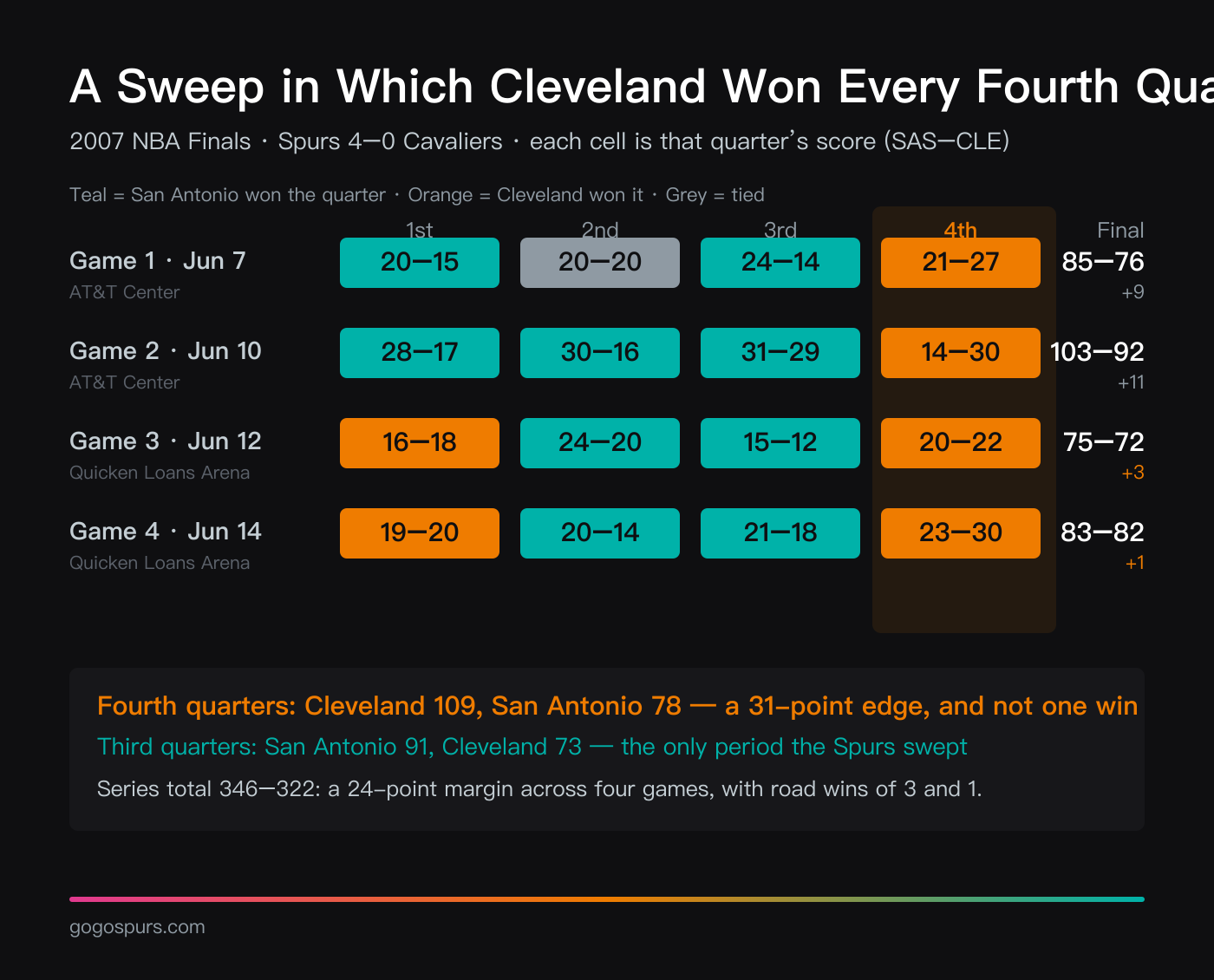
| 1 | Jun 7 · AT&T Center | Spurs 85 – Cavaliers 76 | +9 |
| 2 | Jun 10 · AT&T Center | Spurs 103 – Cavaliers 92 | +11 |
| 3 | Jun 12 · Quicken Loans | Spurs 75 – Cavaliers 72 | +3 |
| 4 | Jun 14 · Quicken Loans | Spurs 83 – Cavaliers 82 | +1 |
Four games, 346-322 — a 24-point margin in total, six a game. On the road, San Antonio won by three and by one.
But here’s the genuinely counterintuitive number: Cleveland won every single fourth quarter.
27-21, 30-14, 22-20, 30-23 — adding the four games above, 109 points to 78 across the four fourth quarters, a 31-point edge, and not one win to show for it. The period San Antonio swept was the third (24-14, 31-29, 15-12, 21-18). That’s the shape of the whole series: the Spurs won the first three quarters by 55 points and lost the fourth by 31.
Game 2 is the extreme case. San Antonio led 58-33 at the half, then got outscored 30-14 in the fourth and still won by 11 — by which point the final score had stopped describing the game.
San Antonio scored 75 in Game 3 — the lowest total by a winning team in a Finals game since 1955, the first season the NBA used a shot clock, as the wire copy noted at the time. The two teams combined for 147 points. “The Spurs made basketball ugly” isn’t only a vibe; it is in the record book.
The end of Game 4 wasn’t garbage time either. Ginóbili went 6-for-6 from the line in the last 24 seconds, but LeBron hit a 24-footer with 4.9 seconds left to cut it to 81-79; Damon Jones’s three at 0:00 is what made the final 83-82. With five seconds left, San Antonio led by two.
As for Cleveland — that team went 50-32 with an offense that ranked 18th, but the second-best defensive rating in the playoffs (San Antonio was fifth). They weren’t making up the numbers. They were stopped by the man who stayed on the floor longer than anyone: Bruce Bowen averaged 41.8 minutes, the most on the Spurs, more than Parker (37.8) or Duncan (37.3), and shot 8-for-27 for six points a game. San Antonio won a championship riding a guy who barely scored for more minutes than anyone else played.
LeBron averaged 22 in those four games on .356 shooting, 4-of-20 from three, with 23 turnovers. Two weeks earlier he had played 50:18 in Detroit and scored 48 — I went through that play-by-play and counted backward: he scored 29 of Cleveland’s last 30 points (the exception is one Drew Gooden free throw at 2:49), then Cleveland’s final 25 points and its final 11 field goals were all his; across two overtimes the Cavaliers scored 18 points, and all 18 were his.
Fourteen days later the same man made four threes in four games. This isn’t “weak team gets swept.” This is a 22-year-old running into the best defense on earth.
Parker: from zero fourth-quarter minutes to the first European-born FMVP
Now the man this chapter is actually about.
Part 3 covered the summer of 2003: the day after winning the title San Antonio went after Jason Kidd, Popovich’s idea being that Kidd would teach 21-year-old Parker how to play point guard — and Parker “didn’t like that idea at all.” Years later he told Adrian Wojnarowski: “If he came here, I don’t think I would be in San Antonio.”
He didn’t just sulk about it. In July 2003 he called San Antonio Express-News reporter Johnny Ludden himself and made his case in public:
“I know I’m the best point guard for this team. I can lead this team. I know deep down in my heart I can. I’m only 21, but I’m going to get better.”
He made that call because of how the season had ended. On June 15, 2003, in the Game 6 that won the title 88-77, Parker played zero seconds in the fourth quarter. On the quarter-by-quarter box score his row is simply blank; he finished with 24:16, 2-of-6, four points. The closer was Speedy Claxton, a fringe guard who averaged 5.8 points that season — he played the entire fourth, scored 13, and finished +21.
Four years later, another clinching game.
June 14, 2007, Game 4: Parker went 10-of-14 for 24 points. For the series he averaged 24.5 on .568 shooting, on a team that shot .444.
Afterward he became the first European-born Finals MVP since the award was created in 1969.
That “first” needs its terms stated precisely, because it is very easy to get wrong. Parker was not the first non-American-born Finals MVP — Hakeem Olajuwon, born in Lagos, Nigeria, won it in 1994 and 1995, twelve years earlier. Nor was he the first Finals MVP without American citizenship — Olajuwon naturalized in 1993, and Parker himself holds both American and French passports. In 2003 he told NBA.com’s French site: “I’m French. My father is American, I have an American passport and a French passport… I’m 50/50.” He was born in Bruges, Belgium, because his American father played at Loyola University Chicago and then went to Europe to make a living at the game.
“European-born” is the only version of this record that survives scrutiny. I took the full list of winners from the award’s creation in 1969 through 2006 and opened each player’s page to check where he was born: 21 were born in the continental United States, and the exceptions are Olajuwon (Lagos, Nigeria) and Duncan (St. Croix, U.S. Virgin Islands — a U.S. citizen at birth under federal law). Neither was born in Europe. For the award’s first 38 years there were no European-born winners at all; in the seventeen years after Parker there have been three — Nowitzki (Würzburg, Germany), Antetokounmpo (Athens, Greece), Jokić (Sombor, Serbia).
Two details you only find by looking
One: he didn’t think it should be him.
Before Game 4, with San Antonio up 3-0, reporters asked Parker whether he wanted the MVP. His answer:
“It would be nice but Timmy is going to get it because he’s our franchise and he’s a superstar… If they want a change why not? I’m joking. This is Timmy’s team. It has always been Timmy’s team.”
In the same story Duncan was asked whether he’d vote for Parker: “Sure. It doesn’t matter. As long as we get to four, that’s all that matters.”
That game ended and Parker won the award.
Two: he didn’t score in the fourth quarter of it.
In the clinching fourth, Parker played 9:53, went 0-for-2, and scored nothing. All 24 came in the first three quarters. So the 2003-to-2007 arc doesn’t close the Hollywood way, benchwarmer to closer. It closes like this: four years earlier he didn’t play a second of a title-clinching fourth quarter; four years later he played almost all of one without scoring, and won MVP.
ESPN’s Marc Stein wrote the other side of it that night. His column opens with Duncan calling this “the best” of his four titles, saying he had played “sub-par,” and noting that he “received only one vote for NBA Finals MVP from a panel of 10.”
Who cast that vote? Stein answered it himself, at the bottom of the same column:
“Duncan was the only guy, from either team, to average a double-double. All of which is why the lone Finals MVP vote Duncan received was mine.”
I love the shape of that: an MVP who was scoreless in the fourth quarter of the clincher, and a writer who voted for his teammate, and both of them right. Parker said afterward that Duncan “gave me the opportunity to play my best basketball” on that stage — and he was correct. That .568 was shot on lanes that opened every time Cleveland sent a second defender at Duncan.
Popovich’s verdict on Parker that night was one sentence: “He has come a long way and it has been very satisfying to watch that progress.”
Twelve years later, in November 2019, Parker’s No. 9 went up into the rafters of the AT&T Center. Popovich’s first line at the microphone:
“Tony, I want to apologize for all the physical and mental abuse I gave you over the years. Thank you. I’ve been wanting to say that for a long time.”
The building roared. Then Duncan testified: “He was the hardest-coached individual of anybody I’ve seen in this entire program, and Pop apologized for that. Rightfully so, he did.”
The championship nobody wanted to watch
One last thing that has to be written honestly.
These Finals averaged a 6.2 rating, an 11 share, 9.3 million viewers on ABC — the lowest-rated NBA Finals on record at the time, down 27 percent from the previous year, and that record stood until 2020. The Associated Press opened its story with a single sentence: “The NBA Finals were a television bust.”
Asked to his face the following year by ESPN The Magazine about a clean-cut San Antonio team a lot of people found boring, with the ratings to match, David Stern’s first response was three words: “Welcome to my world.”
So it’s no mystery that “the real finals were the second round” caught on. Half of it is true — that round was the year’s two best teams. The half it leaves out is that Cleveland had the second-best defense in the playoffs and San Antonio won its road games by three and by one.
Nor will I pretend this team had no flaws. The honest number is this: San Antonio’s net rating across the entire 2007 postseason was only +4.5, lower than the +5.3 of the Suns team it eliminated. A champion with a worse playoff net rating than a team it beat is genuinely unusual — because the way they won was to drag every round down into 88-85 and 75-72. Ugly, and precisely the ledger I worked through in the culture multiplier piece: this franchise never won by overwhelming anyone. It won by turning every game into a question of who blinks first.
When those fourteen seconds happened, nobody knew where they led. Phoenix thought it had taken the series back. San Antonio thought it had given a game away. In a world this evenly matched, all you can do is make sure no link breaks on your side — the rest goes to the dice. In 2007 the dice came up San Antonio. In 2006 they didn’t. In 2004 they didn’t either.
Next chapter, 2013: when the dice land on the other side, with 5.2 seconds to go.
Sources: Basketball-Reference — 2007 NBA Finals, Basketball-Reference — 2005-06 Spurs, Basketball-Reference — 2006-07 Spurs, Basketball-Reference — 2006-07 Cavaliers, Basketball-Reference — 2007 playoffs, Basketball-Reference — 2006-07 Mavericks, Basketball-Reference — 2006-07 Suns, Basketball-Reference — 2013-14 Spurs, Basketball-Reference — West semifinals Game 1, Basketball-Reference — West semifinals Game 4 play-by-play, Basketball-Reference — West semifinals Game 5, Basketball-Reference — West semifinals Game 5 play-by-play, Basketball-Reference — West semifinals Game 6, Basketball-Reference — Finals Game 1, Basketball-Reference — Finals Game 2, Basketball-Reference — Finals Game 3, Basketball-Reference — Finals Game 4, Basketball-Reference — Finals Game 4 play-by-play, Basketball-Reference — 2007 East finals Game 5 play-by-play, Basketball-Reference — 2003 Finals Game 6, Basketball-Reference — Finals MVP winners, Basketball-Reference — Hakeem Olajuwon, Basketball-Reference — Tim Duncan, Basketball-Reference — Dirk Nowitzki, Basketball-Reference — Giannis Antetokounmpo, Basketball-Reference — Nikola Jokić, NBA Official Rulebook, Rule 12, ESPN — the suspensions and the reaction (May 16, 2007, archived), The Seattle Times (AP) — Stoudemire and Diaw suspended, ESPN Page 2 — Bill Simmons on the rule (2007, archived), ESPN — Marc Stein’s clinching-night column (June 15, 2007, archived), ESPN (AP) — record-low Finals ratings (archived), ESPN The Magazine — David Stern interview (March 2008, archived), China Daily (AFP) — Parker on the MVP before Game 4 (June 15, 2007), Taipei Times (AFP) — Parker named Finals MVP (June 16, 2007), NBA.com — 2006-07 season review, KSAT (AP) — Parker’s jersey retirement ceremony (Nov 12, 2019), NBA.com — Parker’s jersey retirement, NBA.com France (archived) — Parker on his nationality (2003), Yahoo Sports — Wojnarowski on Kidd and Parker (2013), Wikipedia — 2007 NBA playoffs
The opinions here are the author’s; every factual claim links to its original reporting. If something is wrong, email contact@gogospurs.com and I will correct it and say so publicly.