Wemby Watch #1: France Called, and the Card the Spurs Didn't Play
On July 18, the French basketball federation named its 15-man roster for August’s World Cup qualifying window. Victor Wembanyama is on it. That announcement landed exactly eight days after he signed a five-year, $252 million extension in San Antonio — one where he took the 25% max and left a supermax structure worth roughly $303 million on the table.
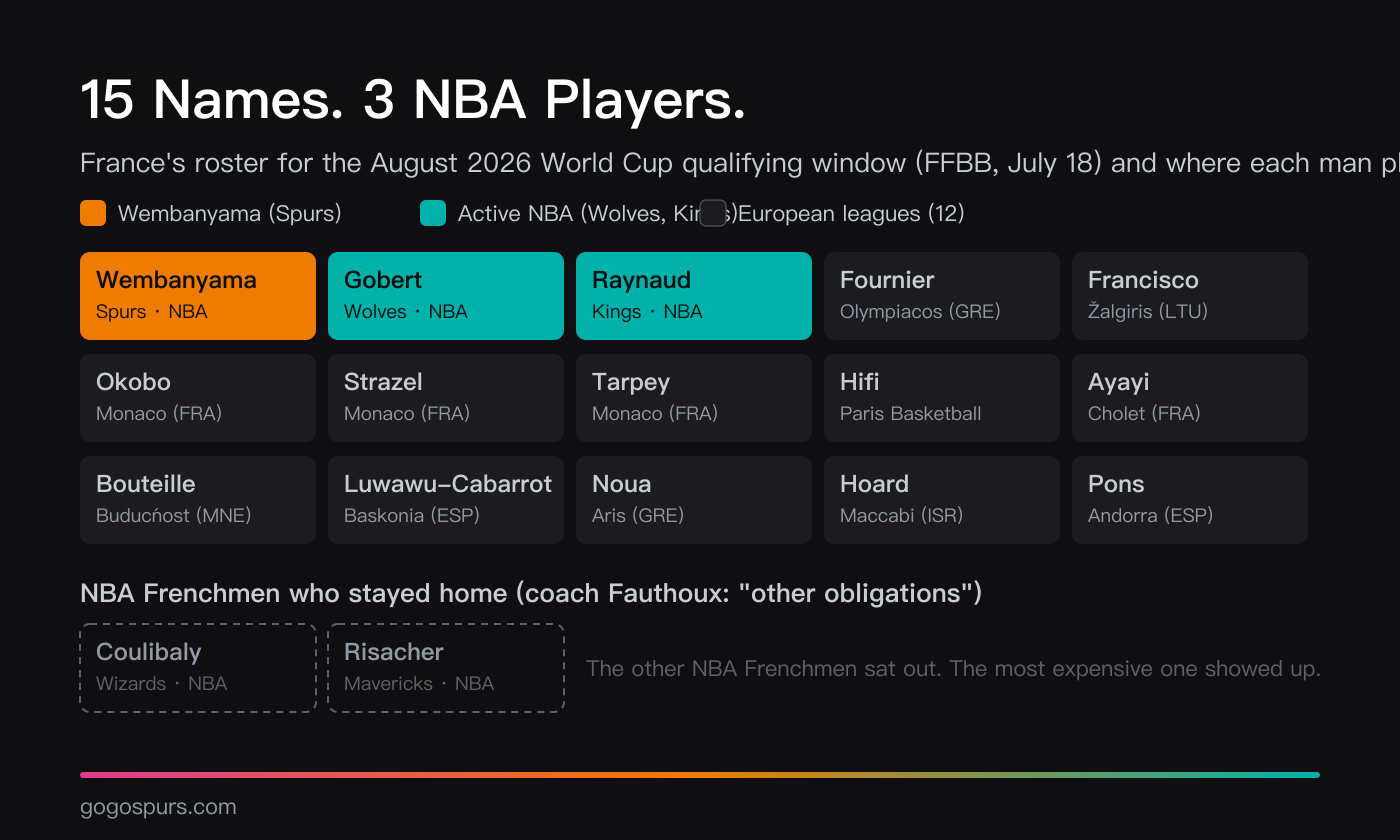
There is a detail in that roster most write-ups skipped. Of the 15 players, exactly three are active NBA players: Wembanyama, Rudy Gobert (Timberwolves) and Maxime Raynaud (Kings). Where is everyone else? Head coach Frédéric Fauthoux named the absences himself in a federation interview — Bilal Coulibaly (Wizards) and Zaccharie Risacher (Mavericks) both had other commitments.
The young Frenchmen on other NBA rosters stayed home. The most expensive one came. That is the story in this roster.
What the schedule actually looks like
France camps in Orléans from August 16, plays Serbia twice in friendlies on August 20 and 23, and then has two competitive 2027 World Cup European qualifiers: Slovenia in Paris at the Accor Arena on August 27 (20:30 local), then Sweden in Stockholm at Hovet on August 30 (17:30 local).
Nothing about the standings is desperate. France leads Group L in the second round at 5-1 — a record built without Wembanyama — and three of the six teams advance to Qatar. Which is exactly what makes the question worth asking: why would a team that is all but through risk the face of a $252 million investment?
Because “willing” was never the question
Start with the rules, because they are blunt. FIBA’s own Internal Regulations, Book 3, Article 3-38 (current as of April 2026) leaves no wiggle room: clubs are obliged to release players called up by their national federation, and any agreement to the contrary is a violation. The NBA side goes further still. As Larry Coon’s long-running CBA FAQ documents, the league’s agreement with FIBA not only requires teams to release players for major international competition — it bars clubs from taking any steps to discourage participation. Asking a player privately to sit, or grumbling about it publicly, is itself a breach.
Then add the calendar. Of the three remaining windows in this qualifying round, November 2026 and February 2027 both fall inside the NBA season, and the league does not release players mid-season. August is the only window in which Wembanyama can wear a France jersey before the 2027 World Cup.
So whether the Spurs were “willing” is, strictly speaking, not a thing the rulebook asks them. But the story does not end there — because San Antonio did hold one card.
The card is called “pre-existing injury concern,” and the Spurs are the textbook case
There is exactly one legal route by which an NBA team can pull a player out of a FIBA event. CBS Sports spelled it out in the aftermath of Paul George’s broken leg in 2014, and the wording matters:
Under the NBA’s agreement with FIBA, a team may withdraw one of its players from a FIBA event only if there is a pre-existing injury concern — as was the case with the Spurs and Manu Ginobili.
Read that again. The example the rule travels with is San Antonio’s own.
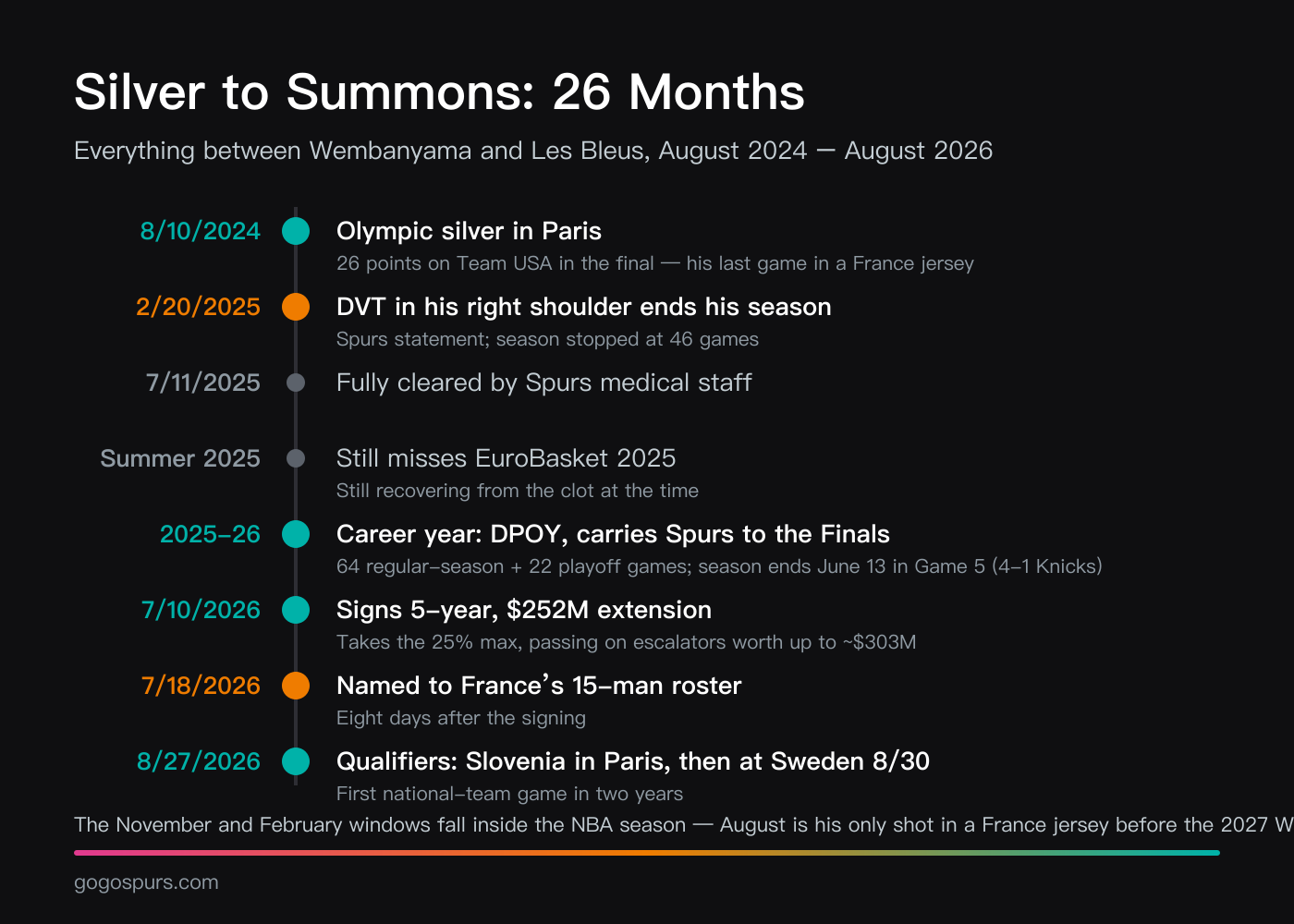
And Wembanyama comes with a chart to point at. On February 20, 2025, the Spurs announced he had been diagnosed with deep vein thrombosis in his right shoulder, ending his season — found, the statement said, after he returned to San Antonio from All-Star weekend in San Francisco. That summer he also sat out EuroBasket 2025 while still recovering from the clot. A player with a clotting history, flying to Europe to play international basketball in August: if the Spurs wanted to raise a medical objection, nobody would have found it strange.
They didn’t.
The league has seen what playing that card costs. In 2017 the Bucks used a physical to keep Giannis Antetokounmpo out of EuroBasket, and the Greek federation publicly called it an “organized and well-planned project by the Bucks” — a club and a national federation at open war. Blocking a player has a price, and San Antonio knew whether that price was worth paying.
And he had already committed himself, months earlier
At All-Star weekend in February, Wembanyama told beIN Sports something that reads, in hindsight, like a prophecy. Of the August window: “I definitely want to play it, if I’m healthy — knock on wood.” And of the July one:
I hope I won’t be able to play in the first one. Because that would mean we went all the way to the NBA Finals.
The Spurs did go all the way to the Finals. He did miss the July window. Four months later, the sentence came true word for word. The premise of his release was never San Antonio sending him — it was that nobody was going to stop him from going. After the 2024 Olympic gold medal game in Paris, where he put up 26 points in a 98-87 loss to the United States, he told Mike Finger of the San Antonio Express-News: “I’m learning, and I’m worried for the opponents in a couple of years.” Asked whether he meant in the NBA or in FIBA, he gave a one-word answer: “everywhere.” Qualifiers, the 2027 World Cup, Los Angeles in 2028 — one road.
San Antonio has lived with this calendar for 25 years
Pull the camera back and none of this is new for the Spurs. This franchise’s international bloodline is not only a story about draft vision — it is a history of coexisting with national teams. The summer after San Antonio’s 2003 title, Ginóbili took Argentina through the Athens semifinal against the United States and then beat Italy 84-69 for gold — the first time since 1988 that the Americans had gone home without it. He kept playing for Argentina until Rio in 2016. Tony Parker won EuroBasket gold with France in 2013, then chose to sit the following summer, explaining it as his way of giving back to the Spurs. Note the direction of that favour: the player repaying the club, not the club blocking the player.
Gregg Popovich went a step further and coached the United States himself: after a seventh-place finish at the 2019 World Cup, he won Olympic gold in Tokyo, 87-82 over France. The opponent in that gold medal game was the national team Wembanyama now plays for. And Popovich is today the Spurs’ president of basketball operations — meaning any decision to hold a player back would have to pass a man who twice gave up his own summers for a national team.
Coexistence is not the same as costless, though. Twelve months ago San Antonio’s own Jeremy Sochan tore a calf muscle in Poland’s national team camp and withdrew from EuroBasket; nobody in the league has forgotten the sight of Paul George’s leg giving way in a Team USA scrimmage in 2014. And the American Society of Hematology is explicit that flights of eight to ten hours or more carry the highest clot risk — Wembanyama’s clot was in his shoulder, a different mechanism from the lower-limb clots associated with prolonged sitting, but that chart still puts a shadow over every transatlantic flight. The risk is real, and an argument for letting him play that refuses to say so out loud does not deserve to win.
Where I stand: releasing him is right, and the reasons are not complicated
First, this is a young man’s patriotism. Nobody put a gun to his head in February. A 22-year-old publicly volunteering his August to the national team is a motive you either respect or destroy; there is no third option.
Second, international basketball is schooling, not attrition. FIBA rules, FIBA double teams, the shorter three-point line — it is a different classroom. The last time he wore this jersey he came home with an Olympic silver and 26 points in the final. The NBA cannot hand him that.
Third, to everyone counting the risk, one question back: do those two games make him healthier? He just played 64 regular-season games and 22 playoff games — 86 games of NBA intensity all the way to the Finals, while winning Defensive Player of the Year. That load held. Four more FIBA games break him? The arithmetic does not work. Real risk management is a medical staff’s clearance standard, not picking which two games he is allowed to skip.
Fourth, the Spurs are the league’s most international franchise, and every game he plays in that jersey lights up their sign in Europe. This is not a one-way donation; it is brand compounding. That $252 million buys a global face for the next decade, and a global face belongs on the world’s floors.
What to watch
August 27 in Paris, August 30 in Stockholm. The thing to watch is not the result — France is 10-0 all-time against Sweden — but the first sight in two years of Wembanyama and Gobert inside Fauthoux’s system together. The coach took over from Vincent Collet in September 2024 and has still never coached him at national-team level. “Victor is the undisputed leader of this generation,” Fauthoux said. These two qualifiers are that generation’s first roll call.
Wemby Watch will follow him the whole way: the qualifiers, the World Cup, and then the Los Angeles Games he has already promised himself. This is part one.
Sources: FFBB roster announcement, FFBB Fauthoux interview, FFBB Fauthoux appointment, FIBA roster news, FIBA game page (Sweden vs France), FIBA Internal Regulations Book 3 (PDF), Larry Coon CBA FAQ (archived), CBS Sports (FIBA release rules), CBS Sports ($252M extension), CBS Sports (post-Olympics), CBS Sports (sitting out EuroBasket 2025), CBS Sports (Giannis), CBS Sports (Ginóbili’s Argentina farewell), CBS Sports (Parker’s France farewell), CBS Sports (Popovich steps down, Tokyo gold), TODAY (Spurs’ blood clot statement), BasketEurope, NBC Sports (Parker, archived), NBC Sports (Sochan, archived), American Society of Hematology (archived), Basketball-Reference (archived), Hovet Arena
The opinions here are my own; the facts link to original reporting. If you spot an error, email contact@gogospurs.com and I’ll correct it publicly.