Taking Less Is a Virtue. Is It Fair? (Duncan Dynasty, Part 10)
On the morning of July 11, 2016, the Spurs put out a press release.
The headline read TIM DUNCAN ANNOUNCES RETIREMENT. It ran 540 words. It listed his career points, his rebounds, his blocks, the years of the five titles, the fifteen All-Star selections.
It quoted nobody.
Not “kept it brief.” Nobody — no farewell from Duncan, no eulogy from Popovich, no thank-you from ownership. I pulled the full text and checked it mechanically: zero quotation marks, zero instances of the word said, and exactly one mention of Popovich, buried inside the stat line about the winningest player-coach pairing in NBA history at 1,001 wins.
A nineteen-year, five-ring career ended with a document in which no human being speaks.
What this one is about
This is the last part of the Duncan dynasty series. Part nine argued that “the Beautiful Game” was a name outsiders hung on the 2014 Spurs, and I ended it with a promise: 2016, a press release, and an exit with no press conference.
This is that exit. But “he left quietly” is a cheap thesis, and everyone has already written it.
What actually stopped me was something else.
Duncan took less money three times in his career and never once explained why. A decade later, on July 10, 2026, a 22-year-old Wembanyama signed a five-year, $252 million extension at 25% of the cap instead of 30%. Almost every write-up filed both under the same heading: the Spurs way, a star’s character, a virtue.
I think it is a virtue too. But I can’t get past one thing: neither of them had to do it.
What they were worth was not a feeling. It was a number — the league has a formula, the team has an offer, and rival franchises put real money on the table. And then they handed some of it back so the roster could buy one more rotation piece, or clear one more line.
So what about the team? Did the Spurs ever make it up to them somewhere else?
Because if the answer is no, this stops being a question about virtue. It becomes a case of the players unilaterally footing the bill for a better roster — and that is not fair to the player.
This piece is me chasing that question down. And what I found is that the answer is different for these two men — which turns out to be the right way to end this series.
1. What he didn’t do
Start with what is documented.
The second paragraph of ESPN’s story that day read:
“No big news conference. No victory lap. Not even a canned quote in the news release. Just a simple goodbye on Monday from the quiet anchor” — ESPN, July 11, 2016
The same story notes there were no plans for Duncan to address the media at all.
The next day the Spurs held something at their practice facility. They deliberately refused to call it a press conference, and the man himself didn’t come.
“In typical Tim Duncan fashion, the San Antonio Spurs legend didn’t show up for his own retirement gathering (don’t call it a news conference, because the Spurs didn’t). Tuesday’s official farewell to Duncan consisted of Gregg Popovich chatting with reporters gathered at the Spurs’ practice facility.” — ESPN, July 12, 2016 (archived)
The AP was blunter: no news conference, no elaborate setup, not even any live coverage permitted.
So Popovich stood there alone. He started here:
“I’m trying to wrap my head around why I’m standing here and he’s not. And we all know why. It’s not Tim Duncan.” — Gregg Popovich, July 12, 2016 (archived)
And then this, which I think is the most important thing anyone said that week:
“I would not be standing here if it wasn’t for Tim Duncan. I’d be in the Budweiser League someplace in America, fat and still trying to play basketball or coach basketball. But he’s why I’m standing. He’s made livings for hundreds of us, staff and coaches, over the years, and never said a word. Just came to work every day. Came early. Stayed late.” — Gregg Popovich, same transcript
Hold on to “never said a word.” The rest of this piece turns on it.
He wasn’t actually silent — and the real detail is better
One correction to the version that has hardened into legend. Duncan did say something.
Two days after the announcement, on July 13, 2016, the Spurs posted a letter from him under the title A Letter From Tim.
It wasn’t a web page.
It was a photograph. A JPG of a printed sheet of stationery lying on a wooden table — Spurs logo at the top, typed body, a handwritten Tim at the bottom. I downloaded the file and looked at it myself; its embedded metadata is stamped July 13, 2016, saved out of Photoshop.
It opens:
“If asked to write a script for my career 19 years ago, there is no way I would’ve been able to dream up this journey.”
And ends:
“The wins and losses will be remembered, but what I’ll remember most are the people… most importantly, the snapshots of my kids growing up and reveling in watching Dad work. That is what I will cherish the most.” — Tim Duncan, open letter, July 13, 2016
So the accurate line isn’t “he never said anything.” It’s this: he never opened his mouth. He left a letter, on paper, photographed.
He wouldn’t even use a text box. That’s a far sharper detail than “he was private.”
An honest complication: the format wasn’t his
I wanted to use the quote-free press release as proof of Duncan’s character. Checking killed that.
When Manu Ginóbili retired on August 27, 2018, the Spurs’ release used the identical format — pure statistics, no quotes from anyone.
So it isn’t that Duncan was unusually self-effacing. It’s that this organization uses the same template even for goodbyes.
Which, honestly, fits the series better. Personalities vary. Templates don’t. San Antonio’s real asset was never one man’s modesty — it was the things that keep running without anyone maintaining them.
2. Reading 540 words of pure statistics
If the document is only numbers, read the numbers.
Its first sentence:
“Since drafting Duncan, the Spurs won five championships and posted a 1,072-438 regular season record, giving the team a .710 winning percentage, which is the best 19-year stretch in NBA history.”
I checked that one specifically, because Spurs fans have been quoting it for a decade without anyone explaining what it counts.
I pulled the franchise index at Basketball-Reference and summed his nineteen seasons by hand. It comes out exactly as advertised: 1,072 wins, 438 losses, a .7099 percentage.
The number is right. But the subject of that sentence is the team, not the man. It includes every game he missed injured.
For him personally: Duncan won 1,001 regular-season games, third all-time, and the only player ever to reach a thousand with a single franchise.
The gap between the franchise’s 1,072 and his own 1,001 is roughly seventy games. Those are wins the Spurs collected while he was in a suit.
That gap tells you more about San Antonio than the milestone does.
A few more lines from the same release:
- The Spurs made the playoffs in every one of his 19 seasons
- He is the only player in league history to start and win a title in three different decades
- The franchise won at least 50 games in his last 17 seasons, the longest such streak in league history
- It posted a winning percentage of at least .600 in all 19 of his seasons, an all-time record across the four major American sports
- 15 All-NBA selections (tied for most ever) and 15 All-Defensive selections (most ever), with both in the same season 15 times — also the most ever
And one line you would not expect in a retirement notice:
At forty years old, he was still the most efficient defender in the league.
He didn’t leave because he ran out
Look at how the team was doing when he walked:
His last season, the Spurs went 67-15 — the best winning percentage of his nineteen years, and a franchise record at the time.
To be fair about it: that team lost in the second round, four games to two, to Oklahoma City. Those 67 wins bought nothing.
Nobody arranged a moment for him
May 12, 2016, Oklahoma City, Game 6 of the Western Conference semifinals.
San Antonio lost 99-113 and went out of the series.
Duncan’s line: 34:25 on the floor, 7-of-14 from the field, 5-of-6 at the line, 5 rebounds, 1 block, 19 points, and a plus-minus of +12.
The team lost by 14 and he was +12. Those 19 points were his playoff high that spring.
I went into the play-by-play looking for the substitution — the standing ovation, the arena on its feet.
There isn’t one.
He played the entire fourth quarter and was on the floor at the buzzer. No one took him out. The last shot of his career came with 3:12 left in the fourth: a layup, blocked by Serge Ibaka.
Then he stood out there and finished the game.
Asked afterward what came next:
“I’ll get to that after I get out of here and figure life out.” — Tim Duncan, May 12, 2016
Two months later, the press release.
3. The thing he did three times and never once explained
Now the actual subject of this piece.
Duncan did something three separate times across his career and never publicly gave a reason for any of them.
He took less money.
All three, itemized
2007. This is the one everyone forgets, and it’s the only one where the counterfactual is sourced:
“Although Duncan is eligible to receive a two-year extension worth about $51 million under the NBA’s collective bargaining agreement, he agreed to nearly $11 million less because it could afford the Spurs greater flexibility to pursue free agents after the 2009-10 season.” — Yahoo Sports, Johnny Ludden, October 30, 2007
The headline on that story was, plainly, “Duncan will take less than maximum salary.”
2012, the big one. He went from $21,164,619 to $9,638,554 — a cut of more than eleven million dollars, about 54.5% of his salary, by my own arithmetic on those two figures.
Where the money went is visible on the same season’s payroll: Boris Diaw at $4,500,000, Danny Green at $3,500,000, Patty Mills at $1,085,120.
Two years later all three played every one of the 23 games of the 2014 title run — Green starting all 23 at 23.0 minutes a night, Diaw at 26.3, Mills at 15.3. The bench of the team I wrote about in part nine was bought with the money he gave back two years earlier.
2015. From $10,361,446 down to $5,250,000 — roughly another half of his salary. That was the summer San Antonio signed LaMarcus Aldridge, and the summer Ginóbili went from $7,000,000 to $2,814,000.
A sourcing detour, because it matters
I fell into a hole writing that section, and readers should see it.
Basketball-Reference’s salary table for Duncan has two wrong cells. It lists 2014-15 as a round 10,000,000 and 2015-16 as a round 5,000,000.
I copied them, and cheerfully calculated that his 2012 deal came to exactly 30,000,000 over three years. Wrong.
Arithmetic caught it. The same page shows him being paid 1,881,250 in each of the three seasons after he retired — waived, with the guaranteed remainder stretched across three years. That totals 5,643,750. NBA Bird rights cap annual raises at 7.5%, so:
- If 2015-16 were 5,000,000, the option year maxes out at 5,375,000 — it cannot produce 5,643,750
- If 2015-16 were 5,250,000, the option year is exactly 5,643,750
In other words, Basketball-Reference’s own numbers refute Basketball-Reference. And ESPN reported it plainly at the time:
“Duncan’s current two-year deal with San Antonio was for $5.25 million in his first season, with the $5.6 million option for 2016-17 and a no-trade clause.” — ESPN, June 28, 2016
The correct total on the 2012 deal is 30,361,446. The difference changes no argument here — but wrong is wrong, and this is exactly why every piece on this site gets re-verified: even the best database in the sport had two stale cells.
The real point: he never explained
I assumed the easy part of this section would be dropping in a good Duncan quote about taking less.
There isn’t one.
I went through ESPN, Yahoo, SI, NBA.com and the San Antonio papers’ archives. There is no contemporaneous quote from Duncan, Popovich or R.C. Buford explaining the reasoning behind any of the pay cuts. Both times, the Spurs’ official release said only that per club policy, terms were not announced.
On the day he signed in 2012, asked about it, he talked about wanting to keep playing:
“I’m happy to be on board for another couple of years and more than happy to be a Spur for life.” — Tim Duncan, July 11, 2012 (archived)
Buford, in the same piece, was drier:
“We’re going to play him as long as he says he can play, and probably a couple days longer.” — R.C. Buford, same
One note on a quote you’ll find everywhere — the line about how he never really knew what anyone else was making. I chased its provenance: the page it lives on returns 403 to every retrieval tool, so nobody has actually opened it, and it comes from a much later interview regardless. It does not run here.
Three pay cuts, zero explanations. Go back to Popovich: he’s made livings for hundreds of us, and never said a word.
That wasn’t a flourish. It was literal.
4. So what did the team give him?
This is the question from the top. Did any of it ever come back to him another way?
First, something I have to be straight about: there is no way to total up what he gave away. The three instances aren’t measured the same way. For 2007 there is a documented counterfactual — a two-year extension signed for nearly $11 million below what he was eligible for. For 2012 and 2015 all we have is the drop in his own salary from one season to the next (about $11.5 million and about $5.1 million), because no reliable source states what he could have commanded either time.
So you won’t find a sentence in this piece claiming he sacrificed some grand total. Nobody ever wrote down what he gave up. Which is already part of the answer to this section’s question.
I checked everything I could check. The answer comes in three parts, and each one is uglier than the last.
What he got: a piece of paper only six men in the league had
Credit where it’s due — the Spurs did give him something, and it wasn’t token.
The 2012 deal included a no-trade clause, and the 2015 deal came with a fresh one.
How rare is that? In 2015-16, exactly six players in the NBA held an outright no-trade clause: Carmelo Anthony, Kobe Bryant, Tim Duncan, Kevin Garnett, Dirk Nowitzki and Dwyane Wade.
Six men out of more than four hundred. That is real compensation — it guaranteed nobody could ship him to a rebuilding team in his last years, which is a dignity most aging stars never get.
But be clear about what it is: autonomy, not money. Nobody can put a number on it.
What he didn’t get: anything that appreciates with the franchise
No public reporting shows Duncan holding equity in the Spurs. Forbes’ 2026 piece on the team’s ownership lists the Holt family, Michael Dell, Joe Gebbia and Sixth Street. He isn’t on it.
Nor a job. He spent one season as an assistant coach and stepped away from full-time coaching in November 2020.
Compare the two men beside him:
- Popovich moved off the bench in May 2025 into the team presidency
- Ginóbili came back in 2021 as special adviser to basketball operations
The one who gave up the most money is the only one without a standing role.
The ugly part: the reported purpose never materialized
This is the one that made me stop and re-read.
Go back to 2007. Yahoo’s report laid out the rationale — he took nearly $11 million less because it could give the Spurs greater flexibility to pursue free agents after the 2009-10 season. The same story notes the front office made a detailed presentation of the team’s long-term plans and showed him the possible impact of accepting a lesser extension.
(Precision matters here: “pursuing free agents” is the reporter’s account of the rationale, not a public commitment from the team — the franchise never publicly said what the money was for. That distinction is about to matter.)
So what happened in the summer of 2010?
No cap-space free-agent signing resulted. That flexibility had been spent a year earlier.
On June 23, 2009, San Antonio traded Bruce Bowen, Kurt Thomas and Fabricio Oberto for Richard Jefferson, who was owed $14.2 million that season and $15 million in 2010-11. The same report notes the deal pushed the Spurs over the luxury-tax threshold — a rarity for that franchise.
Which meant that by the summer of 2010:
More than eleven million over the cap. Zero room.
Who did they sign that summer? Their own Richard Jefferson, their own 2007 draft pick Tiago Splitter, their own Matt Bonner, plus two draftees.
The one genuine outside addition was Gary Neal — a guard who went undrafted in 2007 and spent one season in Spain and two in Italy before reaching the NBA. His 2010-11 salary was $525,000. Minimum tier.
None of which is a knock on Neal, who went on to earn real rotation minutes. The point is narrower: that is not a player bought with cap space. That is a player found by scouting — and scouting doesn’t require anybody to take a pay cut.
Duncan gave back nearly $11 million in 2007; the reported rationale was flexibility to pursue free agents. The front office converted that flexibility into a different large contract in 2009.
To be fair about it: a team over the cap is not out of tools entirely — the league’s own announcement lists a $5.765 million mid-level exception for that season. But the shape of that summer’s shopping is listed above: their own Jefferson and Bonner re-signed, their own 2007 draftee Splitter brought over, one minimum-salary find. No signing that used the money he gave back ever resulted — the one outside addition came in on a minimum, which requires no one’s sacrifice.
I don’t think anyone was lying to him — the team never made a promise, only a presentation. But this is the most honest answer to “did the team make it up to him”: that particular money never became a single addition that required cap space to sign. And nobody ever had to account for it — because he never asked.
Meanwhile the franchise itself went up roughly fifty-eight-fold
This last set of numbers isn’t an accusation. It’s a description of the shape of the trade.
- Peter Holt bought control of the Spurs in 1996 at a reported valuation of $76 million — the year before Duncan arrived
- Forbes valued the franchise at $4.4 billion in 2025
Roughly fifty-eight times over.
In fairness: that climb is driven by leaguewide media deals and asset prices, not by any one player, and not by anything the Holts did wrong.
But the shape is unmistakable. The player hands back a fixed sum of cash. The owner holds an asset that compounds. One side gave up eleven million dollars once; the other side’s holding multiplied many times over across the same years.
This isn’t a story about villains. It’s structural asymmetry — and as the next section shows, the new rulebook makes it worse, not better.
5. A decade later, someone appears to do the same thing
On July 10, 2026, Wembanyama agreed to a five-year, $252 million rookie-scale extension with a player option in the fifth year. It begins in 2027-28; he plays 2026-27 on the last year of his rookie deal at $16,868,246.
His own comment was one line: Spurs family, I'm here to stay. Whatever it takes.
Every story took the same angle: he chose 25% over 30%, walking away from a version worth as much as $303 million and saving the Spurs roughly $50 million. Then straight to Duncan. The Spurs way.
Two things in that framing are wrong.
Correction one: he wasn’t giving up a 30% he already had
The 30% tier isn’t automatic. It has written criteria.
I downloaded the full 2023 collective bargaining agreement and read the clause. Article II, Section 7(a)(i):
“…a player who has four (4) Years of Service… (‘5th Year Eligible Players’) shall be eligible to receive from his Prior Team up to thirty percent (30%) of the Salary Cap… if the player has met at least one of the following criteria (the ‘Higher Max Criteria’) as of the July 1 following the player’s fourth Season: (A) the player was named to the All-NBA first, second, or third team, or was named Defensive Player of the Year, in the immediately preceding Season or in two (2) Seasons during the immediately preceding three (3) Seasons; or (B) the player was named NBA MVP during one of the immediately preceding three (3) Seasons”
While we’re here: the terms “Rose Rule” and “supermax” that everyone uses do not appear anywhere in that agreement. The actual name is the Higher Max Criteria. (The true supermax is a separate 35% mechanism and isn’t involved.)
The trigger date is what matters. His is July 1, 2027, looking back three seasons:
| Season | What happened | Credit toward the criteria |
|---|---|---|
| 2024-25 | Played 46 games after a blood clot in his right shoulder, short of the 65-game threshold | None |
| 2025-26 | Unanimous Defensive Player of the Year, All-NBA First Team, third in MVP voting | One season |
| 2026-27 | Hasn’t happened | — |
The clause requires the immediately preceding season, or two of the last three. With 2024-25 at zero, both routes now depend entirely on 2026-27 — and the MVP path is closed too, since he finished third in 2025-26.
So at signing, 30% wasn’t money in his pocket. It was an outcome he had not yet earned, with exactly one path left to earn it.
CBS Sports put it most cleanly:
“Therefore, most players who can negotiate that 30% max do so through escalators. The contract is guaranteed at the 25% max, but if the player hits any of those benchmarks in his fourth season, it jumps to the 30% max.”
“What Wembanyama is doing here is foregoing those escalators. He just took a 25% max, no questions asked.” — CBS Sports, Sam Quinn, July 10, 2026
And it isn’t even a binary. Section 7(d)(iii) of the same agreement includes a worked example:
| Higher Max Criteria | Percentage |
|---|---|
| All-NBA Second Team | 27% |
| All-NBA First Team | 28% |
| NBA MVP | 30% |
There were rungs between 25 and 30. He took the bottom one.
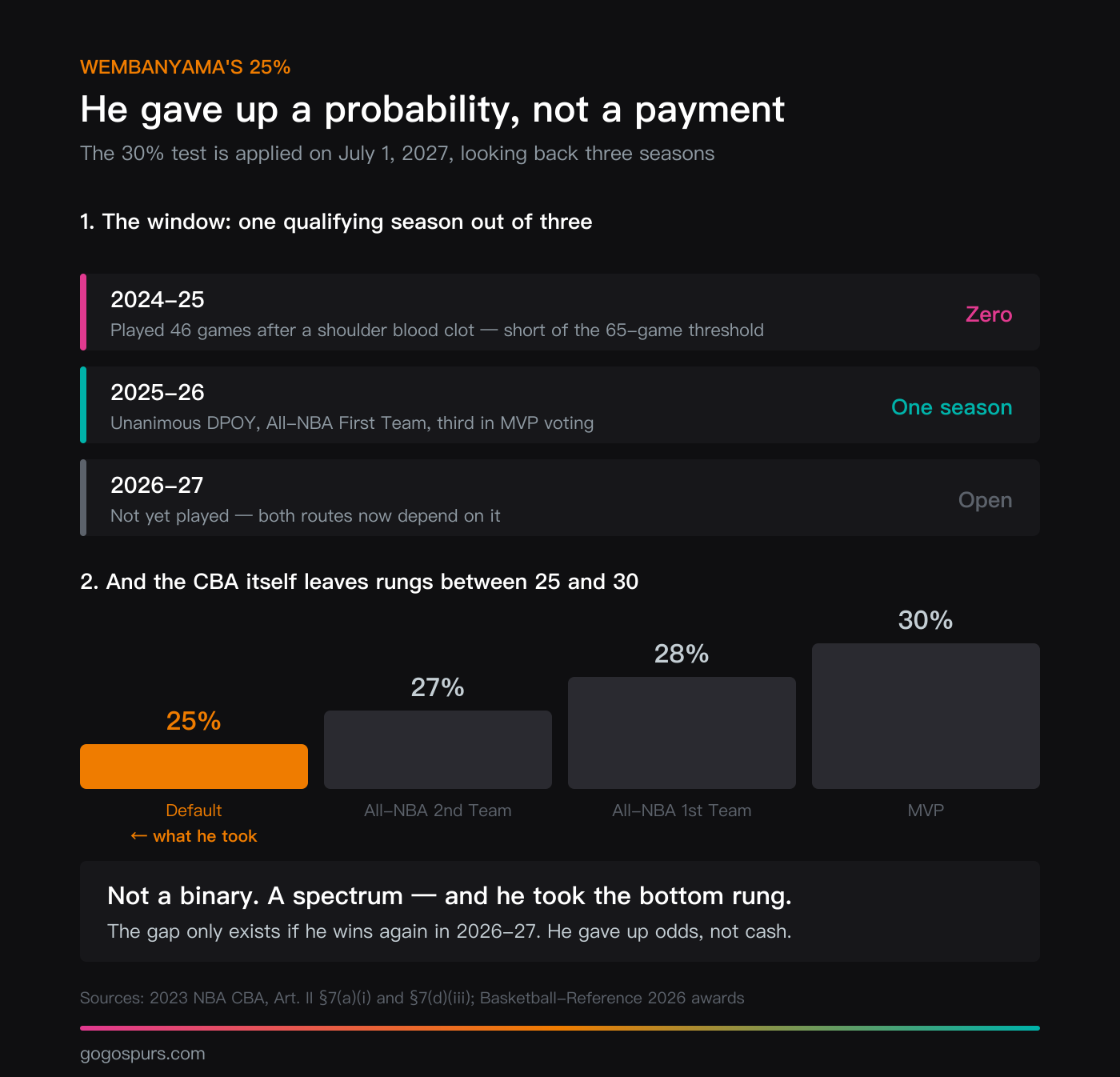
Correction two: that “$50 million” is a probability, not a payment
Subtract $252 million from $303 million and you get about fifty. That’s the arithmetic everyone ran.
But per the clause above, that money only ever exists if he wins All-NBA, DPOY or MVP in 2026-27.
If he gets hurt, or misses the games threshold again, the 30% was never available — and the Spurs saved nothing at all.
This is an easy inference to fumble: treating a counterfactual gap as banked savings. He didn’t give up the money. He gave up a chance at the money — and for a 7-foot-4 center who lost the back half of a season to a blood clot, that chance is well short of certain.
Worth adding: even the totals are projections. The CBA specifies that such deals convert to hard figures on July 1 of the year they begin, against whatever the cap turns out to be.
6. But it isn’t the same thing Duncan did
Here’s where I had to abandon my own thesis.
I set out to argue that Duncan’s pay cuts and Wembanyama’s 25% were one continuous tradition. Checking it out killed the argument.
First: Duncan was not a man who took less
I pulled the league’s historical salary caps and divided his actual yearly salaries into them:
| Season | Salary | Cap that year | Share of cap |
|---|---|---|---|
| 2007-08 | 19,014,188 | 55,630,000 | 34.2% |
| 2008-09 | 20,598,704 | 58,680,000 | 35.1% |
| 2009-10 | 22,183,220 | 57,700,000 | 38.4% |
| 2011-12 | 21,164,619 | 58,044,000 | 36.5% |
| 2012-13 (after the cut) | 9,638,554 | 58,044,000 | 16.6% |
In 2009-10, Tim Duncan alone absorbed 38.4% of the salary cap.
That is more than the 30% Wembanyama just passed on. It is more than today’s 35% veteran tier.
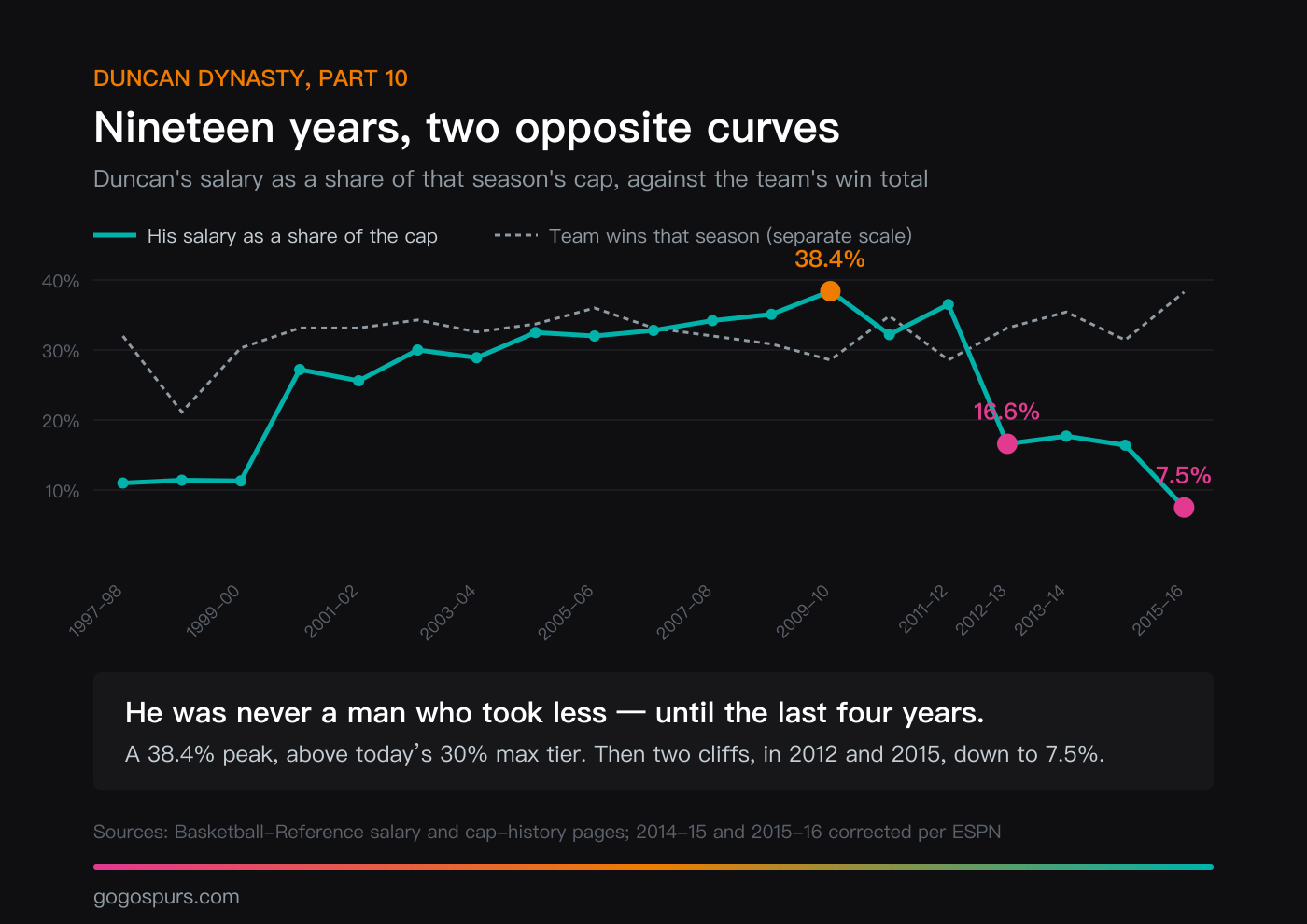
(One caveat on units, because it matters: 38.4% is an end-of-contract salary measured against that year’s cap, and old-CBA deals escalated annually, so late years run high. Wembanyama’s 25% and 30% describe a starting salary. Don’t subtract one from the other. But the conclusion — he was never a man who took less — survives the caveat easily.)
Second: at Wembanyama’s age, Duncan took every dollar
Wembanyama is 22 and signing his second contract. What did Duncan do at the equivalent moment?
Full freight. Not a dollar left behind.
The deal before that wasn’t a discount either. In 2000 he took meetings with Orlando and re-signed for three years and $32.6 million — often written up as a sacrifice, but the reporting at the time is explicit that he took the maximum salary and simply signed short, to get back to market sooner. That’s player leverage, not charity. It also worked: the seven-year deal came three summers later.
So the honest version is: Duncan’s discounts all came at the end — 2007, 2012, 2015 — after 31, after four and five rings were already in the case.
Third: taking less is not a Spurs invention, and the Spurs weren’t best at it
If this is San Antonio’s culture, these people need explaining:
- In 2014 Dirk Nowitzki signed for three years and $25 million, leaving more than $72 million on the table by Forbes’ count — more than Wembanyama just passed up
- In 2024 Jalen Brunson signed for four years and $156.5 million, $113 million less guaranteed than he could have had a year later, specifically to keep New York under the second apron. In fairness, the same ESPN piece notes the deal actually costs Brunson $37.1 million over the next three years — that headline number, like Wembanyama’s, front-loads every future possibility into a single figure
And that Forbes accounting of the largest giveback in league history doesn’t mention Tim Duncan at all.
Worse for the tidy version: Nowitzki’s career earnings finished ahead of Duncan’s. The man who discounted more, earlier, and more often made more money.
So what is actually different? The rules
Those three findings dismantle “same tradition.” What’s left underneath is more interesting.
The money Duncan gave back and the money Wembanyama gave back do not buy the same thing.
In 2012, the line Duncan was ducking under was the luxury tax, and in that era the penalty for crossing it was essentially a bill. The owner paid more; the team kept operating. Money problems were solvable with money. So the salary he surrendered converted directly into contracts: Diaw, Green, Mills. Cash in, players out.
That trade no longer exists.
And the penalties above that second line, written into Article VII of the agreement, are not fines: no aggregating salaries in trades, no sending cash in deals, no taxpayer mid-level exception — and a first-round pick seven years out gets frozen, then dropped to the last slot in the round if the team crosses again twice in the following four years.
That’s the whole distinction: a tax bill can be paid off. An apron restriction can’t be. The only exit is getting cheaper.
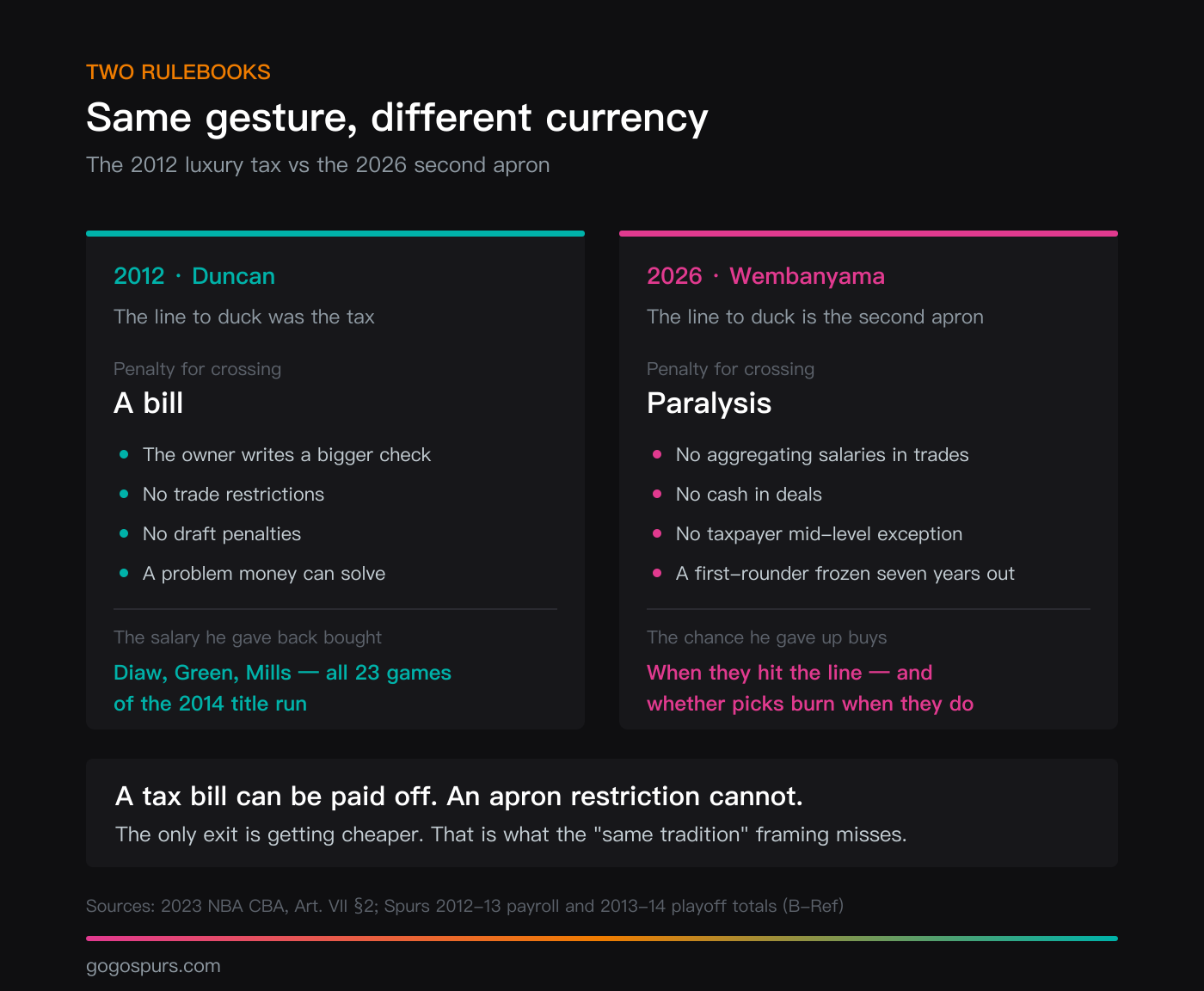
This is not hypothetical. Two years after winning the 2024 title, Boston traded 2024 Finals MVP Jaylen Brown to Philadelphia in July 2026 to escape the second apron, which the Globe described as having severely limited their ability to make trades and sign players.
So the correct sentence is this. Duncan gave up his owner’s money. Wembanyama gave up his team’s freedom to move. Morally similar. Structurally not the same act at all.
7. One more thing I can’t pretend not to see
The argument is more honest now than when I started. But there’s a last problem, and skipping it would leave this piece where everyone else’s ended.
Does the discount actually keep San Antonio out of the second apron?
I don’t think it does, and I think saying otherwise is dishonest.
The discount averages somewhere around ten million a year and doesn’t start until 2027-28. Meanwhile the heaviest object on the payroll isn’t Wembanyama — it’s De’Aaron Fox, at $49,488,300 for 2026-27, several times the size of the annual saving in the back years.
The clearest evidence is right now. This summer the Spurs used the full non-taxpayer mid-level exception, $15,044,000, to sign Tobias Harris — a move that under the transaction rules hard-caps them at the first apron for the entire season. Reporting put their room under that line at about $10.5 million.
They’re already constrained, and his discount hasn’t even started.
So the honest claim isn’t that this money keeps San Antonio out of the apron. It’s that it buys when they hit it, and whether draft picks go into the fire when they do.
Less romantic than a superstar funding a dynasty out of pocket. But true.
It’s also worth recording a dissent: Rich Paul, one of the most powerful agents in the sport, has publicly questioned this kind of deal — players don’t play forever, and value doesn’t hold or rise indefinitely. Applied to a 7-foot-4 center coming off a blood clot, that objection carries weight.
And the players’ union is saying it out loud
I assumed “the system is squeezing players into giving money back” was a fan’s hunch. It isn’t. It is the union’s formal position, and they raised it about this exact contract.
On the day Wembanyama signed, NBPA executive director David Kelly said:
“The system should not require a player to carry all of that burden.” — David Kelly, NBPA executive director, July 10, 2026
Two blunter passages from the same session:
“We are not fans of the second apron. We did not propose the second apron. We should have done a better job of fighting back against the second apron.”
“We’re seeing [the apron system] decimate teams and force decisions to be made that are not basketball decisions.” — same
Union president Fred VanVleet added that more teams, general managers, front offices, owners and agents share those concerns — close to a consensus that it needs addressing.
Zoom out one more level and the players’ slice was already cut. Under the old agreement players received 57% of basketball-related income; after the 2011 negotiation it became 51.15% in 2011-12 and a band of 49% to 51% thereafter. That machinery is still in force: the current 2023 agreement fixes the floor at 49% and the ceiling at 51%.
So here is the full shape of it: the players’ share of the pie was compressed first — and then, inside that smaller pie, a line was drawn that squeezes individual stars into giving back again.
And after all that, the team is still hard-capped with about ten million dollars of room.
8. Two ping-pong balls, 26 years apart
Back to where the series started.
Part one argued that luck is part of skill — skill being the ability to convert luck into results, plus the ability to survive the bad kind, with both sides of the ledger acknowledged.
Ten parts later, here’s the other half.
In 1997 the Spurs went 20-62 after losing David Robinson and Sean Elliott to injury. They won the lottery and took Tim Duncan.
In 2023 they went 22-60. They won the lottery and took Victor Wembanyama.
Rock bottom plus a ping-pong ball, twice. Everyone knows that part.
Here’s the part nobody tells: between 1998 and 2019, San Antonio did not hold a single lottery pick.
I scanned the franchise’s postseason history end to end. The Spurs made the playoffs in 22 consecutive seasons from 1997-98 through 2018-19, a run that ended only with the 32-39 season of 2019-20.
Twenty-two straight postseason appearances also means twenty-two straight years of being ineligible for the lottery. For those two decades the raw material was late first-rounders, second-rounders, international scouting and free agency — no second chance at luck, ever.
When Duncan left in 2016 that streak was still alive. It lasted three more seasons.
Only then came the floor: 22-60 in both 2022-23 and 2023-24.
Twenty-six years separate Duncan’s arrival from Wembanyama’s. In that whole span the Spurs got exactly two pieces of real lottery fortune, at the two ends. Everything in between was structure.
That’s what I want to leave the series on.
Luck really is part of skill — but it doesn’t come around often. It might come twice in twenty-six years. All a team can do is still be standing when it arrives, be capable of catching it, and then make it last a very long time.
San Antonio caught it twice. The twenty-two years in the middle, with no lottery pick and no way to get one, are what this series has actually been about.
And that is the last piece this part adds.
A franchise controls almost nothing. It can’t control the ping-pong balls, or a knee, or what the other team makes in Game 6. So it leans on the one variable that will move — the players’ salaries.
Nobody has to act in bad faith for this to happen. It’s the direction the system tilts: when every other input is locked, the one with any give gets squeezed, repeatedly. And the current agreement wrote that squeeze into the rules — cross the line and the penalty stops being a check and starts being paralysis.
Which means “the player volunteered” is going to look less and less like a choice.
Back to the question I opened with
I said at the top that what I couldn’t get past was this: they didn’t have to do it, and did the team ever make it up to them?
Here is where I land.
Taking less is genuinely a virtue. That does not make it fair. Those two things get collapsed into one, and the collapse only ever costs the player — because once you call something a virtue, nobody has to pay for it. Applause will do.
For Duncan the ledger roughly balances. He was paid in full for fourteen years first — a seven-year, $122 million maximum in 2003, 38.4% of the entire salary cap to one man in 2009-10. He gave money back at the end, after he had already made it. And the team gave him something only six players in the league had.
Even so, one page of that ledger never reconciled: the nearly $11 million he surrendered in 2007 was reported as buying flexibility to chase free agents, and when that summer came the team had not a dollar of cap room. Nobody had to explain it to him, because he never asked.
For Wembanyama the ledger hasn’t opened yet.
He is 22, without a title, and has never been paid on a big contract — 2026-27 is still the last year of his rookie deal. He isn’t giving money back after making it. He is giving it back before earning it. And what he surrendered is a sum that only exists if he wins another award in 2026-27 — meaning he absorbed the risk as well: play great and he really did leave money behind; get hurt and he saved nobody anything, least of all the team.
So my read is this:
Not a tradition continuing. A tradition accelerating — and what accelerated isn’t only the timing. It’s the transfer of risk.
Duncan did it in year 14. Wembanyama did it in year 3. That gap — not the resemblance — is the story.
And if you ask me whether it’s fair: under the old rules it was one man’s choice. Under the new ones it looks increasingly like an expectation. That is exactly why the union reaches for language like “the system should not require a player to carry all of that burden” — once “volunteering” becomes a precondition for a team staying competitive, it has stopped being purely a virtue.
The read is falsifiable, so here are the terms: if Wembanyama wins All-NBA or Defensive Player of the Year in 2026-27 and the Spurs still smash into the second apron after 2028-29 and start breaking up the roster, then this discount bought far less than I’m claiming — and he gave it up for nothing. If instead they get both Castle and Harper extended and keep the group intact, it bought considerably more — though that would only prove it worked, not that it was fair.
We’ll know in a decade. Part one of this series was about a ping-pong ball in 1997 and part ten is about a contract in 2026, and what the 29 years between them demonstrate is that this kind of question is never answerable on signing day.
Last
On December 18, 2016, the Spurs beat New Orleans 113-100 at home and raised his number 21 to the rafters afterward. It had been 160 days since the press release.
That night he finally spoke.
Before he went up, Bruce Bowen, David Robinson and the rest of them were in the hallway running a betting pool on how long he’d talk — nobody’s impression of him lasted a minute.
He went four minutes and 18 seconds. He opened with this:
“I’m going to tell you this: I won a lot of bets tonight. I didn’t wear jeans. I wore a sport coat, and I spoke for more than 30 seconds. Thank you, San Antonio. Thank you.” — Tim Duncan, December 18, 2016
Which is probably why the July release didn’t need anyone to speak in it.
A man who showed up early and stayed late for nineteen years, took less money three times, and explained himself exactly never, could be seen off in nothing but numbers. The evidence had been filed already.
And now: the Spurs have just played in a Finals, losing four games by a combined 16 points. Popovich moved upstairs to team president on May 2, 2025. And a 22-year-old center just signed a contract he had no obligation to structure that way.
The Duncan dynasty ends here.
The first document of the next one is already on file.
The full series: Part 1 · the 1997 Twin Towers, Part 9 · the 2014 Beautiful Game, and the thesis running under all of it, the culture multiplier. For analysis of the Wembanyama extension itself, see the $252 million deal.
Sources: ESPN — Spurs sign Gary Neal (July 22, 2010), Basketball-Reference — 2010-11 Spurs, ESPN — NBPA on players carrying the burden of the second apron (July 10, 2026), ESPN — Larry Coon on how the 2011 CBA compares to the last one, NBA — 2023 Collective Bargaining Agreement (official PDF), ESPN — Duncan’s 2012 three-year deal includes a no-trade clause, Bleacher Report / Marc Stein — Duncan 2015 re-signing details, ESPN — Marc Stein on the 2015-16 no-trade clause list, Forbes — the billionaire owners of the San Antonio Spurs (June 13, 2026), Forbes — the most valuable NBA teams 2025, NBA — 2010-11 salary cap announcement, HoopsHype — Spurs 2010-11 payroll, Sports Illustrated — Spurs acquire Richard Jefferson (June 23, 2009), WalterFootball — Spurs 2010 offseason moves, NBA — Duncan steps down as assistant coach (Nov 12, 2020), ESPN — Ginóbili returns as special adviser (2021), Spurs — Tim Duncan retirement release (July 11, 2016), Spurs — A Letter From Tim (July 13, 2016, archived), Spurs — Manu Ginóbili retirement release (2018), ESPN — Duncan announces retirement (July 11, 2016), ESPN — Popovich farewell transcript (July 12, 2016, archived), AP / Spokesman-Review — Popovich bids farewell (July 12, 2016), ESPN Stats & Info — Duncan departs as an all-time great (July 11, 2016), ESPN — number 21 jersey retirement (Dec 18, 2016, archived), ESPN — Duncan signs seven years, $122M (July 16, 2003, archived), Yahoo Sports — Duncan will take less than maximum salary (Oct 30, 2007), ESPN — Duncan exercises $10.3M option (June 23, 2014), ESPN — Duncan exercises $5.6M option (June 28, 2016), San Antonio Express-News — Duncan on re-signing (July 11, 2012, archived), CBS/AP — Duncan staying in San Antonio (2000), Basketball-Reference — Tim Duncan, Basketball-Reference — Spurs franchise index, Basketball-Reference — 2012-13 Spurs, Basketball-Reference — 2025-26 Spurs, Basketball-Reference — Spurs contracts, Basketball-Reference — NBA salary cap history, Basketball-Reference — Manu Ginóbili, Basketball-Reference — Dirk Nowitzki, Basketball-Reference — 2026 awards, Basketball-Reference — 2026 playoffs, Basketball-Reference — final game box score (May 12, 2016), Basketball-Reference — same game play-by-play, Basketball-Reference — jersey retirement night box score (Dec 18, 2016), Fox News/AP — Thunder eliminate Spurs (May 12, 2016), ESPN — Wembanyama five years, $252M (July 10, 2026), CBS Sports — Wembanyama contract explained (July 10, 2026), ESPN — Wembanyama shut down with blood clot (Feb 2025), NBA 2023 Collective Bargaining Agreement (PDF), Hoops Rumors — 2026-27 cap and tax lines, Hoops Rumors — Spurs sign Tobias Harris (July 2026), Hoops Rumors — 2026-27 rookie scale option decisions, ESPN — Jalen Brunson accepts $113M less (2024), Forbes — Dirk Nowitzki passes up the most money in NBA history (2014), Boston Globe — Celtics trade Jaylen Brown (July 2026), Spurs — Popovich transitions to team president (May 2, 2025)
The judgments here are the author’s; every factual claim links to its original reporting. If something is wrong, write to contact@gogospurs.com and I will correct it publicly.