Wembanyama's $252M Extension and the Second Apron
Two things happened in San Antonio on July 10, 2026, about three hours apart.
At 6:47 p.m. ET, ESPN’s Michael C. Wright, citing Shams Charania, reported that Victor Wembanyama had agreed to a five-year maximum rookie-scale extension worth $252M, with a player option in the fifth season. Wembanyama’s own summary, posted that night, ran to seven words:
“Spurs family, I’m here to stay. Whatever it takes.”
At 9:56 p.m. ET, also at ESPN, Ben Golliver filed from Las Vegas: players’ union executive director David Kelly had spent his press conference demanding that the league soften or scrap the second apron. Asked directly about Wembanyama, Kelly said this:
“The system should not require a player to carry all of that burden. We should not put a player in the position to carry the burden of keeping a team together.”
Same night, same event, two readings. One frames a young star’s choice as virtue. The other says nobody should have been put in that position to begin with.
I am with the second one, and I will put my cards down now: the move is very San Antonio and I have no problem with the basketball logic — but a 22-year-old who may not have hit his prime yet should not be the one buying his team’s competitiveness.
What follows is the version with the receipts: what he actually gave up, why “saves the Spurs $50M” is the wrong sentence, and which season the bill actually comes due.
The deal, year by year
Start with the money. He is playing this season on the last year of his rookie deal at $16,868,246. The extension does not hit the books until next season, runs five years, and ends with a player option.
Per Spotrac’s structure, it starts at $43,500,000 and rises by 8% of that first-year figure every season:
| Extension year | At 25% (signed) | At 30% (never triggered) | Annual gap |
|---|---|---|---|
| Year 1 | $43,500,000 | $52,200,000 | $8,700,000 |
| Year 2 | $46,980,000 | $56,376,000 | $9,396,000 |
| Year 3 | $50,460,000 | $60,552,000 | $10,092,000 |
| Year 4 | $53,940,000 | $64,728,000 | $10,788,000 |
| Year 5 (player option) | $57,420,000 | $68,904,000 | $11,484,000 |
| Five-year total | $252,300,000 | $302,760,000 | $50,460,000 |
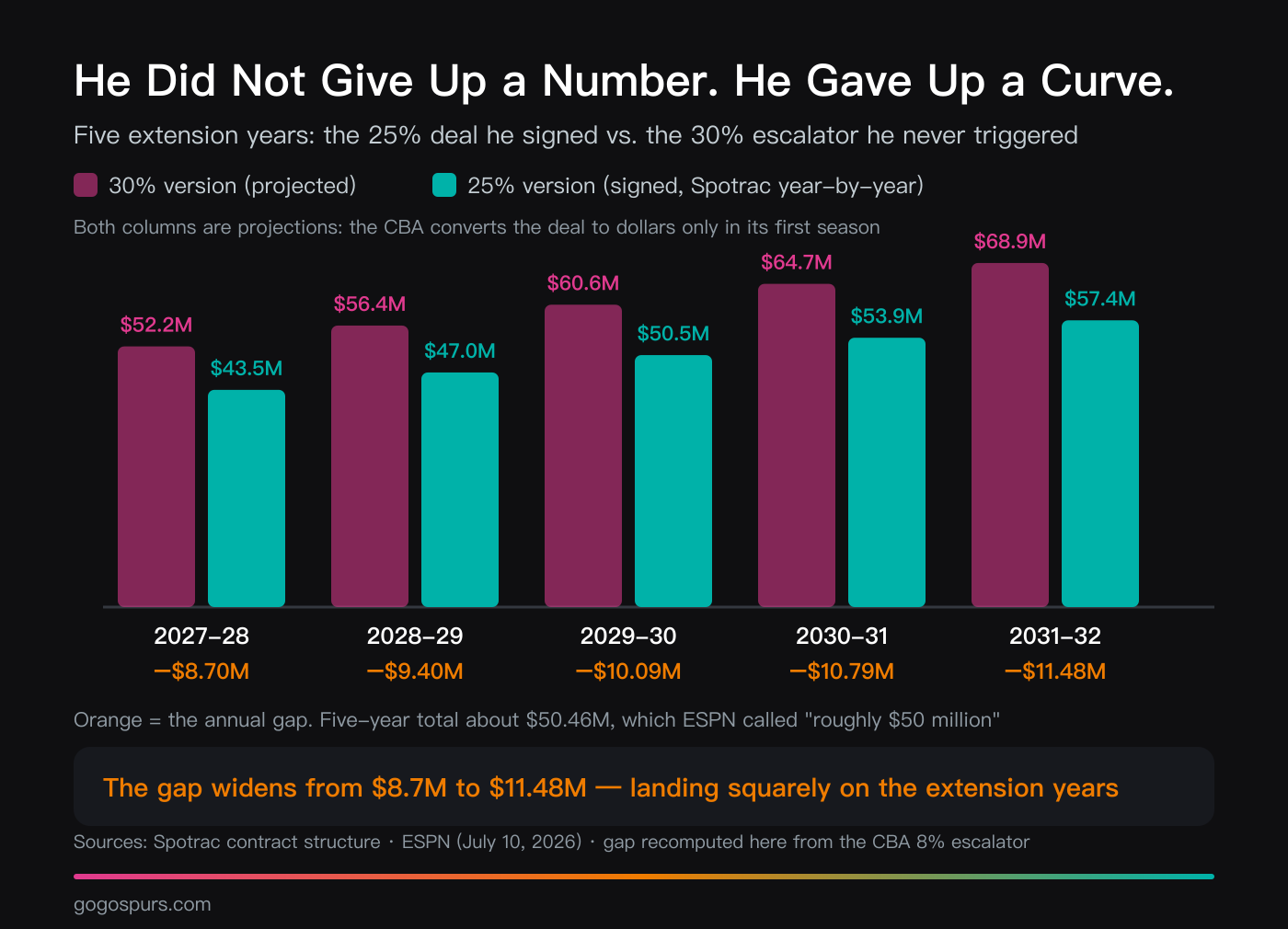
The left column is what Spotrac already has on file. The right column is our arithmetic, applying the same 8% escalator to a 30% starting point. Two independent checks land where they should: the five-year total matches the “five-year pact worth $302.8 million” ESPN cited in the union story, and the difference matches the “roughly $50 million” from the original report.
Every cell above is still a projection. The CBA converts a percentage-of-cap extension into actual dollars only when its first season begins, so all of these numbers move with whatever the league announces in July 2027 — but both columns move together, and the ratio holds.
The column that matters is the last one. The gap is not flat. It starts at $8,700,000 and finishes at $11,484,000. That widening curve is the whole story, and where it widens turns out to matter more than how much.
Three words the coverage keeps blending together
ESPN’s phrasing was “the 25% maximum instead of the 30% supermax escalators.” That sentence needs two corrections, and I went through the 2023 collective bargaining agreement line by line to make them.
A supermax is not 30%. It is 35%. Article II, Section 7(a)(ii) reserves the Designated Veteran Player Contract — what everyone calls the supermax — for players with eight or nine years of service who never left the team that drafted them, and it tops out at 35% of the cap. Wembanyama is what the document calls a “5th Year Eligible Player.” His ceiling was 30% and never anything else. Two different mechanisms, one borrowed nickname.
That 30% tier has a real name, and it isn’t the Rose Rule. The CBA calls the qualifying standards the “Higher Max Criteria,” and the phrase “Rose Rule” appears nowhere in the document. The bar: All-NBA (any team) or Defensive Player of the Year in the immediately preceding season or in two of the previous three, or MVP in one of the previous three.
And what he gave up was not a number. It was a bracket. Section 7(d) offers three ways to write a rookie-scale extension. A player who has already qualified can lock in any figure between 25% and 30%. A player who has not yet qualified can write the conditional version, which reads:
“25% of the Salary Cap in effect during the first Season of the extended term, or, if the player meets at least one of the applicable Higher Max Criteria during the fourth Season of his Rookie Scale Contract, [ ]% of the Salary Cap in effect during the first Season of the extended term.”
That empty bracket is the thing Wembanyama declined to fill. CBS Sports’ Sam Quinn put it plainly the same day:
“What Wembanyama is doing here is foregoing those escalators. He just took a 25% max, no questions asked. Even if he makes an All-NBA Team or wins Defensive Player of the Year or MVP, he will not get boosted up to 30%.”
The CBA even prints a sample ladder to show the range is continuous rather than binary: All-NBA Second Team 27%, All-NBA First Team 28%, MVP 30%.
So he did not pick 25% over 30%. He picked the floor of a negotiable range.
Why “saved the Spurs $50 million” is the wrong sentence
ESPN wrote “could potentially save.” Both of those words are load-bearing, and both fall out of most retellings, which leaves you with a man writing his team a check.
The bracket is conditional, and the condition is tied to the fourth year of his rookie deal — the season he is about to play. He has to earn All-NBA or Defensive Player of the Year again, this year, for that clause to fire. Last year he lost the award cycle entirely to a shoulder blood clot, and Quinn identified the mechanism:
“Well, that might be the case if not for the 65-game rule. Wembanyama just barely skirted beyond the threshold last season, and he didn’t reach it in the 2024-25 campaign.”
Which means both routes to 30% — “the immediately preceding season” and “two of the previous three” — ran through this year and only this year. Put bluntly: if he gets hurt or the voters go elsewhere, the 30% was never available and San Antonio saves nothing. Quinn reached the same conclusion we did:
“So the answer to whether or not Wembanyama took a discount depends on what happens this season.”
None of this is a knock on him. His last season holds up to any standard: Defensive Player of the Year, All-NBA first team, career highs of 25.0 points and 11.5 rebounds, a league-leading 3.08 blocks, and the seventh 25-10-3 season in league history. Asking him to do it again is not a stretch.
But it is still a probability, not a check. He gave up an expected value. For what it is worth, he played only 64 regular-season games last year and reached the awards ballot because the NBA Cup final counts as an additional appearance under league rules — a technicality that got him to 65. Which is a fair summary of this entire situation.
The second apron is not a new rule
Before the rest of it makes sense, one thing has to be cleared up: there is nothing new about the second apron.
It was written into the CBA that took effect in July 2023. The text sets the level in the agreement’s first salary cap year at that season’s tax line plus $17,500,000, then scales it to the cap every year after. The tier has existed since the day the deal was signed.
The document did grant one year of grace. Section 2(e)(5) of Article VII exempts the first salary cap year: teams that made rows F through J transactions that season were not barred from finishing above the corresponding apron. The teeth came the following year. Section 2(f)(2) opens like this:
“Beginning with the 2024-25 Salary Cap Year, if a Team is a Second Apron Team for a Salary Cap Year, then: (i) the Team shall be prohibited from trading (either conditionally or unconditionally) its first round draft pick in the first NBA Draft that occurs following the seventh Season that follows the Season occurring within such Salary Cap Year”
In plain English: from that salary cap year forward, cross the second apron and your first-round pick seven years out is frozen. Do it twice more within the following four years and that pick slides to the last slot in the round.
Kelly, again, said it in one line:
“The apron’s been in place for three years. For five years leading into the apron, we had parity. I don’t think the apron was necessary to create parity.”
He said that in July 2026. So: the tier has been in the text since the agreement began, the enforcement arrived in full with the 2024-25 salary cap year, and three complete seasons have now been played under it. Any story calling it “newly implemented” is describing something else. It is not new, and the results are already in.
What it has done to everyone else
One number from the union story is worth keeping: exactly one team, the Cleveland Cavaliers, finished above the second apron last season.
The rest are not unwilling. They are unnerved. Per the same report: the Boston Celtics traded 2024 Finals MVP Jaylen Brown to the Philadelphia 76ers, with the second apron cited as one factor; the New York Knicks won the 2026 title and owner James Dolan still said the team would look to avoid second-apron penalties, after which backup center Mitchell Robinson walked in free agency. On Boston, Kelly said:
“You have a [Celtics] team that just came off of a championship [in 2024] that will not have those guys together.”
Rockets guard Fred VanVleet, the union’s president, added the detail that makes this more than a players’ complaint:
“We’ve seen more teams, GMs, front offices, owners and agents have issues and concerns with the apron as well. That’s a little bit newer, right? We had to see it play out. It’s almost a consensus that it’s something that needs to be addressed.”
One champion that could not stay together, another that chose not to try. That was the view from Wembanyama’s side of the table.
Where San Antonio actually stands
The league published this season’s thresholds on July 1. Four numbers:
| Threshold | Official figure |
|---|---|
| Salary cap | $164,961,000 |
| Tax level | $200,428,000 |
| First apron | $209,015,000 |
| Second apron | $221,686,000 |
San Antonio is tighter against those lines than most people assume.
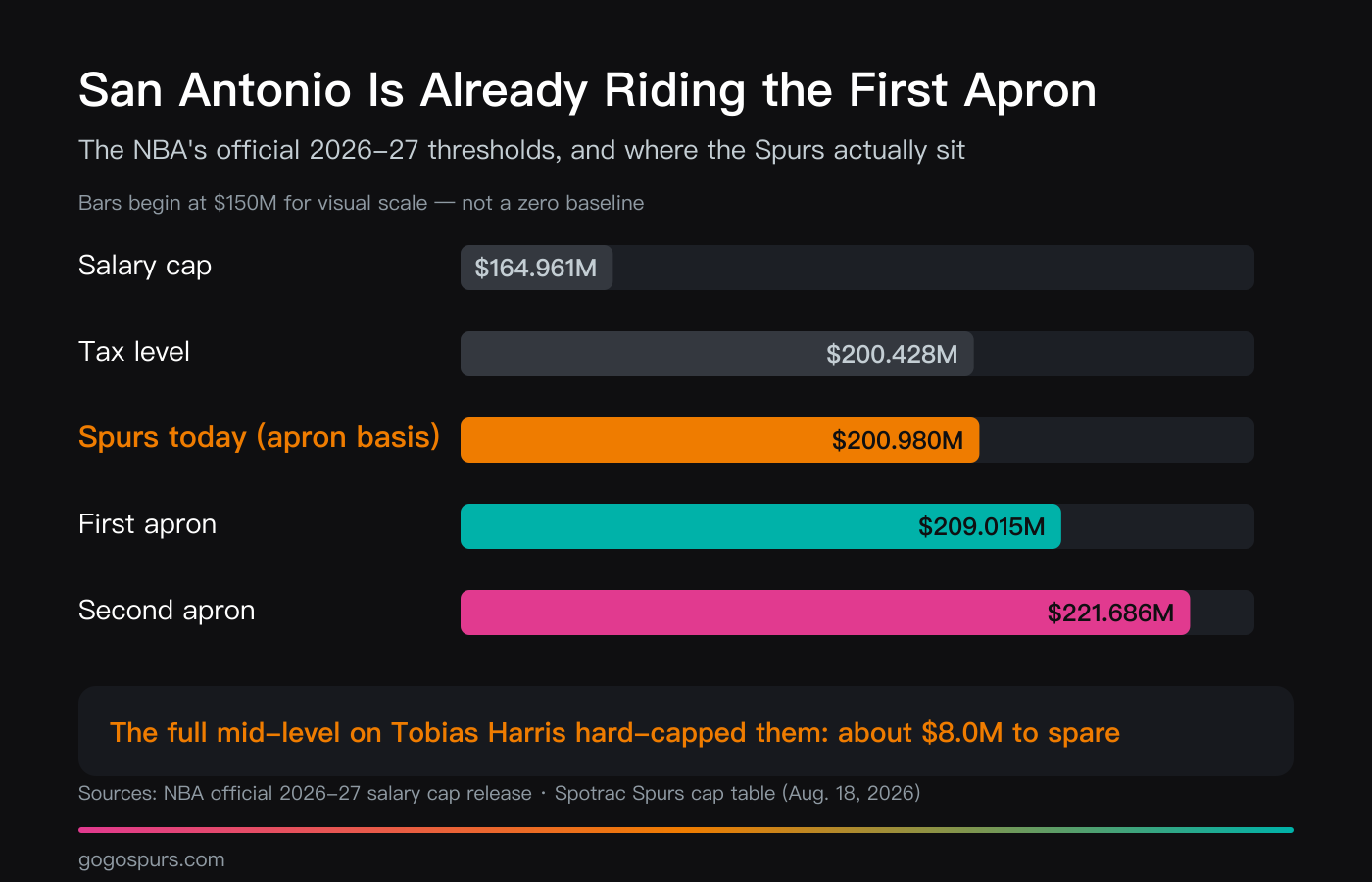
Per Spotrac, the Spurs’ apron team salary is $200,979,967, leaving $8,035,033 below the first apron. And this is not merely proximity. They spent the full non-taxpayer mid-level ($15,044,000) on Tobias Harris, and Spotrac’s page carries the consequence in one line:
“This team is currently hard-capped at the first apron.”
That is a hard cap, not a tax threshold. No exceptions, all season.
So the flexibility is already gone — and Wembanyama’s extension has not started counting yet. That is the financial backdrop to bringing the whole roster back and adding only Tobias Harris this summer. Not a lack of ambition. A team that knows exactly when the next invoice arrives.
The fork is two years out
Three bills come due in order:
| When | What |
|---|---|
| Next season | Wembanyama’s extension starts counting |
| July 1, 2027 | Stephon Castle becomes extension-eligible |
| July 1, 2028 | Dylan Harper becomes extension-eligible |
| Aug. 4, 2028 | De’Aaron Fox becomes extension-eligible |
Year one of the extension is survivable: eleven players under contract at $201,749,199, with roughly thirty million to spare against a projected second apron.
The year after is where it gets interesting.
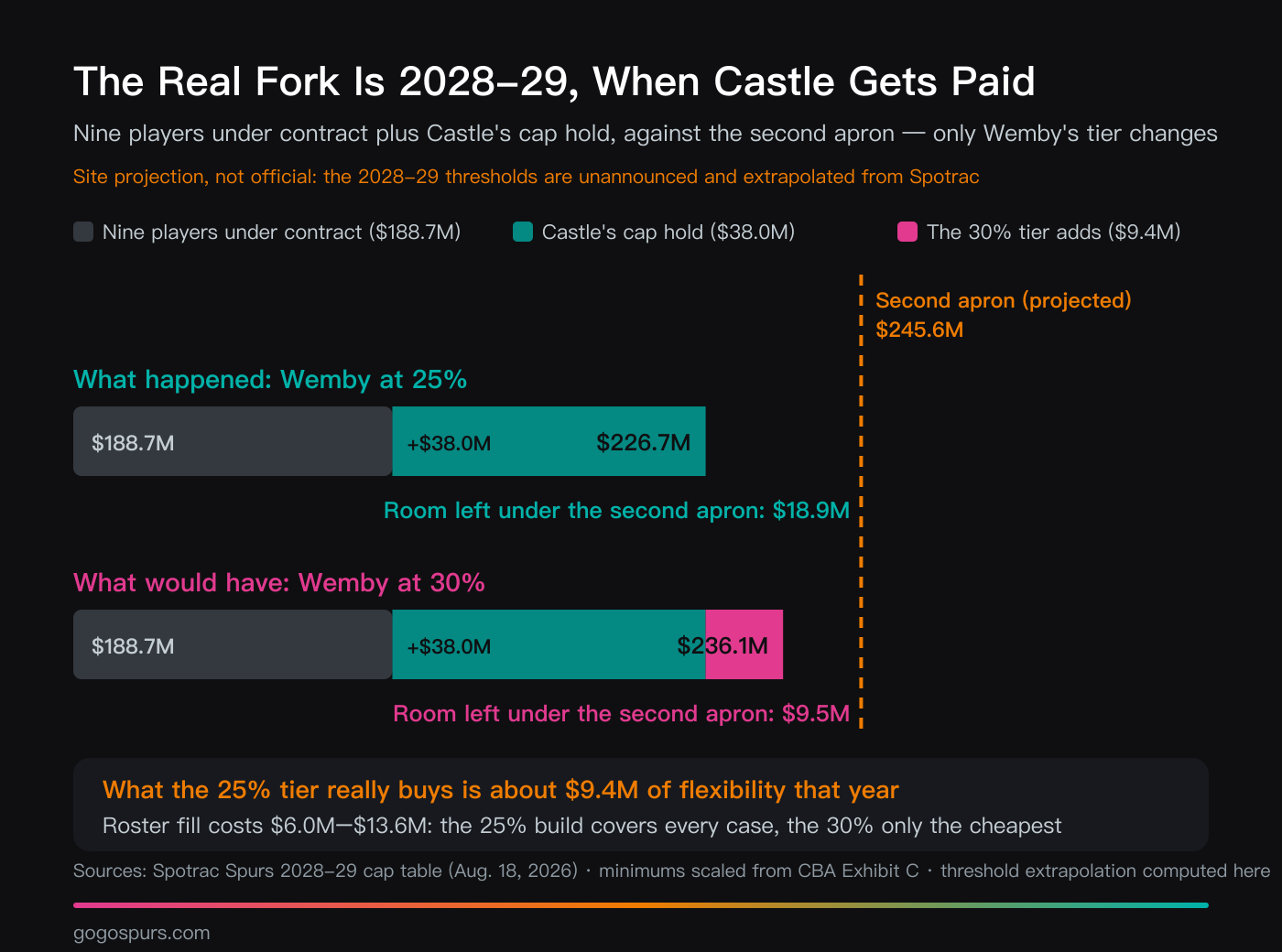
Here is the shape of it: nine players under contract for $188,720,321, with Stephon Castle sitting on the sheet as a restricted free agent carrying a $38,010,417 cap hold. That is past $226,000,000 before anyone fills out the roster.
What follows is our projection, not a reported figure, and the assumptions are here to be checked: the league has not set that year’s thresholds, so I scaled Spotrac’s prior-year projection by the cap ratio and landed on a second apron a little above $245,000,000. On that basis:
- Wembanyama at 25% (what happened): roughly $18,900,000 of room
- Wembanyama at 30% (the counterfactual): roughly $9,500,000
And the roster still is not full. The assumptions here matter, because they decide how strong the conclusion can be:
Article XXIX, Section 2(a) of the CBA requires each team to carry either fourteen or fifteen players across its active and inactive lists during the regular season, excluding two-way deals — the text reads “either fourteen (14) or fifteen (15) players”, so fifteen is not mandatory. Minimum salaries are also tiered by service time, and when a team uses the minimum exception on a player with three or more years, the cap charge is capped at the two-year tier. Scaling Exhibit C’s baseline table to that season’s projected cap gives this:
| How you fill it | All rookie-scale minimums | All veteran minimums |
|---|---|---|
| Up to fifteen (five spots) | about $7,520,000 | about $13,570,000 |
| Up to fourteen (four spots) | about $6,020,000 | about $10,850,000 |
(You can check the conversion: run the same method on this season and the two-year tier lands on $2,449,422, against the $2,449,421 Spotrac lists for San Antonio’s veteran-minimum deals — a dollar apart.)
Against the room above: the 25% build absorbs all four scenarios. The 30% build only survives the cheapest ones — the versions where every addition is a minimum-service player. Wanting veterans in those spots forces a choice between bench quality and crossing the second apron.
So the precise claim is not “the 30% tier makes the roster unfillable.” That overstates it. It is this: the 25% tier buys about $9,400,000 of flexibility that season, and with it the choice of who fills the last spots.
Which is how the question of how to divide the ball among three guards turns into a payroll question: the better Castle and Harper play, the more their next contracts cost.
One piece of causation nearly everyone gets backwards
The standard version of this story — including the one I had in my head before I opened the document — is that Wembanyama took less so the Spurs could keep all four of them.
Read the transaction restrictions table and that sentence falls apart.
Article VII, Section 2(e)(4) lists eleven rows, A through K. The first seven are tied to the first apron. The last four are tied to the second: acquiring a player with an aggregated traded player exception, sending cash in a trade, using a trade exception that was created by signing-and-trading one of your own players, and signing anyone with the taxpayer mid-level. (Worth separating: receiving a signed-and-traded player is row C, which sits under the first apron — the two are easy to conflate.)
Ten of the eleven begin “Team signs” or “Team acquires”; the eleventh is “Team pays cash to another Team in connection with a trade.” Every restriction covers bringing someone in from outside, or what you spend to do it. Re-signing your own free agent with Bird rights — a Qualifying Veteran Free Agent, in the document’s language — does not appear anywhere in the apron restrictions.
The second apron has never stopped a team from keeping its own players. What it takes away is every tool you would use to build out spots six through fifteen, plus the draft penalties.
So the accurate version is not “25% is why the four of them can coexist.” It is: 25% is why the bench is still affordable while they do. The claim survives the correction. It just has to be stated properly.
And the most expensive contract was never his
One more comparison belongs here. De’Aaron Fox is on the team’s largest deal at $49,488,300, a full 30% of the cap. In year one of Wembanyama’s extension, Fox makes $53,447,364 to Wembanyama’s $43,500,000. The year after, it is $57,406,428 to $46,980,000.
Across all five years, the most expensive player on San Antonio’s books is never Wembanyama. If this team ever does cross the second apron, his is not the first contract anyone will re-examine — which should tell you something about how much narrative weight has been placed on one 22-year-old’s percentage.
The “Spurs pay-cut tradition” does not survive a fact check
I started this piece intending to run the line back to 1999: David Robinson stepping aside for Tim Duncan, then Duncan taking less again and again, then Wembanyama. A tidy inheritance.
It breaks at the first link.
Robinson spent the 1990s among the highest-paid players in the league, not among the ones subsidizing their teams. The negotiation that actually made the papers came in 2001, and it ran the other direction:
“Robinson had rebuffed the Spurs’ suggestion he take a pay cut anywhere from 50 percent to 80 percent of the $14.7 million he made last season.”
The same report has chairman Peter Holt saying the reduction was what keeping the team competitive required. The front office asked. The player declined.
Robinson did give something up in 1999, and it was not a small thing — he handed over the first option, the offense, and a city’s understanding of whose team it was. It just wasn’t money. Filing that under salary sacrifice is a widely repeated claim that does not survive being looked up.
The Duncan half is real. The best-documented instance came in 2012, when NBC Sports reported he took a steep cut that let the team re-sign its key free agents and duck back under the tax line — north of twenty-one million down to a little over nine. He did it more than once; we went through the CBA language clause by clause in the final part of the Duncan dynasty series, including why his cuts and Wembanyama’s choice are structurally different animals.
So the honest version is that this tradition starts with Duncan, not Robinson — and that even Duncan is an imperfect match. He gave back money that was already negotiated and certain. Wembanyama gave back a condition that has not happened yet.
But the technical difference is not what stops me. The age is.
You can make Duncan’s cuts add up. He was 36 in 2012, on the back nine, and trading salary for help is what a player does when he can see the end of his own runway.
Wembanyama is 22. He may not have reached his prime yet, and he is already giving money back.
Why?
Where I come down
I think the basketball logic here is sound. I am not going to write it up as a morality tale — and the reason is not in the numbers. It is who is paying.
A playing career is short. Short enough that you have to treat it as an asset with an expiration date: one injury, one bad stretch, one piece of rotten luck, and the curve just stops. Franchises do not expire. Neither does the league. So when a team’s competitiveness has to be funded out of one player’s limited window, I cannot file that under feel-good story. Building a contender is the front office’s job. It should not be paid for by the player.
Now connect that to the money. In year one, the distance between 25% and 30% is $8,700,000 — not a dramatic number for a team already hard-capped, and not enough on its own to decide which side of an apron they finish on. What makes it valuable is timing: the gap widens every year, and the rate it widens at happens to match the rate Castle’s and Harper’s extensions arrive. By year two it stops being “a little cheaper” and becomes “can we still afford the bench we actually want.”
The move itself is very San Antonio — not solving a problem with one big trade, but staggering the peaks so the invoices never land in the same summer. This franchise has been running that play for thirty years.
But executing it well is not the same as it being necessary. Kelly’s line — “We should not put a player in the position to carry the burden of keeping a team together” — is aimed at the system, not the player. ESPN reported that the team was “offering the full super max and different variations of extensions.” He picked the floor himself. When a league needs its best players to volunteer for less so that a Finals team can stay intact, that is not discipline working. That is a design flaw.
And there is an asymmetry nobody says out loud: if he plays well enough this season to win those honors, he really did leave the money behind. If he gets hurt, the money never existed and he left nothing. The praise is identical either way — which usually means the thing being praised was never really the money.
On Fox: I keep him
The research points hard the other way. He is the most expensive contract on the team, he out-earns Wembanyama in each of the next two seasons, and moving him before Castle’s extension is the cleanest fix on the whiteboard. I understand the math.
I still keep him.
The reason is not on the cap sheet. It is what San Antonio is. This is a small market. Coming off a Finals run does not suddenly make it Los Angeles or New York — those teams recruit off the logo. San Antonio never has. Replacing talent here is genuinely hard.
So cap room and a proven starting backcourt are not an even trade. Room only becomes a player if someone says yes; the player is already in the building. I would rather carry a contract that looks too big than spend the summer of 2028 holding flexibility and chasing someone who was never going to come.
What would change my mind
- If he misses All-NBA and Defensive Player of the Year this season, the 30% route was closed anyway and San Antonio saved nothing. That would not make his choice wrong. It would expose “saved $50M” for what it always was: a probability, not a payment.
- If Castle or Harper never grow into max-money players, the squeeze two years out never happens and this contract’s financial value shrinks — which is the bad version, because it means the young core did not hit.
- If Fox’s body or level drops off over the next two years, I take the paragraph above back. Keeping him is premised on him still being the guard who can carry that backcourt. Once he isn’t, “hard to replace talent” stops being a reason and becomes a delay.
- If the second apron gets softened or removed in the next round of bargaining, start over. Per ESPN, either side can opt out of the current agreement at the appointed point, which means the answer arrives after Castle’s second contract is already signed.
Until then I am judging this by one thing: ignore the total, and count how many players are on the roster in July 2028.
Update (Aug. 18, 2026): this piece was originally published on July 20, 2026 as a short item. It has been substantially expanded into a full breakdown of the apron rules, with CBA language, three years of cap projections and three original charts. The original followed ESPN in writing “30% supermax escalators”; this version uses the CBA’s own terms (Higher Max Criteria at 30%; the supermax is the 35% Designated Veteran Player Contract) and explains why “saves roughly $50M” describes a counterfactual rather than cash. No factual errors were found in the original — the changes above are precision and additions. If you spot an error, write to contact@gogospurs.com and I will correct it and say so publicly.
Sources: ESPN — Wembanyama’s extension, ESPN — the union on the second apron, NBA official salary cap release, 2023 Collective Bargaining Agreement (PDF), CBS Sports — Sam Quinn’s contract explainer, Spotrac — Spurs cap tables, Yahoo Sports — games played and award eligibility, ESPN — Robinson’s 2001 negotiation, NBC Sports — Duncan’s 2012 pay cut