Dylan Harper Year 2: Don't Split the Ball Three Ways
The De’Aaron Fox–Stephon Castle–Dylan Harper question is usually presented as a math problem. Three guards need the ball. There is only one ball. Find the touch distribution that keeps everyone productive and happy.
I think that is the wrong problem.
My view is unapologetically old-school: I do not care much about making the possession count democratic. Give the ball to Tim. It is the same organizing idea as giving it to Jordan or Kobe.
That is an analogy about hierarchy, not playing style. Tim Duncan did not dribble out every clock while four teammates watched. The 2014 Spurs certainly did not win that way. “Give it to Tim” meant the group knew which pressure point organized everything else. The early title teams entered the ball to Duncan, forced a choice, then played the next advantage. David Robinson’s decision to yield the primary scoring role to Duncan made the order unmistakable without making Robinson unimportant.
Victor Wembanyama is the modern answer to that first question.
The Fox–Castle–Harper puzzle therefore comes second. Their job is not to bid against Wemby for ownership of the offense. It is to decide who bends the first defender, who attacks the second rotation and who closes a possession when the matchup changes.
The Spurs already had a hierarchy
San Antonio did not split the offense three ways during its run to the Finals. In the playoffs, Wembanyama posted a 27.8% usage rate, followed by Castle at 24.5%, Fox at 22.3% and Harper at 20.4%. The team carried this allegedly unfair arrangement all the way through the West.
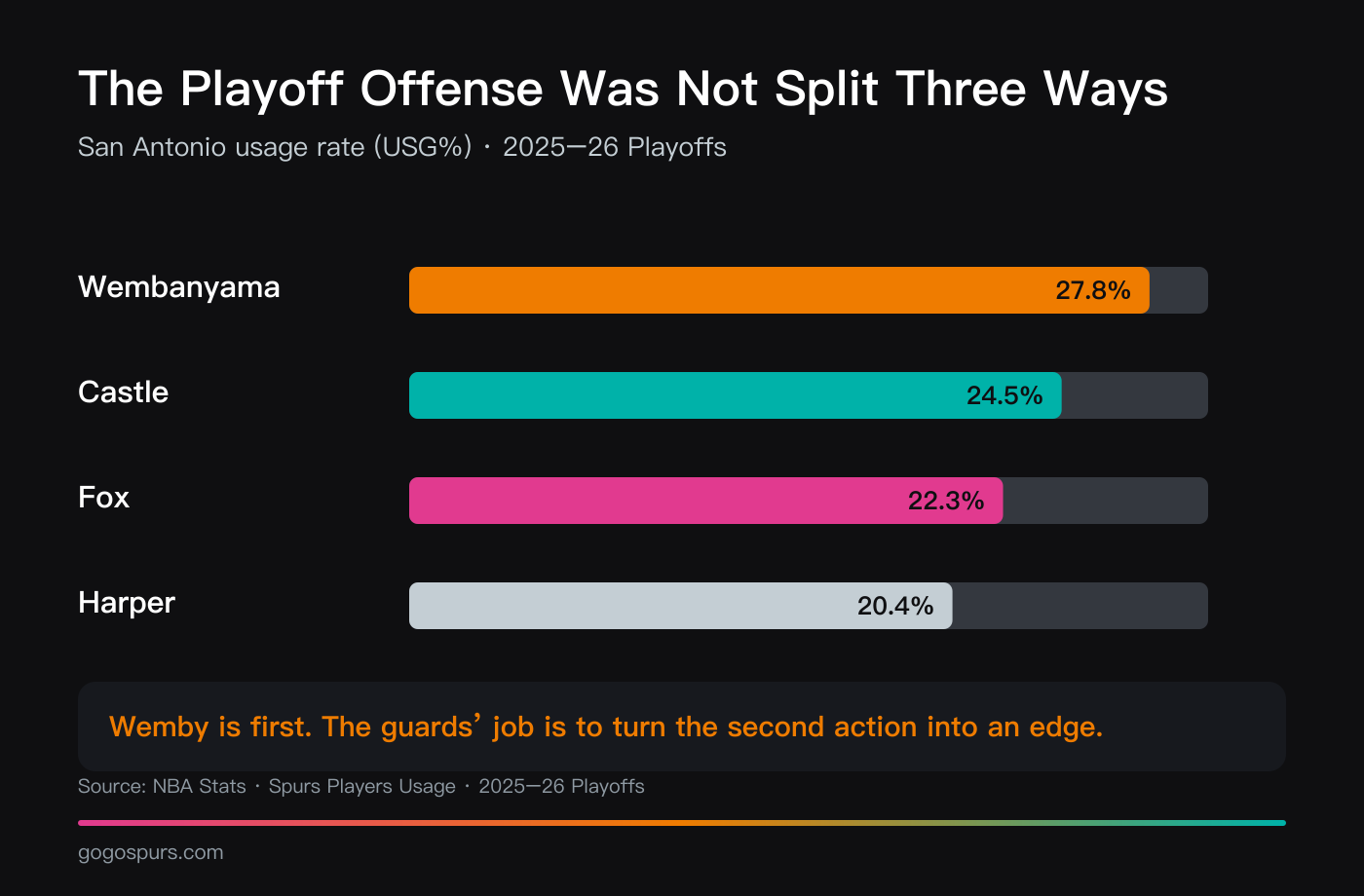
The useful conclusion is not that Castle deserves 2.2 percentage points more than Fox. It is that the offense had two levels. Wemby was first. The guards supplied different forms of creation underneath him.
That distinction matters because “who has the ball?” is not the same as “who owns the shot?” Castle can bring the team into structure without finishing the action. Fox can be more dangerous attacking a defense that has already shifted than starting against five set defenders. Harper can use his size and downhill force to create the shift in the first place.
A rigid point-guard depth chart would flatten those differences. The goal should not be to declare a permanent No. 1, No. 2 and No. 3 among the guards. It should be to route each possession through the skill most likely to create an edge.
Harper has earned more first actions, not a courtesy share
The best evidence came when the job found him before the coaching staff could ease him into it. Fox missed Game 1 of the Western Conference finals. In his first career playoff start, Harper played 47 minutes and produced 24 points, 11 rebounds, six assists and seven steals. San Antonio beat Oklahoma City 122–115 in double overtime. Fourteen of Harper’s points came in the paint, and 11 arrived across the fourth quarter and the two overtime periods.
The historical label survives a stricter check. Since steals became an official NBA statistic in 1973–74, Harper is the second rookie with at least 20 points, 10 rebounds, five assists and five steals in a playoff game. The other was Magic Johnson. Magic’s qualifying game was not his famous Finals clincher: it was an April 9, 1980 overtime win over Phoenix in which he had 25 points, 13 rebounds, 11 assists and six steals.
One masterpiece does not dictate an 82-game offense. It does establish that the stage and the responsibility did not swallow Harper. More important, his full postseason play-type data points toward a specific way to test him.
Give him more ball screens.
“Give it to Harper” should mean pick-and-roll, not clear-out
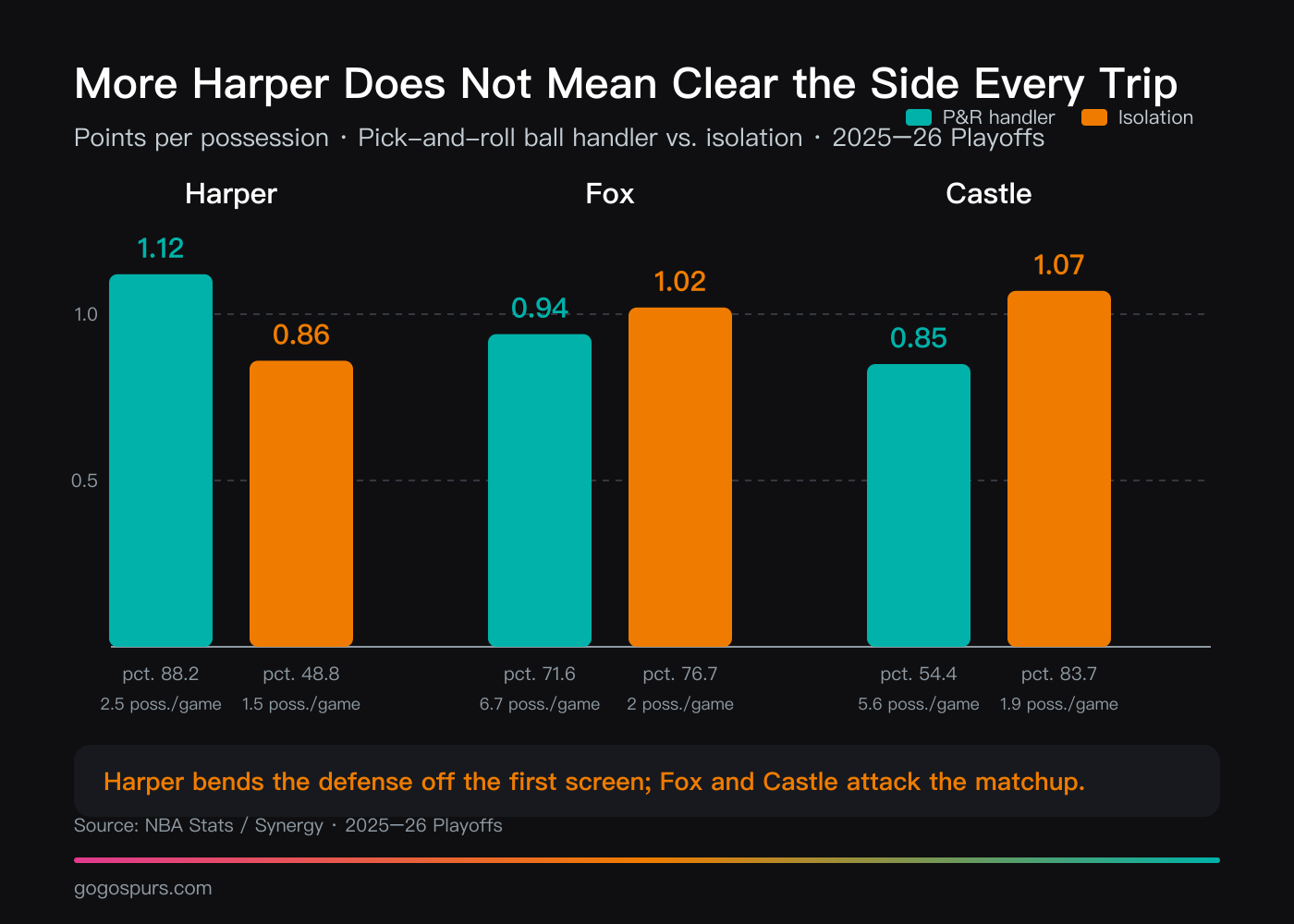
As a playoff pick-and-roll ball handler, Harper produced 1.12 points per possession on 2.5 possessions per game, with a percentile rank of 88.2. The volume is modest. That prevents us from calling him an elite high-volume operator today. It also makes increased volume one of the most valuable experiments San Antonio can run in Year 2.
The counterevidence is just as important. Harper’s isolation possessions generated only 0.86 points apiece on 1.5 possessions per game, the 48.8th percentile. Fox scored 1.02 per isolation possession; Castle scored 1.07. The data supports a bigger Harper role. It does not support turning every possession into four spectators and a clear side.
Here is what the modern “give it to Tim” action looks like to me: Harper runs an empty-corner pick-and-roll with Wemby and gets downhill before the shell is set. If the weak side tags, Fox receives the next pass and attacks the tilted floor. Castle can ghost a screen, cut from the 45 or punish the smaller guard who switched onto him. Wemby remains the reason the defense cannot solve every branch.
Harper owns the first advantage decision. That does not mean he is contractually entitled to the last shot.
Fox’s contract buys a roster commitment, not a touch guarantee
Money makes this conversation emotional. Fox’s extension begins in 2026–27, runs through 2029–30 and was reported as an estimated four-year, $229 million maximum when it was signed. He will open the season at 28 and turn 29 in December. He is neither a disposable bridge nor an aging passenger waiting to surrender his seat.
The exact first-year number also needed a correction. The NBA set the 2026–27 cap at $164,961,000. The corresponding 30% maximum for a player with seven to nine years of service is $49,488,300. Early contract tables used a higher cap projection and listed $49.8 million. Once the real cap arrived, that projection could no longer be presented as exact.
That salary gives San Antonio a responsibility to deploy Fox well. It does not create a nightly shot quota. In fact, using Harper to crack the first line may be the cleanest way to maximize Fox’s value. Fox receiving the ball against a moving defense can turn speed into immediate pressure instead of spending energy manufacturing the initial bend.
The bad alternatives sit on both extremes. Trading Fox at the bottom of his market would exchange a real player for distressed-asset value. Turning him into a stationary spacer would erase the reason to keep him. The middle path is to ask Fox for more value in fewer first actions: second-side pick-and-rolls, transition attacks, selective isolations and late-clock decisions.
If he succeeds, Harper’s rise does not bury Fox. It makes Fox’s possessions easier.
Castle is the connector, not the casualty
A Fox-versus-Harper framing also leaves out the guard who did the most organizing last season. During the regular season, Castle averaged 7.4 assists, Fox 6.2 and Harper 3.9. Castle then led the three guards in playoff usage.
He should not be demoted to “off-ball wing” because Harper needs development reps. Castle’s strength punishes small defenders. His passing carries an action into its second phase. His defense gives the coaching staff somewhere to place the toughest perimeter assignment when Fox and Harper share the court. Those are not leftover jobs. They are what let the structure survive.
Spacing is the real constraint. The three guards shot 33.2% for Castle, 33.2% for Fox and 34.3% for Harper from three during the regular season. None is a defender-warping standstill shooter yet. A three-guard lineup can work as a changeup, especially when pace and ball pressure matter, but it should not become the automatic closing five. Wemby and a genuine shooting threat need to occupy the other two spots, or the arrangement compresses the very driving lanes it is supposed to exploit.
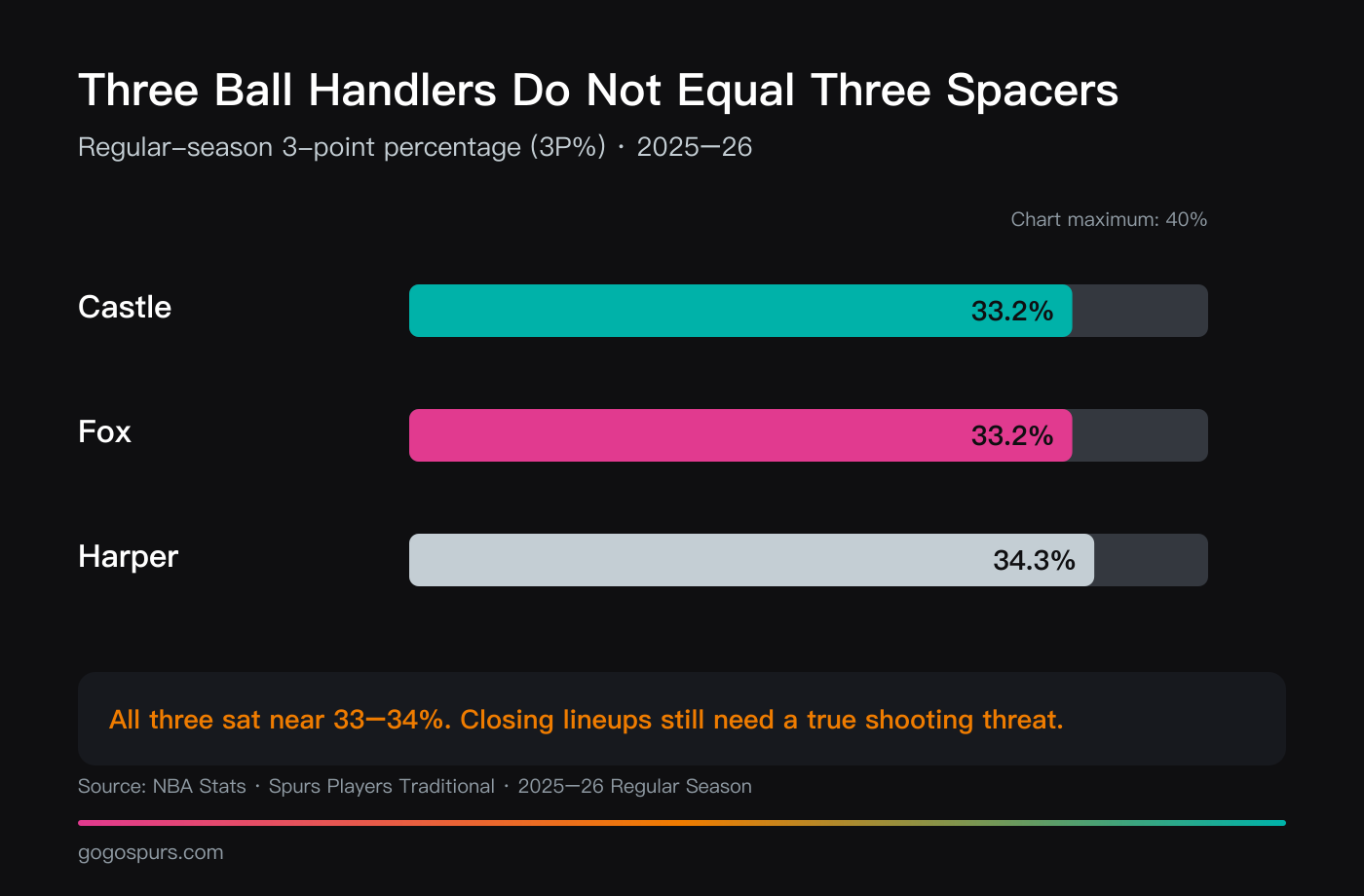
This is not an argument about the decimal-point difference between them. It is a lineup-design warning: when all three share the floor, at least one remaining perimeter spot must punish defenders for helping. Otherwise, adding a ball handler can remove the driving lane that made the extra creation valuable.
My Year 2 rotation principles
First, San Antonio does not need to stage a ceremonial lineup change. The Fox–Castle starting structure around Wemby has earned continuity. Harper can gain ownership without a press-conference promotion.
Second, Harper should be the first guard off the bench and receive more initiation work while Wemby rests, but he should be staggered with at least one of Fox or Castle rather than asked to carry an entire second unit alone. The coaching staff should also preserve deliberate Harper–Wemby stretches so the 2.5 pick-and-roll possessions per game can become a larger, honest sample.
Third, transition belongs to whoever secures the rebound. The other two guards sprint wide. Stopping a fast break to honor a pecking order would be the most literal and least useful version of possession management.
Fourth, Wemby is the only automatic closer. Choose two guards around him by opponent and need. Castle supplies size and perimeter defense. Fox supplies second-side speed and a more efficient isolation option. Harper supplies rim pressure, rebounding and disruption. Salary, draft position and a vague promise to “develop everyone” should not reserve the final five minutes.
This fits the organization’s larger bet on continuity and internal growth. Keeping all three guards gives the staff multiple answers. It does not require writing all three answers on every possession.
What would prove this wrong
The case for more Harper is not unconditional. His pick-and-roll efficiency could collapse when the volume rises and teams build a series plan around taking away his preferred downhill lane. Defenders could duck under screens, close the paint and force the jumper to carry the possession. His passing could look much less settled once he is responsible for diagnosing the second and third rotation every night.
If those things happen, San Antonio should scale back the experiment. A 2.5-possession sample is an invitation to test, not a commandment.
The upside case is equally measurable. Does a heavier Harper–Wemby menu produce deeper Wemby catches? Does it give Fox more catch-and-go opportunities against a bent defense? Do Castle’s cuts become more damaging because the low man has already committed? If the answers are yes, the touch-count argument disappears. The offense will be telling the coaches where the ball belongs.
That is why my conclusion remains simple. Do not divide the ball into thirds. Give it to Tim: establish Wemby first, then give Harper more chances to create the first guard-driven advantage. Fox and Castle do not vanish from that plan. They become the players who turn the first crack into a broken defense.
The Jordan and Kobe comparison ends at clarity. It does not declare Harper their peer, and it does not endorse hero ball. It says a championship offense has to know what it trusts. San Antonio’s Year 2 answer should not be equal. It should be legible.
Sources: NBA.com — Harper and Castle’s playoff growth, NBA.com Starting 5 — West finals Game 1 and Harper data, Basketball-Reference — Magic Johnson playoff game log, NBA Stats — Spurs playoff usage, NBA Stats / Synergy — playoff pick-and-roll ball handlers, NBA Stats / Synergy — playoff isolations, NBA Stats — Spurs regular-season player stats, NBA.com — Fox extension, NBA Stats — Fox profile, NBA official release — 2026–27 salary cap, The CBA Guide — 2026–27 maximum salaries, Basketball-Reference — Spurs salary table’s old projection
If you spot an error, email contact@gogospurs.com. I will correct it and disclose the change.