The Spurs Did Not Stand Pat. They Bet on Continuity
A 62-20 team reached the NBA Finals, lost to the Knicks in five games, and entered the summer with a familiar demand hanging over it: go get another star.
San Antonio did not do that. The Spurs kept the group that carried them through the West, re-signed Julian Champagnie and Harrison Barnes, and made 33-year-old Tobias Harris their one notable addition from another NBA team. “They barely did anything” became the easy verdict.
Here is mine: the Spurs were not unwilling to improve. They decided that an addition only counts as improvement if the team becomes better after the subtraction, the salary math and the chemistry are included. Their cap position and their pull as a destination did not give them a menu of superior players who would also accept the right role and make the existing group fit better. Making a transaction to prove that the front office is awake would be a bigger gamble than continuity.
That is not a claim that Harris was the best player available, or that every better player rejected San Antonio. We do not know whom the Spurs called. We can establish two narrower points. They used the largest ordinary free-agent tool they had, and a 4-1 Finals score does not by itself diagnose a roster that needs to be torn apart.
4-1 was the result, not the diagnosis
The official game results are more useful than the series headline. San Antonio lost Game 1 by 10, Game 2 by one, won Game 3 by four, then lost Games 4 and 5 by one and four. Three of the four losses came by one, one and four points.
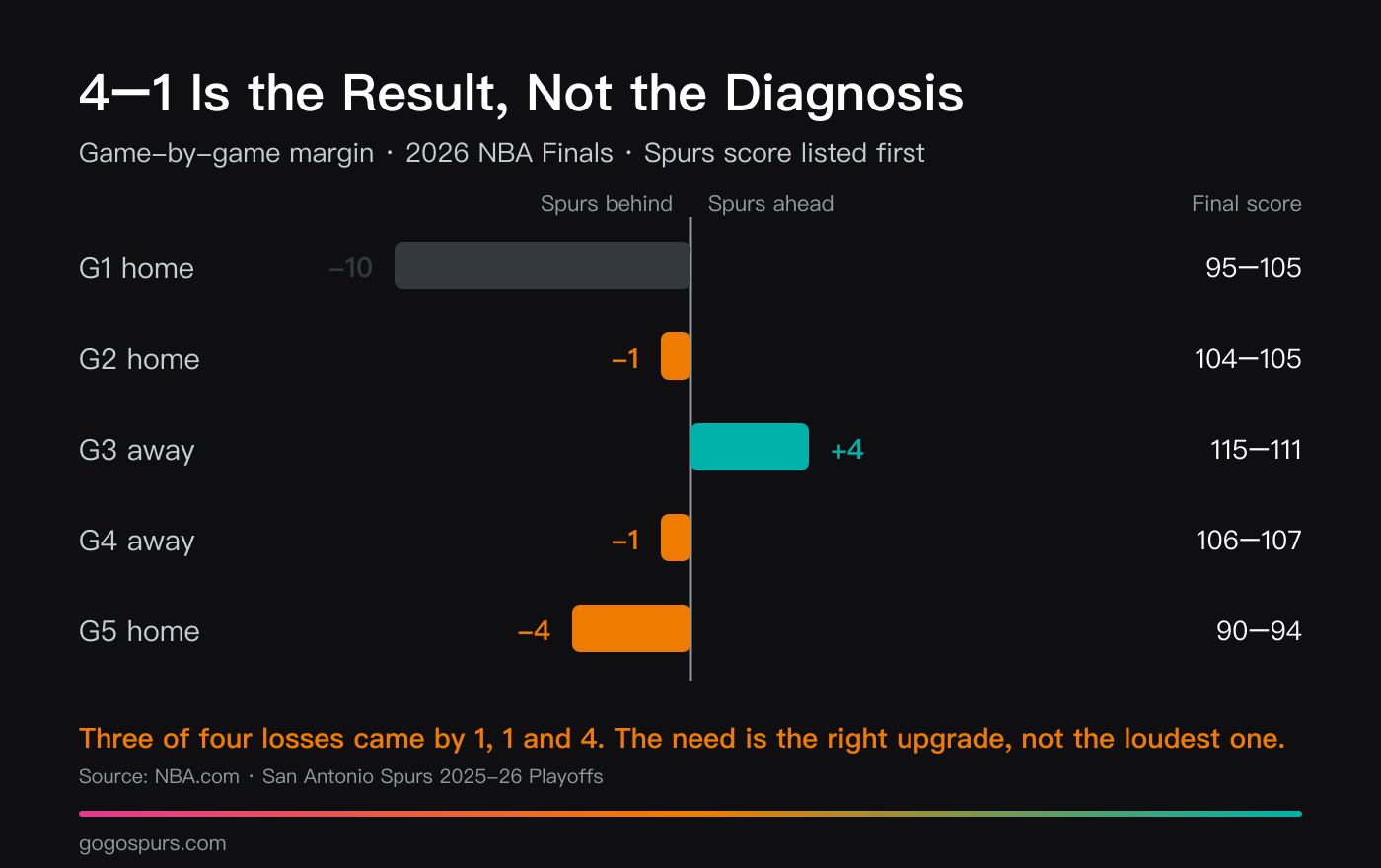
That does not mean the Spurs were three possessions from a championship. A series is not a stack of independent alternate endings; change Game 2 and everything after it changes too. New York won four games and deserved the trophy. But the shape of the losses matters. If the real problems were late-clock offense, end-game decisions and matchup details, the answer is not automatically to dismantle a 62-win team.
Another season of De’Aaron Fox, Stephon Castle, Dylan Harper and Victor Wembanyama learning one another may be more valuable than a trade that requires one of them to leave. Another step from Champagnie as a shooter and defender cannot be bought simply by replacing his name with a more famous one. That is the logic behind the offseason tracker’s description of this summer as a bet on internal growth. It is a risk, but it is a coherent one.
The better question is not why San Antonio failed to acquire a big name. It is which available big name would have solved those close-game problems without damaging what already worked. If there is no persuasive answer, the largest move is not necessarily the move that gets the team closest to June.
The cap sheet does not have a 2K override button
The NBA set the 2026-27 salary cap at $164.961 million, the luxury-tax line at $200.428 million and the first apron at $209.015 million. San Antonio’s 14 guaranteed standard contracts add up to approximately $196.131 million. That total excludes Taelon Peter’s non-guaranteed Exhibit 10 camp contract.
This was not a team sitting on $30 million of cap room with a closed checkbook. It was operating above the cap, where additions require an exception or a trade.
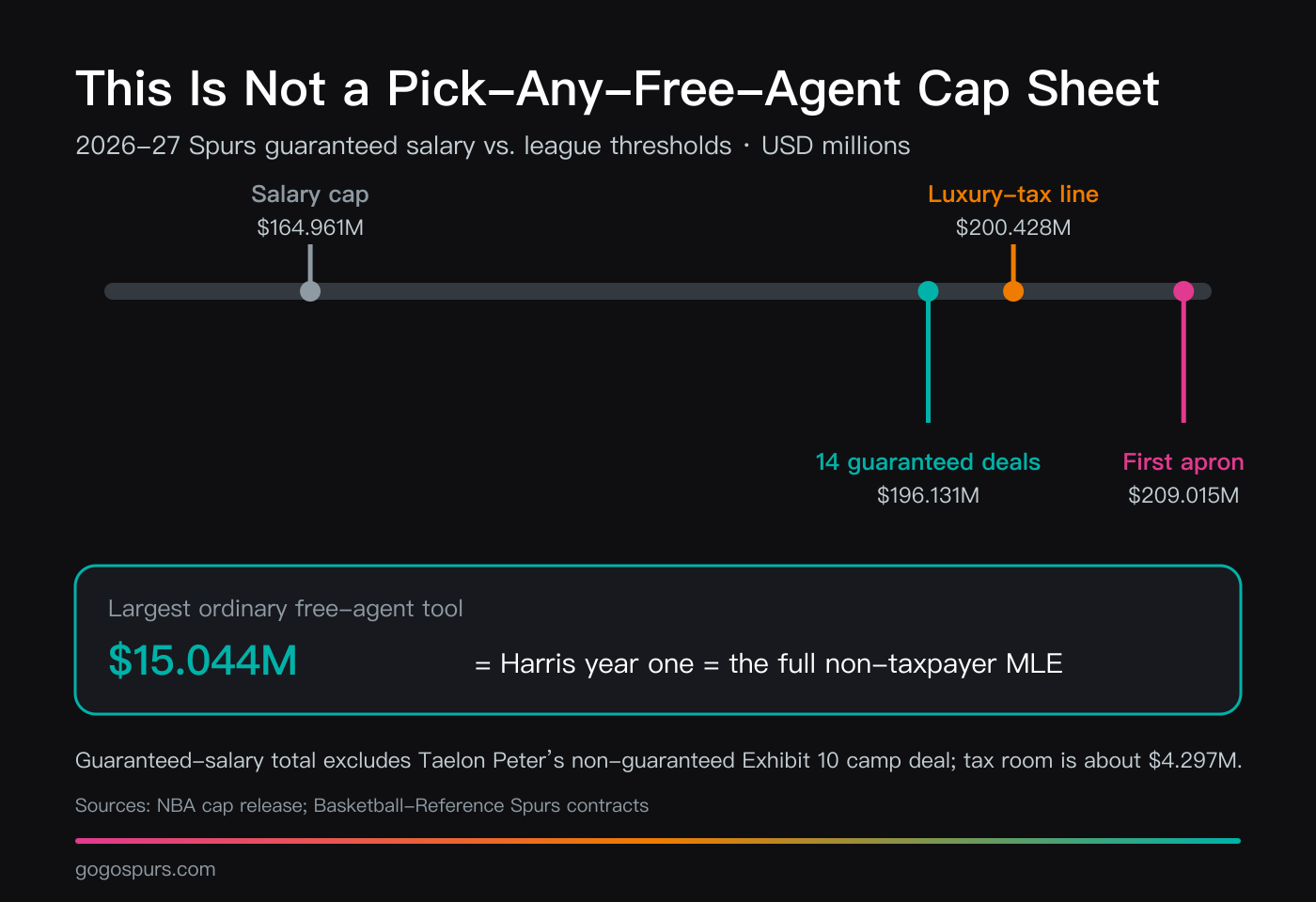
The largest ordinary tool available was the $15.044 million non-taxpayer mid-level exception. Harris’s deal became official on July 6 and was reported as two years and $31 million. His actual first-year salary is $15.044 million, down to the dollar. San Antonio used the full exception on him. There was no unused second star slot hiding behind the transaction.
The other money maintained continuity. The Spurs announced Champagnie’s three-year, $45 million deal on June 29, and Barnes’s one-year, $8 million contract became official July 8. Keeping two wings who already understand how to play with Wembanyama and Fox is a roster decision, not clerical housekeeping.
A larger upgrade was still possible through a trade. But once the conversation moves from Harris-level free agency to a demonstrably better player, the price can become rotation players, draft capital and future flexibility. If individual talent rises one tier while two system-fluent players leave, the team can lose the exchange. Roster building is a net-value calculation, not a sorting exercise.
San Antonio has attracted ring-chasing veterans before
The claim that no free agent has ever chosen San Antonio does not survive the Spurs’ own history.
After the 2004 loss to the Lakers, the headline outside addition was 32-year-old Brent Barry. ESPN reported a four-year deal worth between $22 million and $24 million, and reported that Barry chose San Antonio in part because he believed the Spurs were closer to a championship. The 2004-05 Spurs went 59-23 and won the title.
Yet that title cannot be assigned to Barry alone. Manu Ginóbili’s playoff scoring jumped from 13.0 points per game in 2004 to 20.8 in 2005. A veteran supplied the right skill while a player already in the building crossed a developmental threshold. Part 5 is the longer version of why both changes mattered.
The next summer makes the better warning. San Antonio did not merely run back the 2005 champions. The Spurs added Michael Finley, Nick Van Exel and Fabricio Oberto. After Dallas released Finley through the amnesty provision, he passed on a richer Miami offer to join the defending champions. The contemporaneous Associated Press report put the contrast plainly: Miami could offer the full $5 million mid-level while San Antonio had roughly $2.5 million. Van Exel signed a one-year veteran deal worth close to $1.2 million because the championship chance mattered more than the money he had already lost.
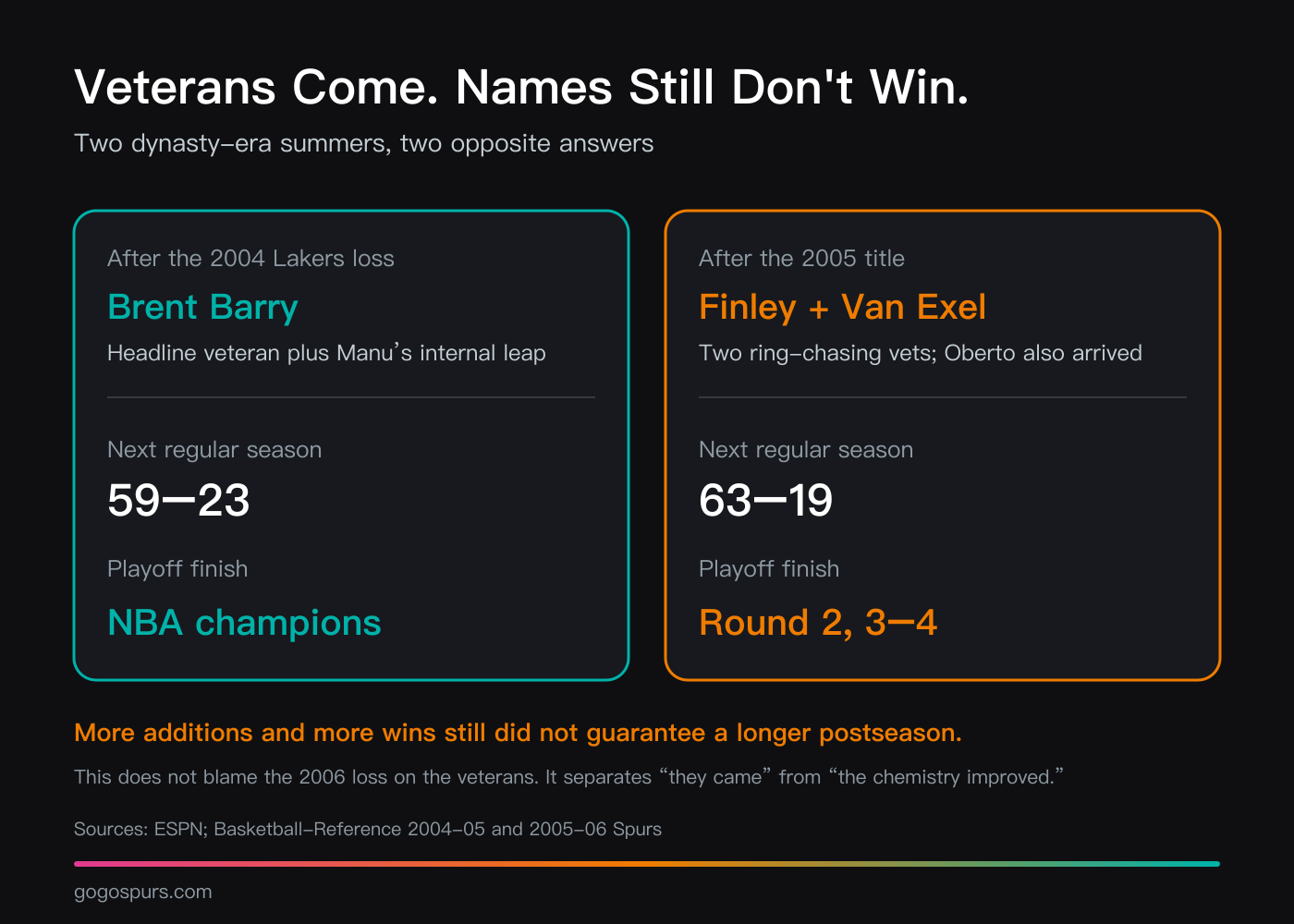
That deeper roster produced a 63-19 regular season, four wins better than the championship team, and then lost 4-3 to Dallas in the second round. The reasons were larger than the newcomers: the seeding format forced two elite teams together early, Tim Duncan played through plantar fasciitis, and the series turned on a handful of late possessions. Part 6 reconstructs those 11.3 seconds and the rest of the series.
This is not an argument that Finley or Van Exel damaged the chemistry. It is a narrower, sturdier conclusion: attracting recognizable veterans who want a ring does not guarantee a better postseason ending. Names, regular-season wins and May problem-solving belong on three different ledgers.
How I see the difference between the eras
I have never accepted the absolute version of “San Antonio cannot attract anyone.” Barry, Finley and Van Exel are enough to show that this franchise has been a veteran destination.
My read of the eras is more specific. Younger players in the earlier period usually still needed to establish themselves: earn minutes, command touches, build the next contract. The classic ring chaser was closer to the back end of his career and willing to trade salary or role for a title window. Today’s “superteam” conversation more often involves players in or near their primes exerting power over teammates and destinations. That is a different market, and it asks a non-glamour destination to pay a different kind of price.
This is an observation, not a league law proven by three Spurs transactions. Every era supplies counterexamples. My point is that “no star demanded San Antonio” cannot automatically become “the front office refused to improve.” Contention was enough to make Finley take less. It does not guarantee that a prime-age star today will surrender maximum money, a central role or a preferred city.
Harris marks the boundary well. He is a veteran who brings size, rebounding and postseason experience, but he did not arrive on a minimum deal as a passenger chasing jewelry. San Antonio paid the full mid-level. The Spurs can be attractive and the market can still have a price. Both statements can be true.
I support the bet, not a blank check
The optimistic version is easy to see. Wembanyama makes another leap. Fox learns his windows. Castle and Harper turn talent into repeatable decisions. Champagnie holds up as both spacer and wing defender. Harris provides size in the possessions that exposed San Antonio in June. If two or three of those changes happen together, the Spurs will not need a blockbuster to prove their ambition.
The failure case is just as clear. Development stalls. Opponents spend an offseason mapping the half-court offense. Harris cannot survive the most important playoff matchups. “Patience” becomes a shield against making a hard decision.
That leaves three tests worth carrying into the season:
- Is the close-game half-court offense meaningfully better than it was in the Finals?
- Can Harris stay on the floor in May and June, rather than merely absorb regular-season minutes?
- If the same hole survives until the 2027 trade deadline and a clearly better fit becomes available at a rational price, will the front office act?
Progress on the first two would make continuity a judgment. Failure on all three would make it timidity.
San Antonio’s bet is not that this roster is already complete. It is that a group with shared experience, plus one properly chosen veteran, will produce more than a bigger name purchased with core assets. I am willing to take that side in August. The balance sheet still needs to be reopened at the trade deadline.
Sources: San Antonio Spurs — 2025-26 playoffs, NBA.com — 2026 Finals schedule and results, NBA.com — Tobias Harris joins San Antonio, NBA.com — Julian Champagnie re-signs, NBA.com — Harrison Barnes re-signs, NBA official release — 2026-27 salary cap, Basketball-Reference — Spurs contracts, ESPN — Brent Barry chooses San Antonio, Basketball-Reference — 2004-05 Spurs, RealGM / ESPN — Michael Finley chooses San Antonio, Associated Press / Deseret News — Finley’s decision, ESPN — Nick Van Exel joins San Antonio, Basketball-Reference — 2005-06 Spurs, Basketball-Reference — 2006 Western Conference semifinals
If you spot an error, email contact@gogospurs.com. I will correct it and disclose the change.